• About

Paul Bigland

~ Blogging on transport, travel & whatever takes my fancy.

Paul Bigland

Tag Archives: Rail Investment

Calder Valley rail improvements

16 Monday Jul 2018

Posted by Paul Bigland in Rail Investment, Railways, West Yorkshire

≈ Leave a comment

Tags

Hebden Bridge, Rail Investment, Railways, West Yorkshire

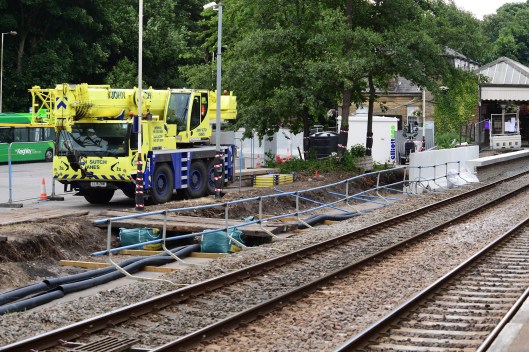
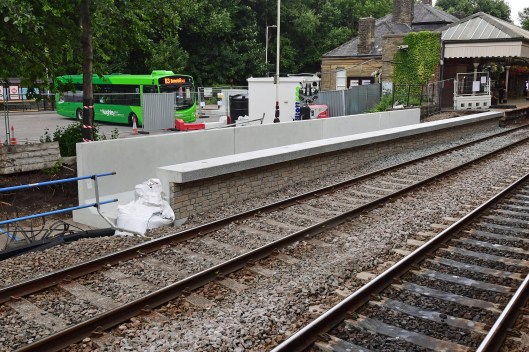
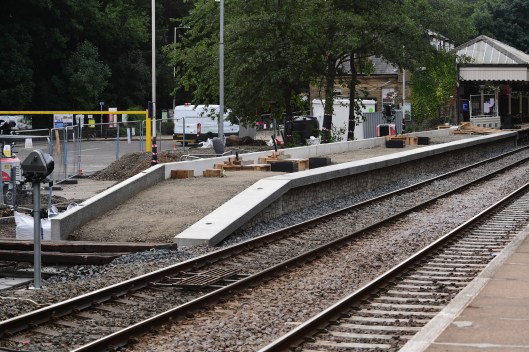
There’s not much of a blog today, despite me being out and about. A combination of poor weather and the need to sort out some bids for work has kept me otherwise occupied. That said, I did stop off at Hebden Bridge on the way home to get some pictures of the work to extend the length of both platforms. I have  to say, it’s been speedy. In the space of a few weeks the work’s got as far as this.

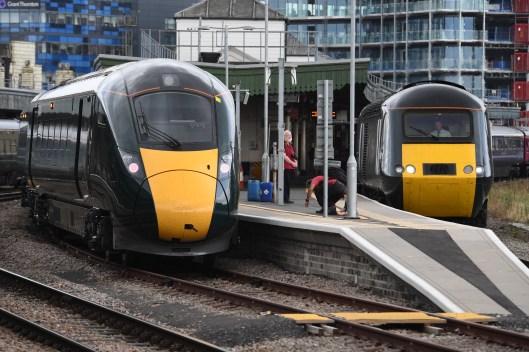
DG302806. Platform extensions. Hebden Bridge. 16.7.18

The Leeds bound platform with much of the side of the new platform in place, including the stone facing which will disguise the concrete structure, allowing the new to blend with the old.

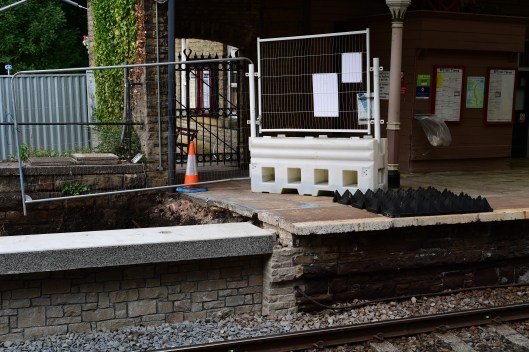
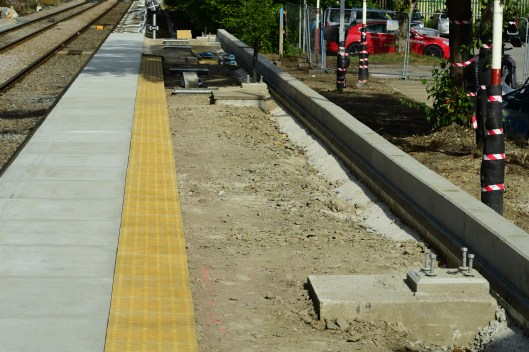
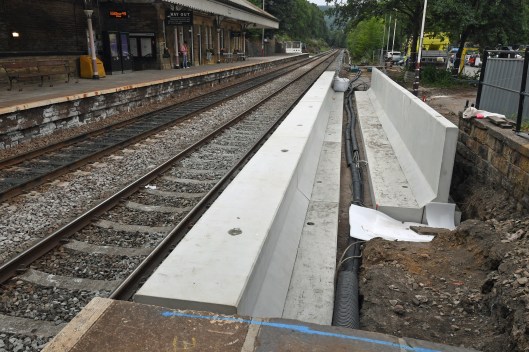
DG302818. Platform extensions. Hebden Bridge. 16.7.18

Another view of the same platform extension, this time showing the cable runs inside.

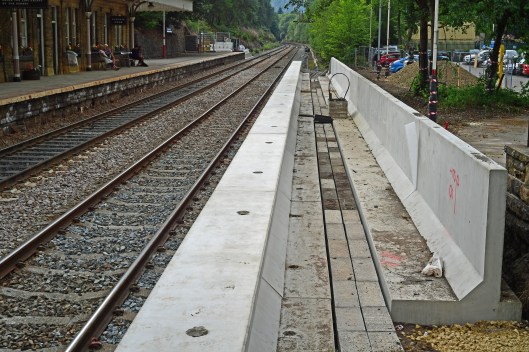
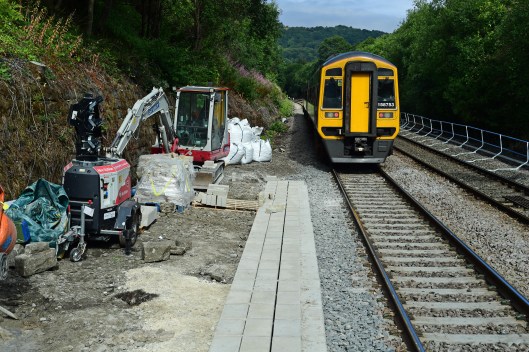
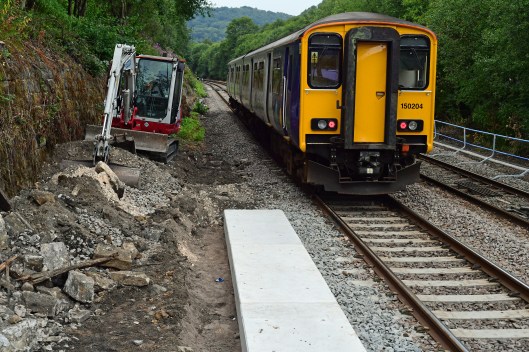
DG302811

150204 passes the footings of the extension to the Manchester bound platform at Hebden Bridge

Tomorrow I’ll be heading North of the border, so expect another rolling blog…


Rolling blog: Sunny days and Mondays…

25 Monday Jun 2018

Posted by Paul Bigland in Community rail, Northern Rail, Pacers, Rail electrification, Rail Investment, Railways, Travel

≈ Leave a comment

Tags

Northern Rail, Rail Investment, Railways, Travel

I’m taking advantage of the glorious sunshine to get some rail pictures for a client today – I had planned to visit a line I’ve not been on for some time – the South Fylde line to Blackpool South. It’s a shadow of its former self compared to the glory days of the Edwardian era when tens of thousands would travel to the seaside town by train. Then mills across the North would shut down for the annual Wakes week with people travelling en-masse on excusion trains dispatched from stations across Lancashire and Yorkshire. Now it’s a glorified siding that branches off the main line to Blackpool North at Kirkham and Wesham, but it’s still a useful line used by a Pacer train shuttle service from Colne (another much truncated line). Sadly, due to problems with delayed electrification and a shortage of rolling stock, the service isn’t operated by trains today – only buses. So I’ve opted for plan B. I’m heading for the Windermere branch!

Right now I’m on a Northern service from Halifax to Preston. The Blackpool lines only recently reopened after being electrified. My train would normally run through to Blackpool but a combination of factors mean many services are replaced by buses from Preston, including this one.

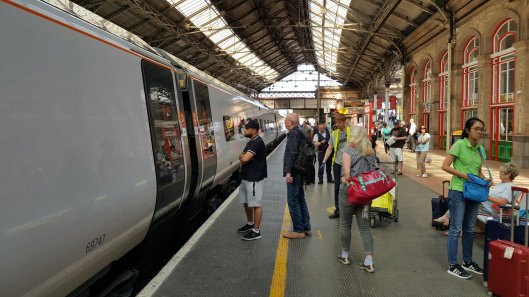
Plan B meant changing to a Virgin Trains Pendolino to Lancaster. Then picking up a Trans-Pennine service to Oxenholme. Icould have caught the TPE srvice at Preston but those 4 car trains are always rammed, whilst the VT service was a 9 car Pendolino, giving me a bit more space. Here it is pulling in. A repainted 390047…

True enough, when I caught the TPE at Lancaster,I ended up sitting on the vestibule floor!

20:19.

I’m retracing my steps towards Halifax after an enjoyable day exploring a railway I’ve rarely visited. It’s been a trip made even more fun by fab weather and old-fashioned loco-hauled trains.

My first surprise was when the TPE guard annouced “change at Oxenholme for the West Coast Railways service to Windermere”. I wadn’t expecting that, but good on them for recognising it was something unusual. As we were late I had to sprint across the platform to make the train, which was made up of 3 old Mk2 coaches in WCR livery topped and tailed by a pair of ex-Virgin Trains “Thunderbirds” (57314 and 57316 for the number crunchers). The train was packed so I ended up stood in a vestibule -right next to someone I knew from the rail industry who was having a ‘jolly’!

We had a real catch-up about mutual friends and what they were all up to nowadays as we made our way to Staveley where I decamped to look for a suitable lineside location to get pictures. Sadly, like many lines, vegetation has encroached to choke off many opportunities. This is the problem when you don’t know a line well and haven’t had time to do much research!

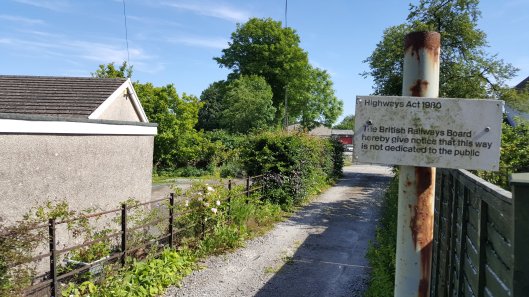
In the end I decided to spend more time exploring than photographing and headed back as far as Burneside where I found the remains of a freight branch that used to serve 3 local paper mills. Only a short section of track is intact but it’s a suprising survivor in this day and age. I never even knew it existed, but a few minutes on the internet threw up this Wikipedia page.

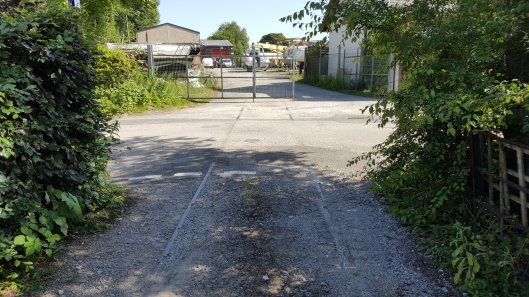
The track is still in situ at this point but it’s gradually disappearing beneath the gravel. The old BRB sign’s a bit of a giveaway! The old goods yard is in front of the camera. Behind me the line crosses a yard then ends in a stone wall.

Looking towards the old goods yard. The road here leads to Burnside railway station on the left.

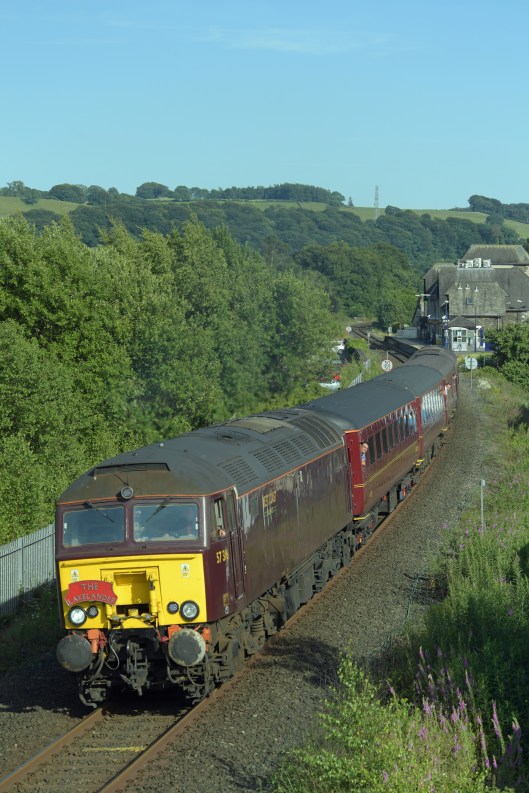
After an amble around the area & noting locations for a future visit I had a run down to Windermere before heading back to Kendal to get a few more pictures like this one.

DG300784

57316 (with 57314 on the rear) pulls away from Kendal station as it heads towards Windermere. I took this picture from a lattice footbridge which crosses the line at this point. The land to the right was once a large goods yard which is long gone.


New report on ‘fast-tracking prosperity in the North-West and Midlands’ with Hs2 phase 2a

10 Tuesday Apr 2018

Posted by Paul Bigland in Crewe Hub, Hs2, Hs2 to Crewe, Rail Investment

≈ 3 Comments

Tags

Hs2, Hs2 to Crewe, Rail Investment

Yesterday I was in Crewe to attend the launch of a new report into how the Midlands and North-West can unlock the economic and transport opportunities presented by phase 2a of Hs2 which is due to reach Crewe by 2026. The report was commissioned by the High Speed Rail Industry Leaders group (HSRIL). You can download it from the website via this link.


DG294525copy

Guests at the launch of the report included Councillor Rachel Bailey, Leader of Cheshire East Council. Councillor Paul Yates, Leader of Crewe Town Council. Phillip Cox, CEO of Cheshire and Warrington LEP.  Paul Colman, CEO of South Cheshire Chamber of Commerce and Jims Steer of Greengauge 21 which authored the report. 


The report outlines how, when Sir David Higgins became Hs2 Ltd’s Chairman in 2014 he suggested accelerating Phase 2, bringing the line to Crewe 6 years earlier than planned (to 2027 from 2033). This resulted in the Government agreeing to bring forward a second Hybrid Bill for what became known as Hs2 Phase 2a. In January, the bill passed 2nd reading by an overwhelming majority (295 to 12 against).

Another chapter of the report deals with the Crewe Hub scheme, which was agreed by the Government in March 2018. In the past there were several different proposals for Crewe. At one time Network Rail were suggesting building a new station further South on the site of the Basford Hall marshalling yard. This met with local political opposition.

In July 2017 the Government published a consultation on the idea of the Crewe hub. The outcome was published on March 9th

Now the Crewe hub scheme has agreement from all sides. It doesn’t form part of the Hs2 Phase 2a Hybrid Bill, instead it’ll be created through a partnership of Network Rail, Cheshire East Council and Cheshire and Warrington Local Enterprise Council (LEP).

The plan is to create a strategic interchange that will allow the whole of Cheshire, North Staffordshire, North Wales and the Mersey-Dee area to benefit from Hs2 at the earliest opportunity. In total, this sub-region has a population of more than 1.5 million whilst around 5 million live within an hour of the station. It’s worth remembering that by 2013/14, Crewe accounted for more London-bound passengers than Warrington, Stafford, Chester or Stafford, yet the facilities don’t measure up. In 2016-17 the station was used by 3.086 million people, plus an additional 1.476 million interchange passengers.

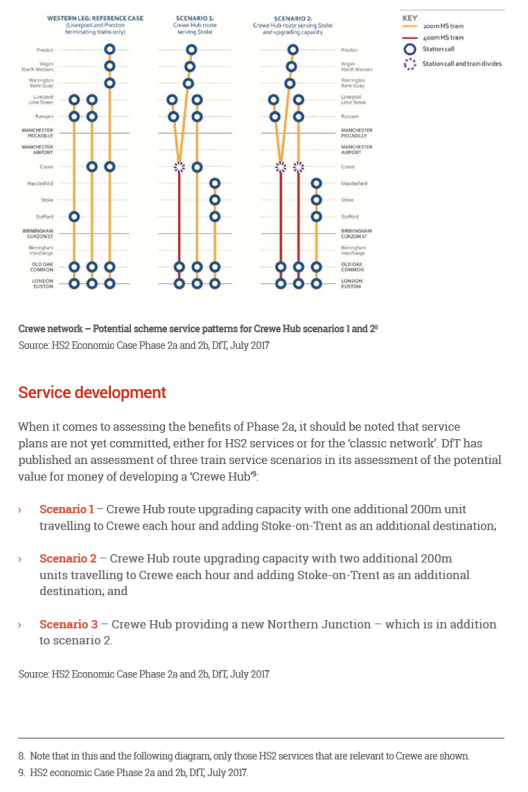
The redesigned station would allow 400m long Hs2 trains to divide and join at Crewe. Service plans aren’t yet finalised but options suggested are for one set serving Lancaster/Preston and another Stoke-on-Trent (and possibly Macclesfield, Stockport and Manchester) to split/join at Crewe, thus only using one Euston path instead of two.

The locations for the 400m platforms are on two sites. One would be an extension of the existing platform 5, the other proposal would be a platform on the Manchester Independent (freight) lines to the West of the existing station although Network Rail are  examining if reinstating the old platform 13 would be an affordable alternative as this would address concerns by freight operators worried that paths through the area may be lost.

In order to link the different sites together and make the station a modern gateway to the town the plan is to build a transfer deck across the site. Grimshaw Architects have been looking at a design for the new station which will keep and enhance the historic parts of the site whilst sweeping away much of the later clutter. At the moment station access is limited and causes traffic congestion as most people use the entrance from the Nantwich Rd over bridge which is a busy link road and the only one across the site. Station car parking is also an issue as the main station car-park is North-West of the site, where the old Crewe North Loco shed was. The plan would include moving this to the Eastern side of the station in a new multi-storey car park, freeing up the Nantwich Rd bridge for other traffic. The transfer deck would create a new link from Weston Rd on the East and (possibly) Gresty Rd and the Crewe Alexandra football ground on the West.


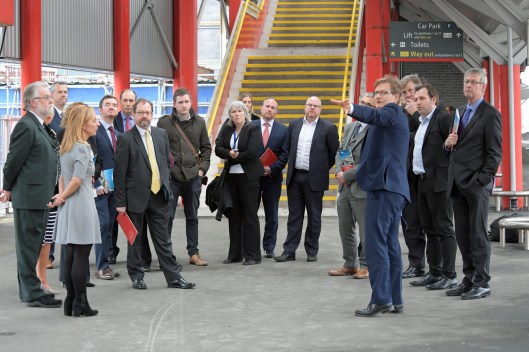
DG294556

After the launch, guests were given a guided tour of the station to see what works were proposed. 


The consultation also agreed a change to the design of the southern connection from HS2, so that HS2 joins (and takes over) the central two lines on the existing network.

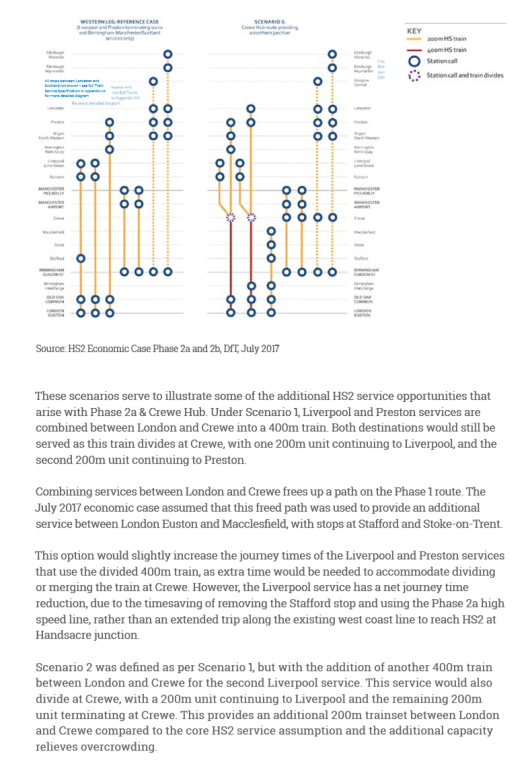
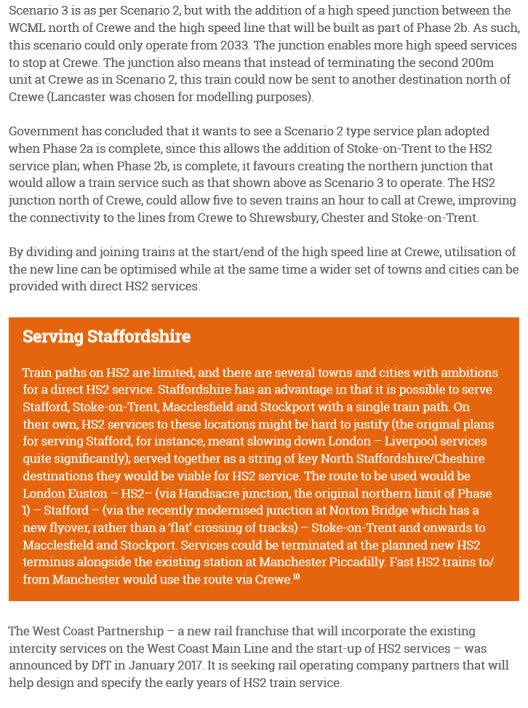
The report also mentions that a junction north of Crewe, enabling HS2 trains to call at Crewe and then re-join the HS2 main line, as part of Phase 2b would be needed to allow Crewe station to support the Constellation Partnership’s ambition of 5–7 HS2 trains per hour calling at Crewe and frequencies of 3-4 trains per hour on each of the regional links.

Included in the report are details of the economic appraisal.

economic appraisal

There’s also potential service patterns.

scen 1

scen 2

scen 3

I’m not going to go into all the economic data contained in the report as I’m concentrating more on the rail aspects, but it does contain details of the Northern Gateway Development Zone and business opportunities and development as well as plans to create 100,000 new homes and 120,000 jobs.

The report’s a useful document for drawing together the ambitious plans for the Crewe hub and the benefits Hs2 phase 2a brings, not just to Crewe but also to the routes that radiate from the station. Work is expected to begin and be funded from Network Rail’s control period CP6 (2019-2024) as most of what is proposed is within the existing railway footprint.

It’s great to see that, after all the years of wrangling over the future of the station, Hs2 has provided a catalyst that’s brought the parties together around a firm proposal. As someone who’s known Crewe station since the early 1970s and watched its decline all the way through the 1990s to the present I’m looking forward to the new plans coming to fruition.

The week ahead…

08 Sunday Apr 2018

Posted by Paul Bigland in Hs2, Musings, Travel

≈ Leave a comment

Tags

Musings, Rail Investment, Travel, West Yorkshire

There’s a lot to write about at the moment but little time to do it, so here’s a brief look at what’s coming up over the next week.

The pair of us have been based at home for the past few days. Dawn’s been on holiday which has meant I’ve taken a bit of time off in order that we could explore and have some quality time together. We rediscovered an old haunt in a new guise when we walked up to Norland Moor which is on the opposite side of the Calder Valley to where we live. On the edge of the moor is a pub called the Moorcock Inn. It’s new tenants who’re doing some really exciting things with the place – which includes both food and drink. It’s worth a blog in its own right so that’s what I’m in the process of writing – although It’ll take a few days as I’ve other priorities. But here’s a taster (literally), we walked back up to the pub today and sampled some of the food they cook in the smoke ovens which have been installed at the back of the pub. These smoky potato’s are stunning! By the way, the plates and bowls they’re served in have been made in the very same ovens the potato’s have been cooked in.

Tomorrow I’m in Crewe for the launch of a new High Speed Rail Industry Leaders Group (HSRIL) report called ‘Fast Tracking Prosperity’ which is about the benefits of HS2 Phase 2a, so expect a blog about that first.

Later in the week I intend to be in London to add to my picture library, whilst on Thursday a group of rail industry friends are meeting up in Huddersfield for a catch-up and a few drinks. I’m sure there’ll be some more rolling blogging going on…

The new trains dilemma (what to do with the old ones).

28 Wednesday Mar 2018

Posted by Paul Bigland in New trains, Rail Investment, Railways, ROSCOs

≈ 12 Comments

Tags

New trains, Rail Investment, Railways, ROSCOs

UPDATE, Aug 2019. I’ve added new details where the position (and future) of some fleets has changed since this was originally written.

The old expression ‘feast or famine’ springs to mind when I look at the situation our railways are currently facing with the amount of new trains on order and old ones coming off-lease.

I remember when the railways were first being privatised. The uncertainty around what was happening led to a 1,064 day hiatus when no new trains were ordered. This led to the closure of the ABB works (formerly BREL) at York, where the majority of the BR built trains that still run in service were constructed.

How things have moved on from those days! Now we have a massive amount of new trains coming into service or on order. Also, a mix of old and new train builders are either planning (or building) new assembly plants in the UK. TALGO have plumped for Scotland whilst CAF have picked Llanwern in S Wales and begun construction. Alstom have a site in Widnes whilst Siemens have announced a site in Goole.

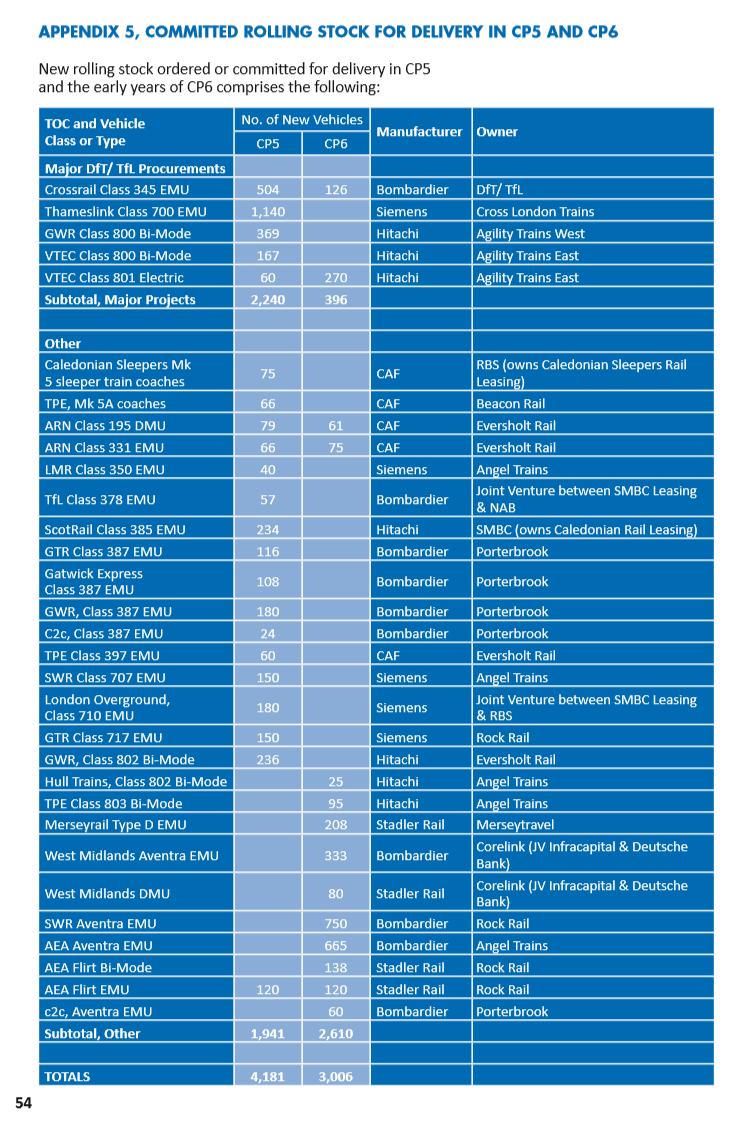
This month the Rail Delivery Group published the 6th edition of its Long Term Passenger Rolling Stock Strategy. It makes for interesting reading. It points out that

” The number of new vehicles committed for delivery in the five-year period that commenced in April 2014 (CP5) and in the early years of CP6 is now 7,187 – more than 50% of the current in-service fleet of 14,025. These new vehicles have a capital cost of more than £13 billion, and around 50% will be built in Britain. The average age of the national fleet is estimated to fall from 21 years to 15 years by March 2021, while the numbers of vehicles in service will grow by 6% next year and by a further 5% to 13% by 2024″

Those 7,187 vehicles will see a step-change in our existing fleet and the near elimination of loco-hauled, main line services and displacement of many of the old BR built fleets. As the document highlights,

“Major orders for new build vehicles coupled with the reduced electrification programme has so far resulted in over 4,000 vehicles being displaced from service in the next 3 years. Many of these vehicles are near the end of their life, but 150 are brand new. As at March 2018, there are over 1,500 vehicles less than 30 years old that do not currently have a future lessee, so while over 7,000 vehicles will be built, the net impact on the national fleet total will be less than this number. Displaced, serviceable vehicles bring challenges to the supply chain, notably for owners who may have idle assets, but also for overhaulers who would historically have refurbished mid-life vehicles for their next role.”

That’s a hell of a lot of displaced trains with nowhere to go. OK, many will be on a one-way trip to the scrapyard (who would want to lease Pacers or Class 313s and 315s?) but there’s a significant number of trains with life left in them yet. Firstly, here’s a list of what’s coming into service now or in the next few years.

new fleets

Now here’s a list of what’s coming off-lease and when.

off lease

As the list shows, 2019 is going to bring big changes. Class 90s on Anglia and 91s on the East coast will disappear, even some modern DMUs like the 170s and 185s will be surplus (although I’m sure they’ll find homes somewhere). It’s clear that the old Pacers will be going for scrap, although some will be preserved. I do wonder about the future of the single-car 153s. Could they be added to Northern’s 155 fleet to make permanent 3 cars in the way GWRs 158/9s have been? Due to modern engine emissions standards and the fact they have ‘grandfather rights’ I can’t see the 150s and 156s remaining homeless for long either. Curiously, whilst the list mentions the 313 & 315 fleet, it neglects to mention their Merseyside cousins, the 507/508 fleet. From 2019 they’ll be replaced by new trains from Stadler of Switzerland.

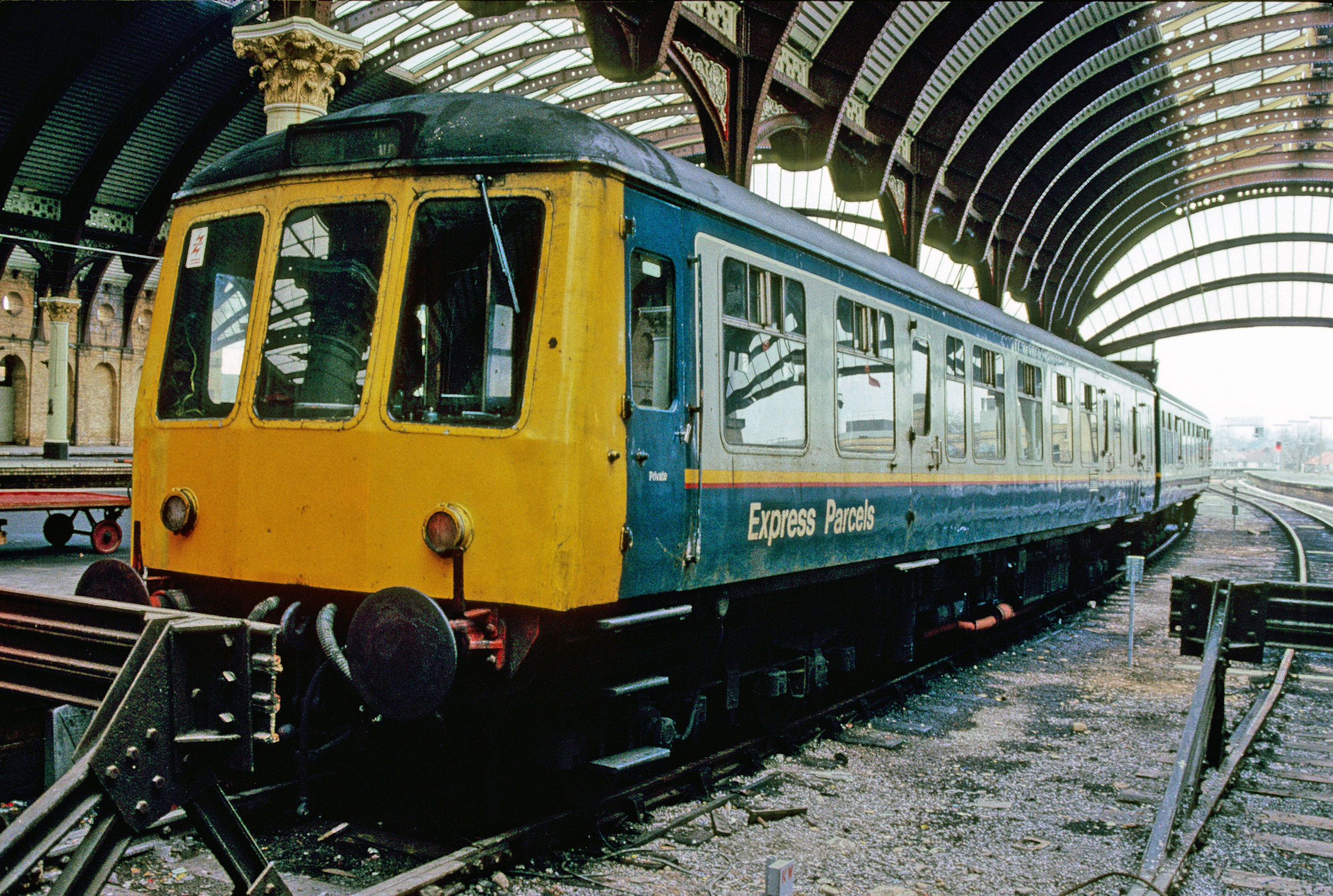
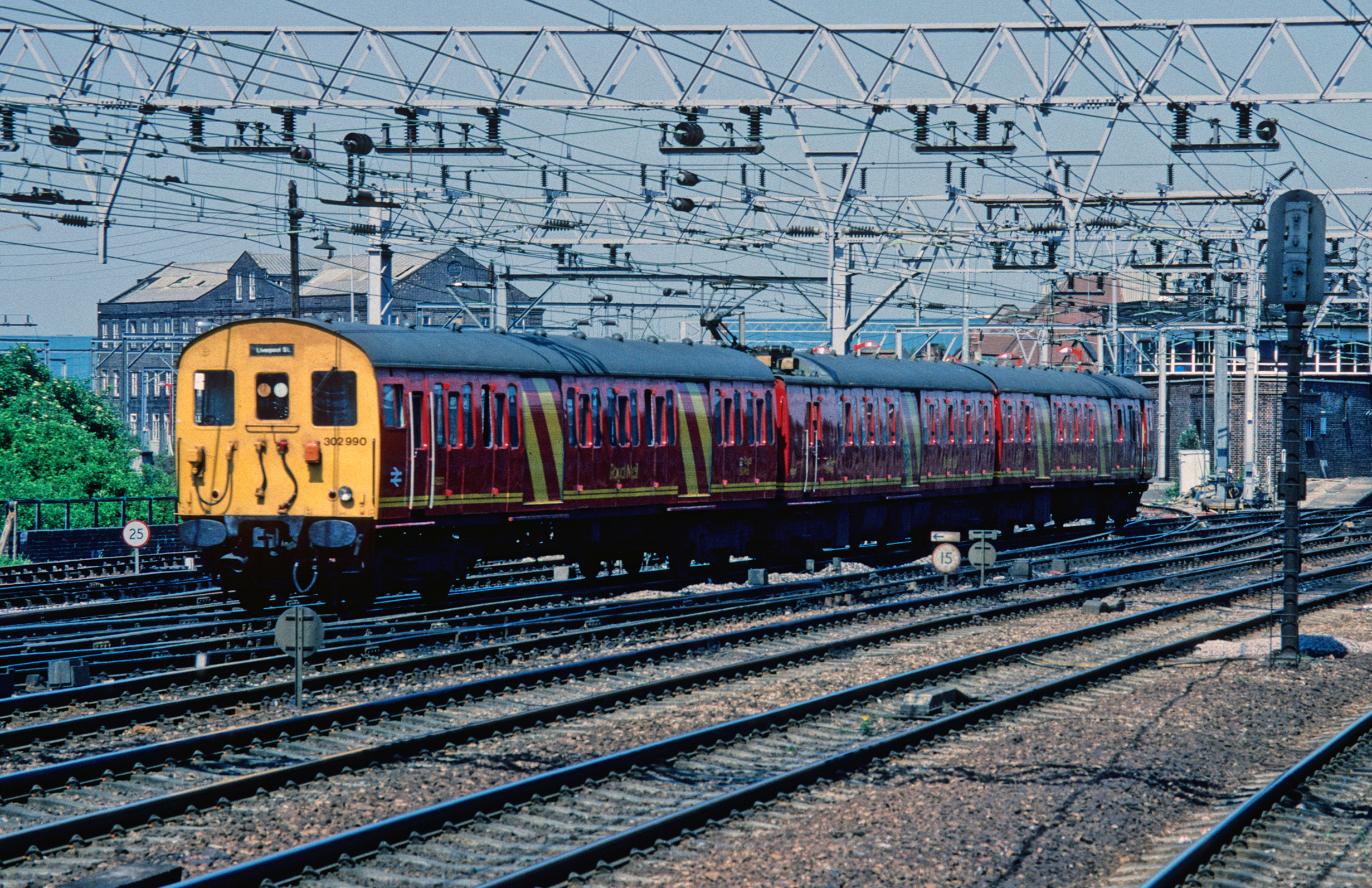
The idea that some trains could be converted for freight use has been mooted. HSTs are one example, and there are suggestions that Pacers *could* be (however unlikely). Here’s a couple of examples of when this happened in BR days.

00408. 53046. York. 21.1.90.
A Class 114 ‘Derby Heavyweight’ DMU converted for express parcels traffic and based at Cambridge stands in one of the bay platforms in York on the 21st January 1990.
00844. 302990. Stratford. 4.5.90.
A former Class 302 unit converted to carry Royal Mail by stripping out the interior and adding roller doors which was used on services out of Liverpool St seen at Stratford (E London) on the 4th May 1990.

Other fleets which are unlikely to find new homes are the old BR 3rd rail stock such as the SWR 455s – despite them having been re-tractioned recently (link). They date from the early 1980s, so they’re 35 years old, and I can’t realistically see them being converted to bi-mode or 25kv overhead – especially as more modern fleets will also be off-lease. Another fleet with an uncertain future (despite having been expensively rebuilt between 2013-16) is the Class 458/5s.

In 2020, just 2 years after entering service, the Siemens Desiro Class 707s will be homeless – although again, I can’t see them remaining so for long. The same with the Anglia Class 379s and I would think the Class 360s and former LM 350/2s. The Class 323 fleet’s an interesting one. Split between Northern and the former London Midland franchise, both will be surplus from 2019-20. They’re a popular train with both passengers and crew – and pretty nippy, but will their age (they were built in 1992-3) and fact they’re a small non-standard fleet of 43 units count against them? Some of the 319s on the list may have a future as more bi-mode conversions but, for me, the big question mark is over the surplus BR built class 317s and 321/322s. I’m not a fan of any of them, the passenger environment’s not as good as the later Class 365s (also surplus, but I hope they do find a home) plus, what’s the need for 100s of 4 -car EMU’s now that electrification’s being scaled back? I suspect a few ROSCO staff will be asking the same question…

Of course, this glut of surplus trains may yet grow depending what happens when the next SET franchise is let. Will we see the Class 465’s and 466s being added to the list?

An interesting fact is that the Railway Magazine calculated we’d need 52 miles of sidings to store the vehicles that are coming off-lease. 52 miles! That’s a hell of a logistical and economic challenge for the ROSCOs. As the old Chinese curse says ‘may you live in interesting times’ – and for the ROSCOs and train maintainers, they certainly are…

To round up, here’s a few examples of the fleets which are coming off lease.

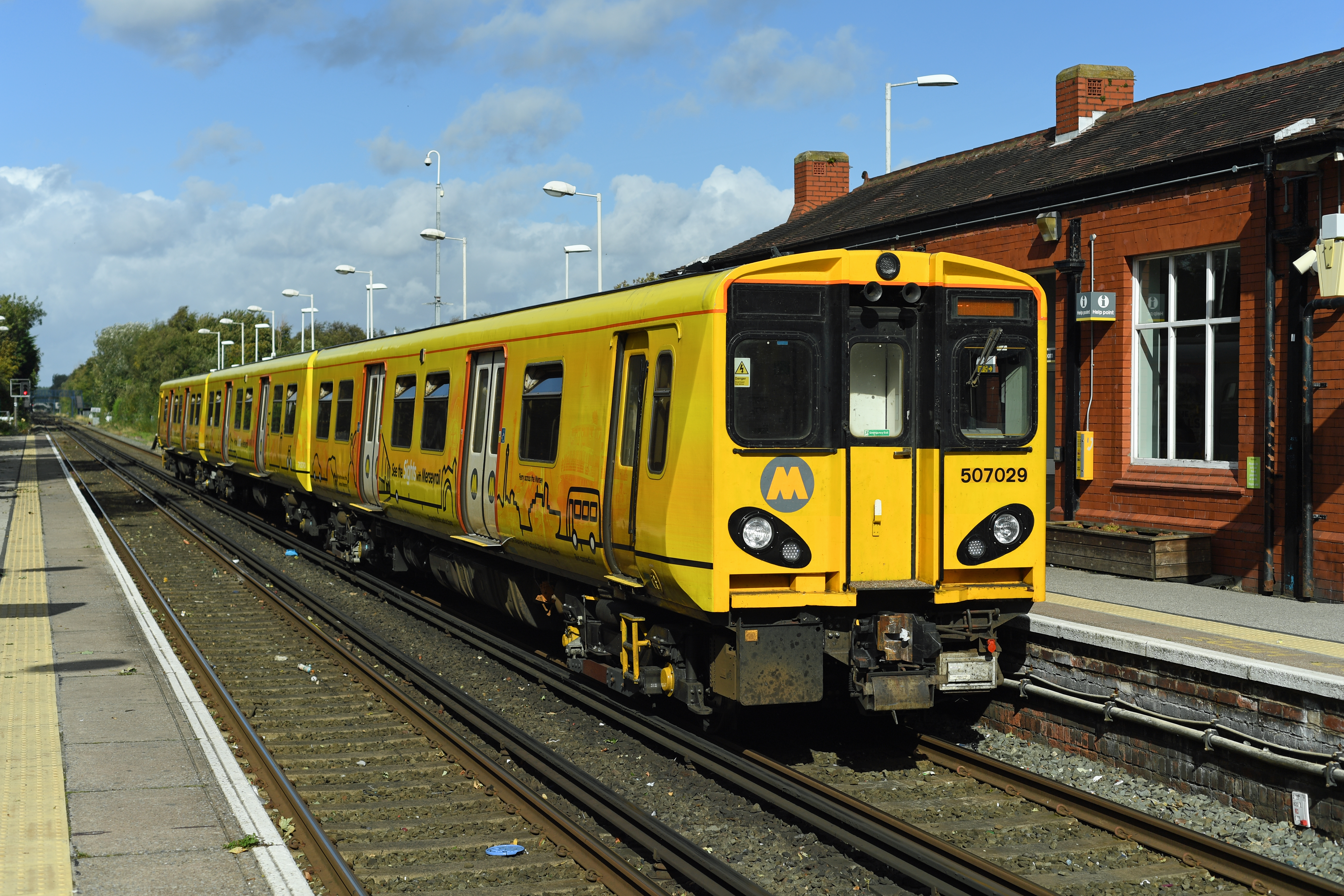
DG256699. 507029. Formby. 29.9.16
Missed off the RDG off-lease list are the 177 vehicles that make up Mersyrail’s Class 507/508 fleets. The 507s were built for Merseyside in 1978-80 whilst their sisters, the 508s were originally built for SW London services in 1979-80 as 4-car units. They transferred to Merseyside in 1983, leaving one car behind which was incorporated into a late build of the Class 455s which replaced them.
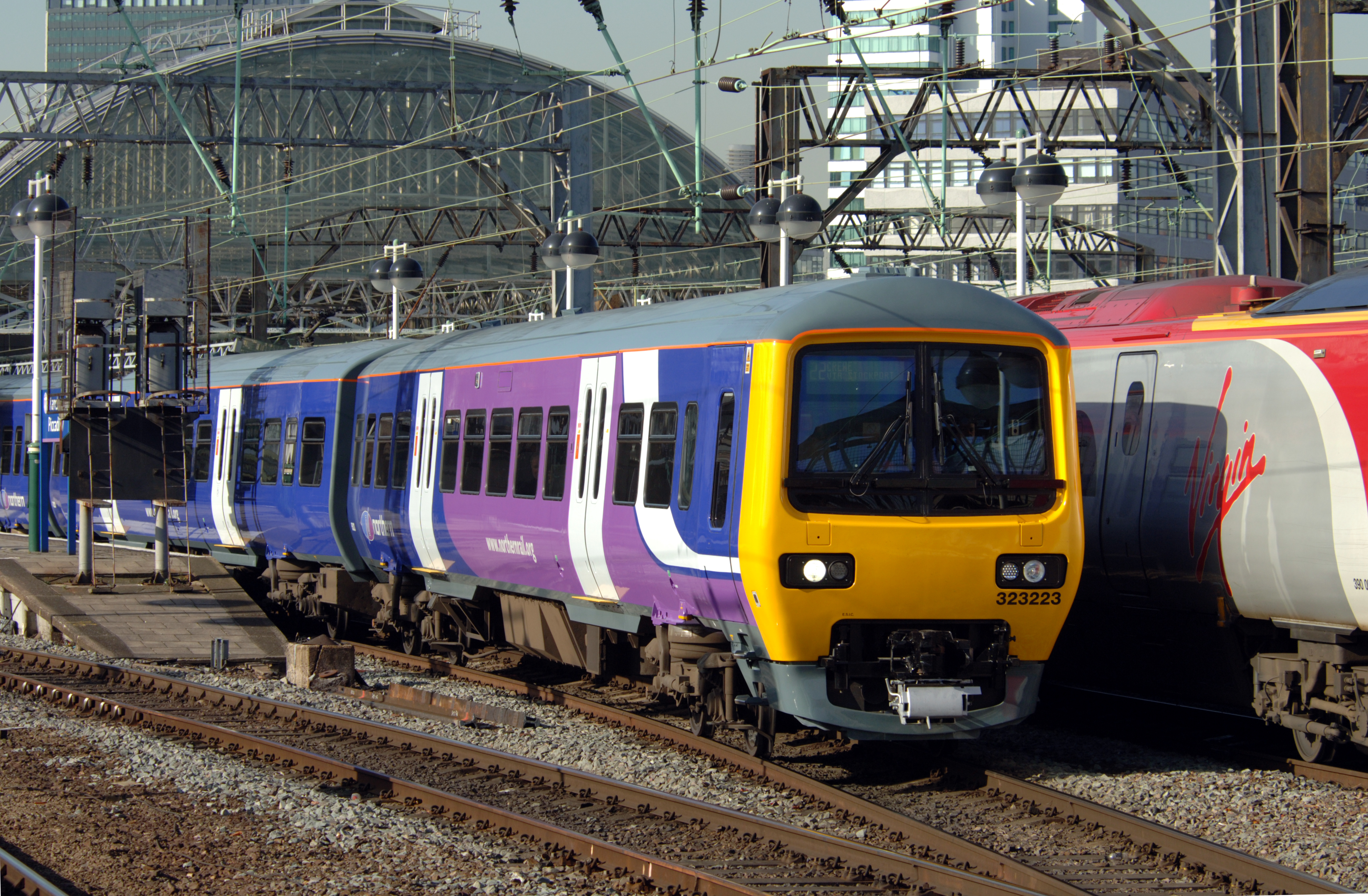
DG14404. 323223. Manchester Piccadilly. 18.2.08
The 43 strong Class 323 fleet is split between Northern Rail and the former London Midland franchise, originally, the plan was that both would be be relinquished, but now it looks like Northern will keep their 323s which will be joined by most of the WM sets.
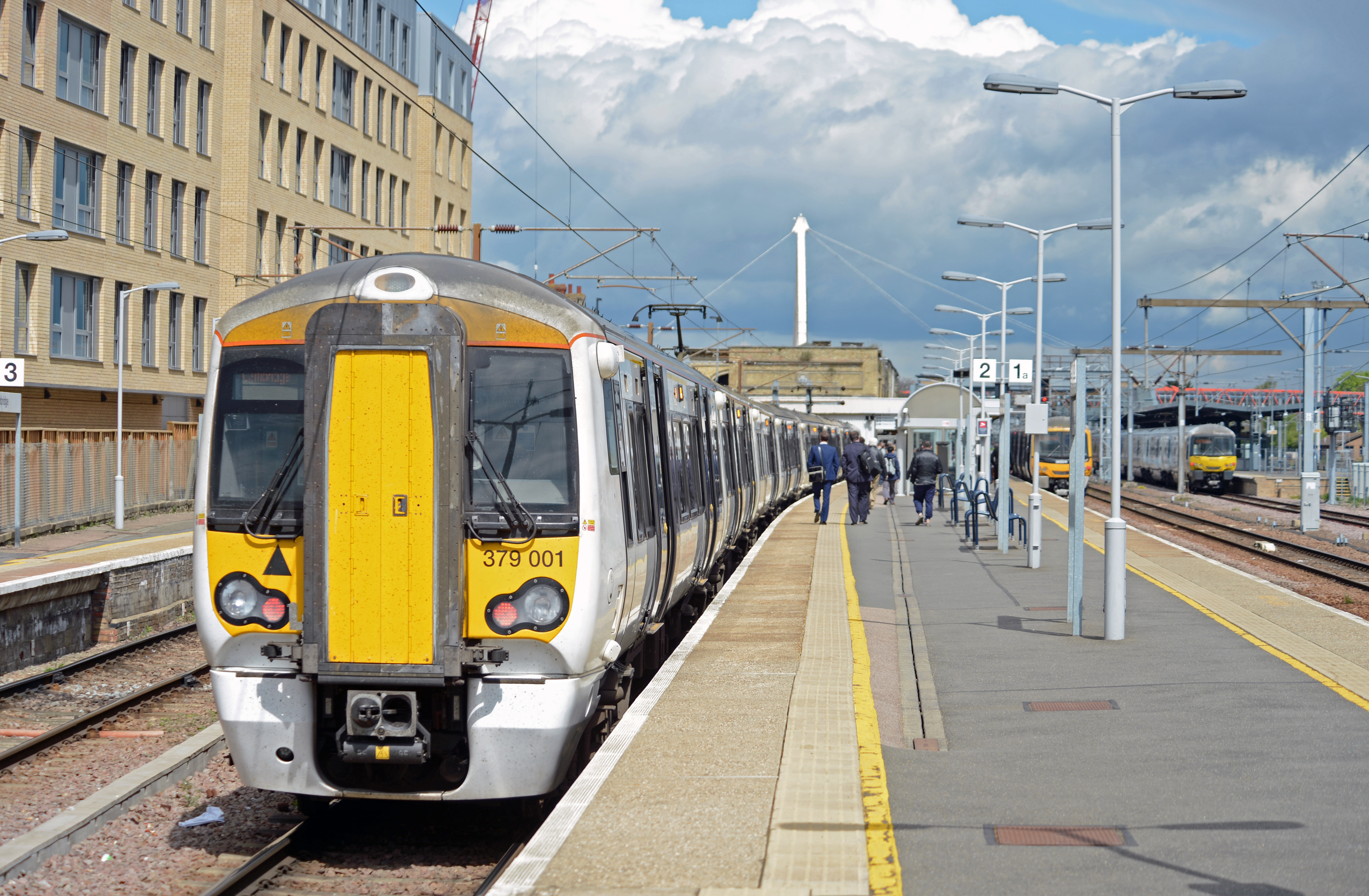
DG212684. 379001. Cambridge. 30.4.15
Abellio Greater Anglia are replacing their entire train fleet with brand new vehicles, which means even this 30 strong fleet of 2010 built Class 379s will go off-lease.
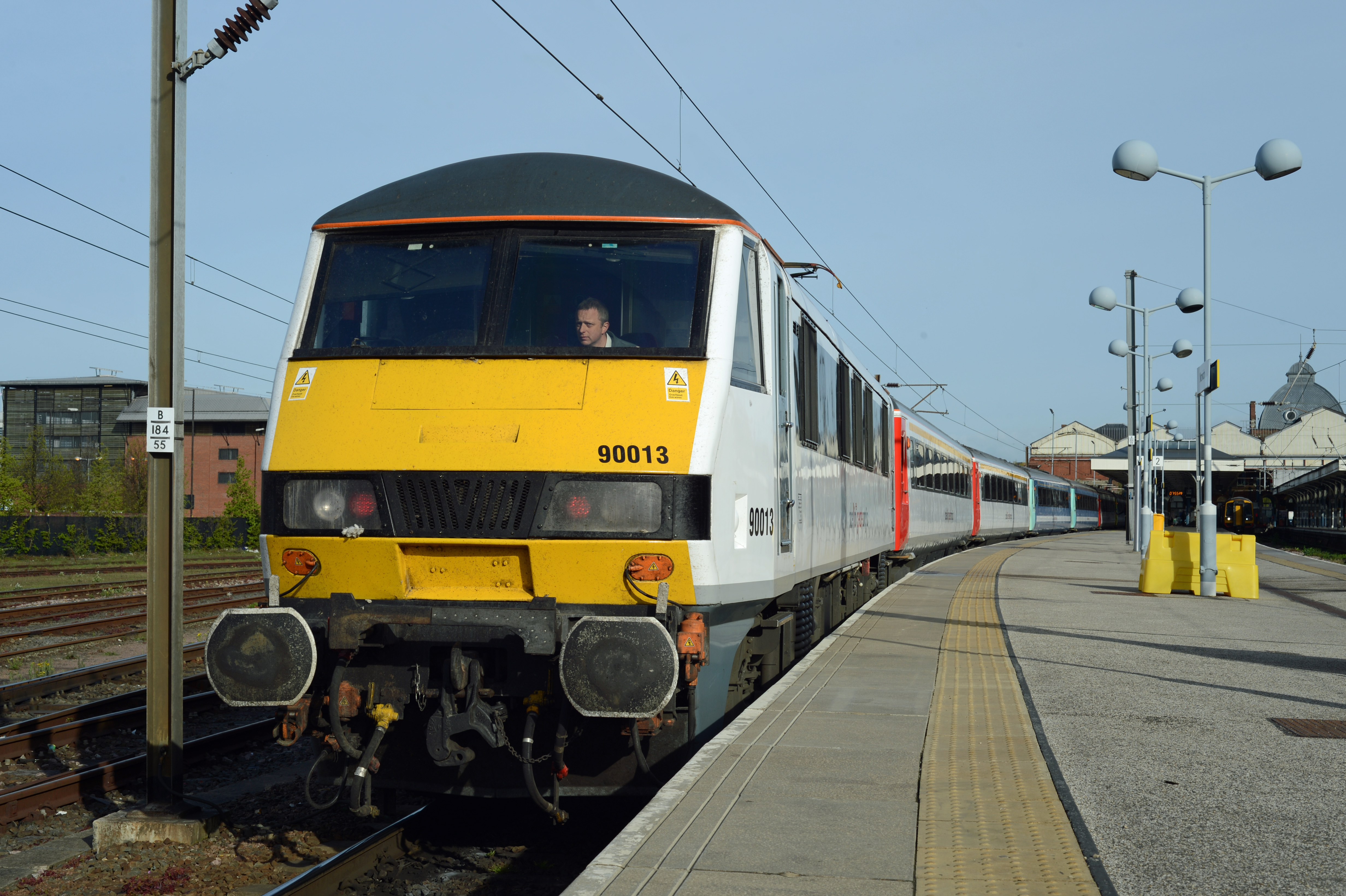
DG212786. 90013. Norwich. 1.5.15
AGA will also be dispensing with the services of their 15 Class 90s and Mk3 coaching stock. Some of the Class 90s are now due to go to Freightliner to replace Class 86s.
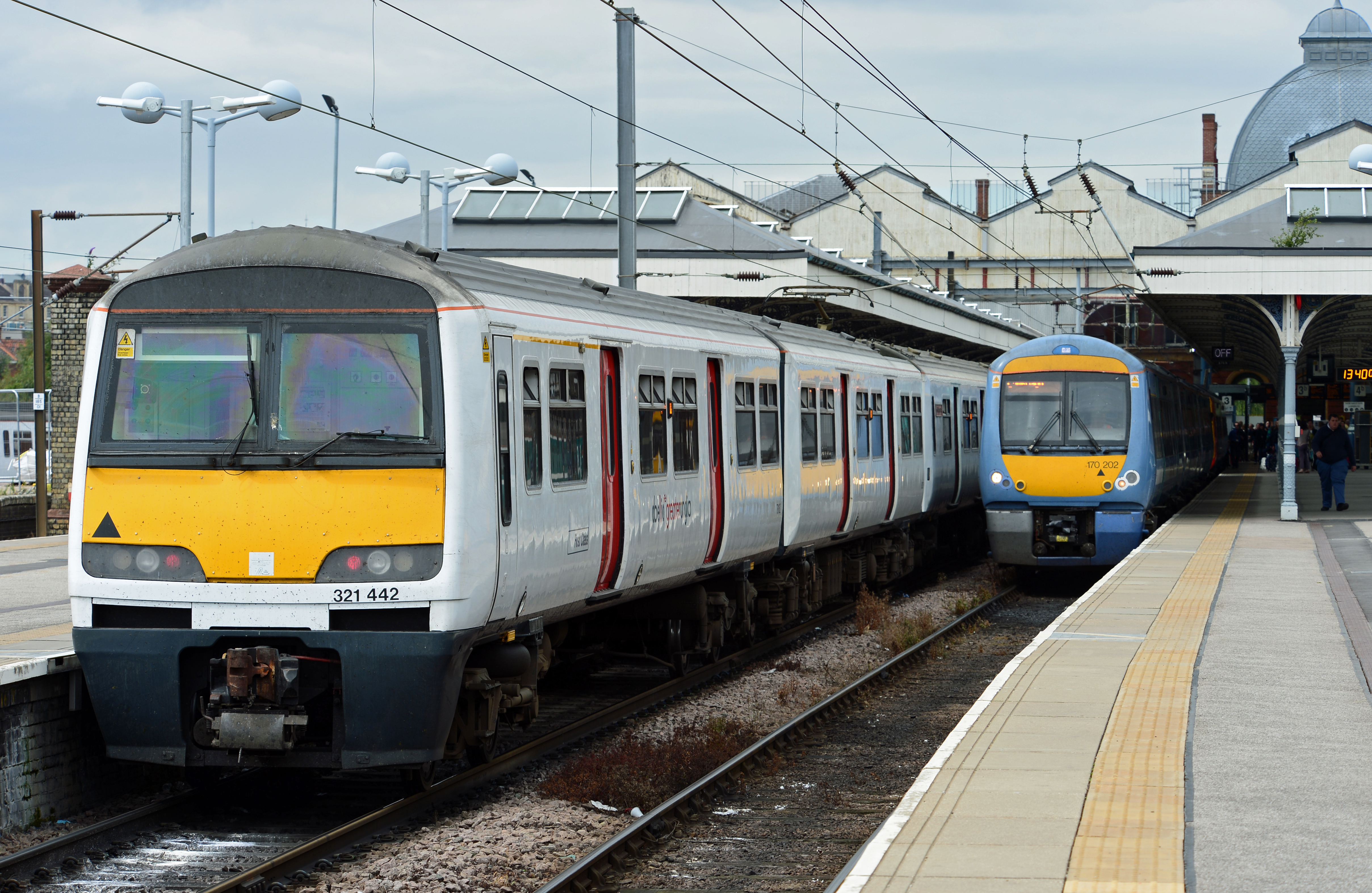
DG249479. 321422. 170202. Norwich. 8.8.16
Other trains going off-lease are these Class 321 EMU’s and the Class 170/2 DMU’s, both seen here at Norwich.
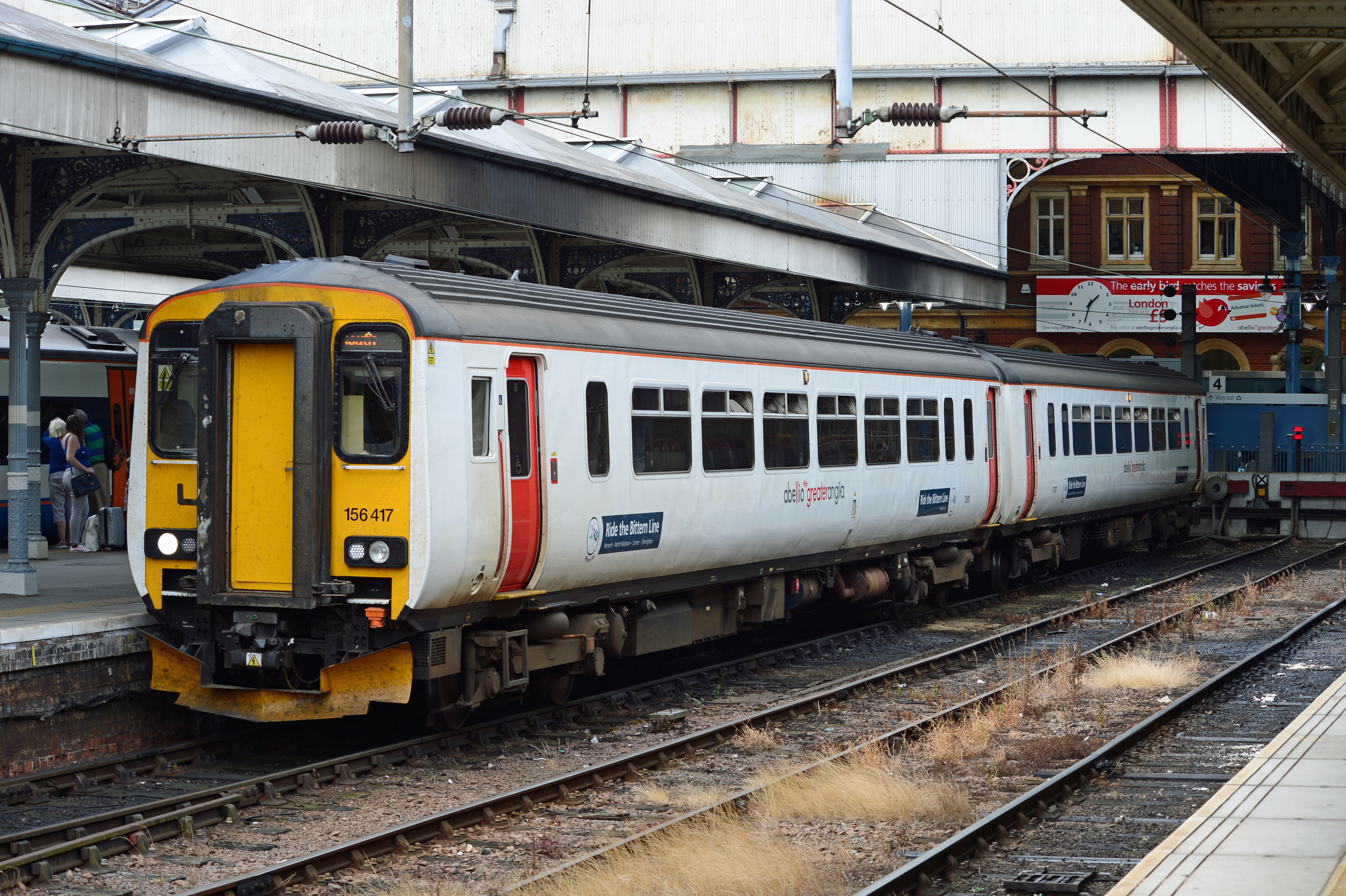
DG249474. 156417. Norwich. 8.8.16
9 of these two-car Class 156s will also be coming up for grabs in 2019…
DG214166. AGA Class 360s. Manningtree. 19.5.15
21 sets of these Siemens Desiros were built at Krefeld, Germany in 2002-3. AGA will make them all surplus to requirements. They’ve now found a new home for the future with East Midlands Railway who will use them on St Pancras – Corby services.
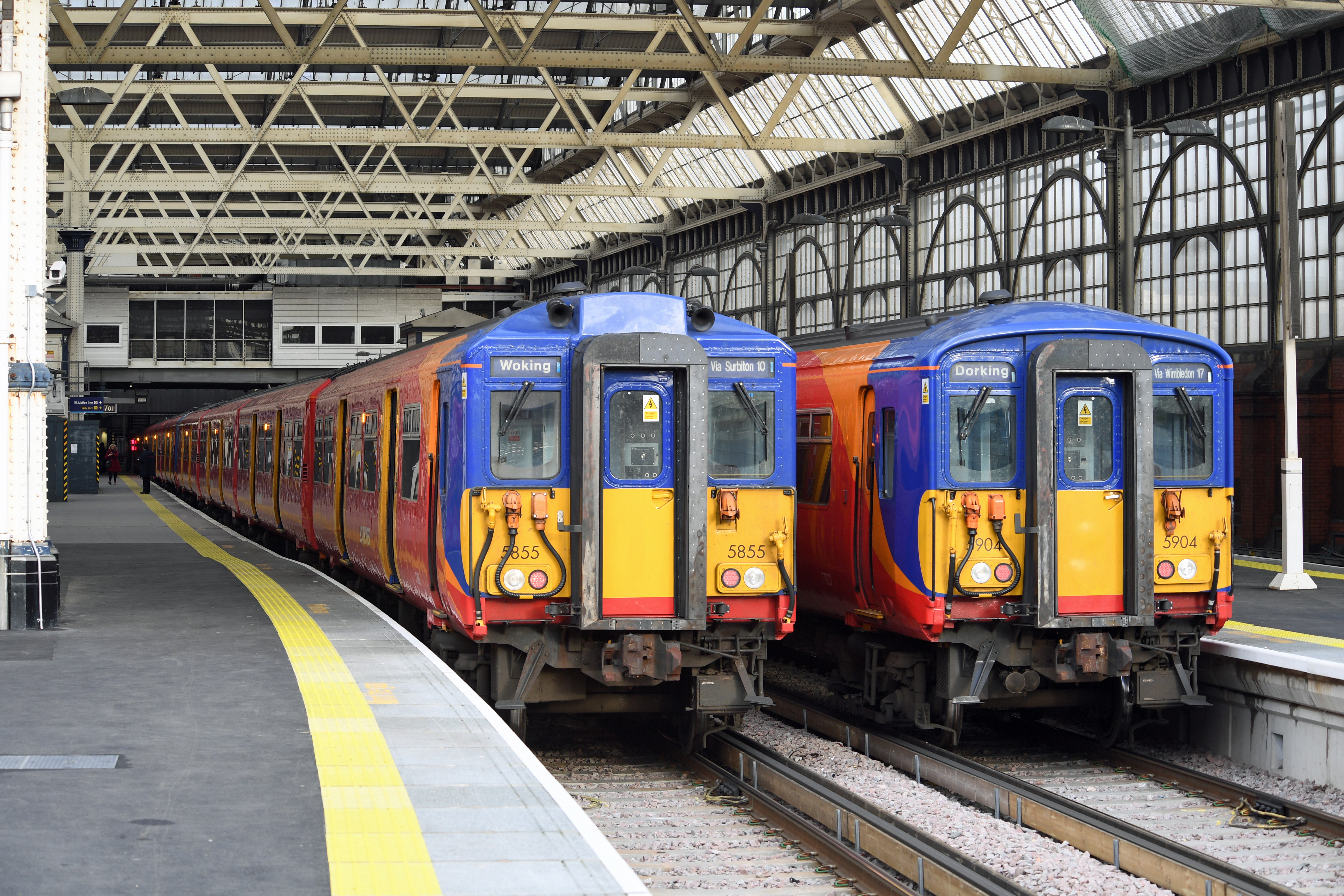
DG288310. 5855. 5904. Waterloo. London. 3.1.18
Two variants of the Class 455s that BR built in 1981-85 for SW London suburban services. A total of 364 of these vehicles will be made redundant by 2020.
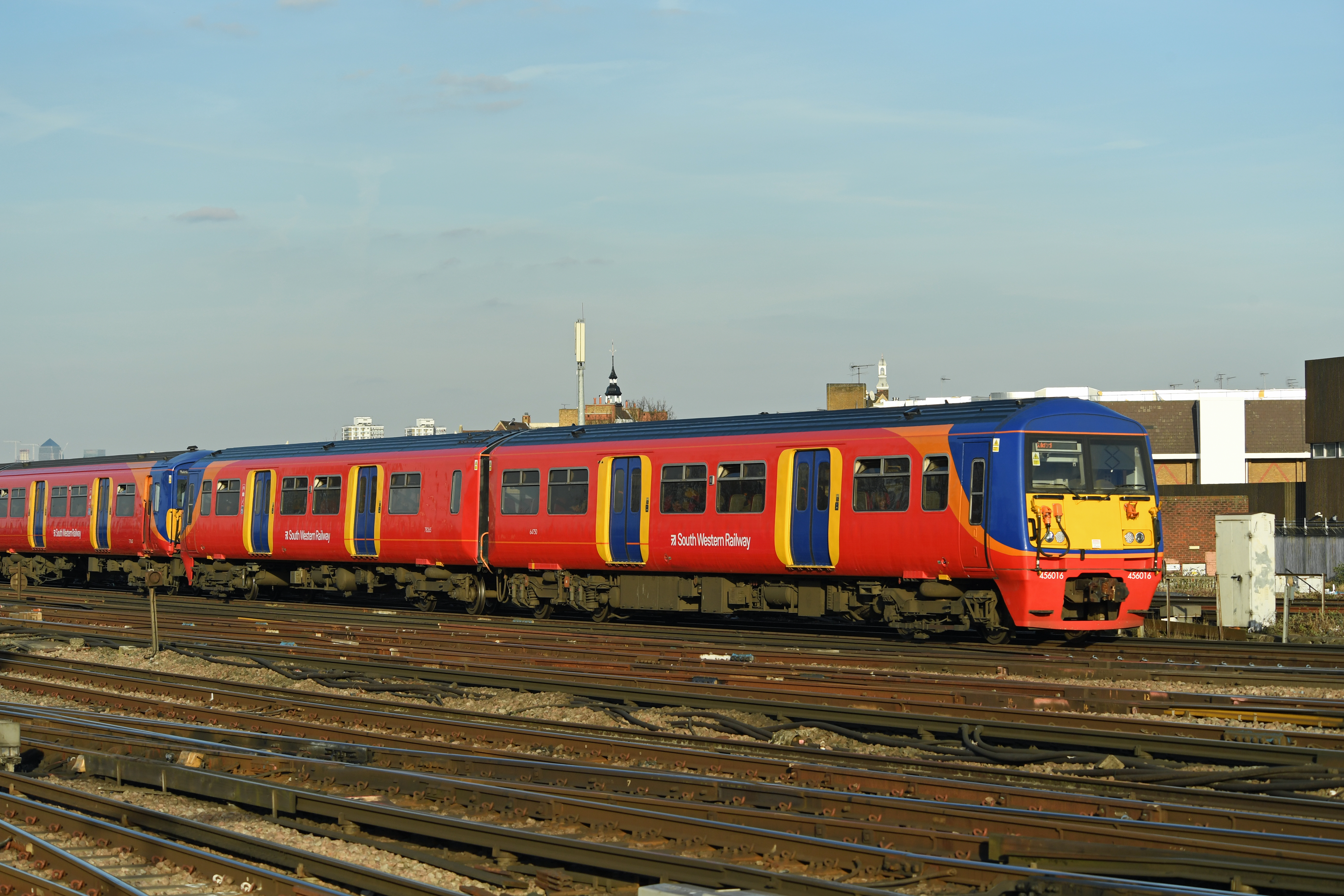
DG294058. 456016. Clapham Junction. 21.3.18
BREL built 24 of these 2-car Class 456s in 1990-91. All will be surplus in 2020.
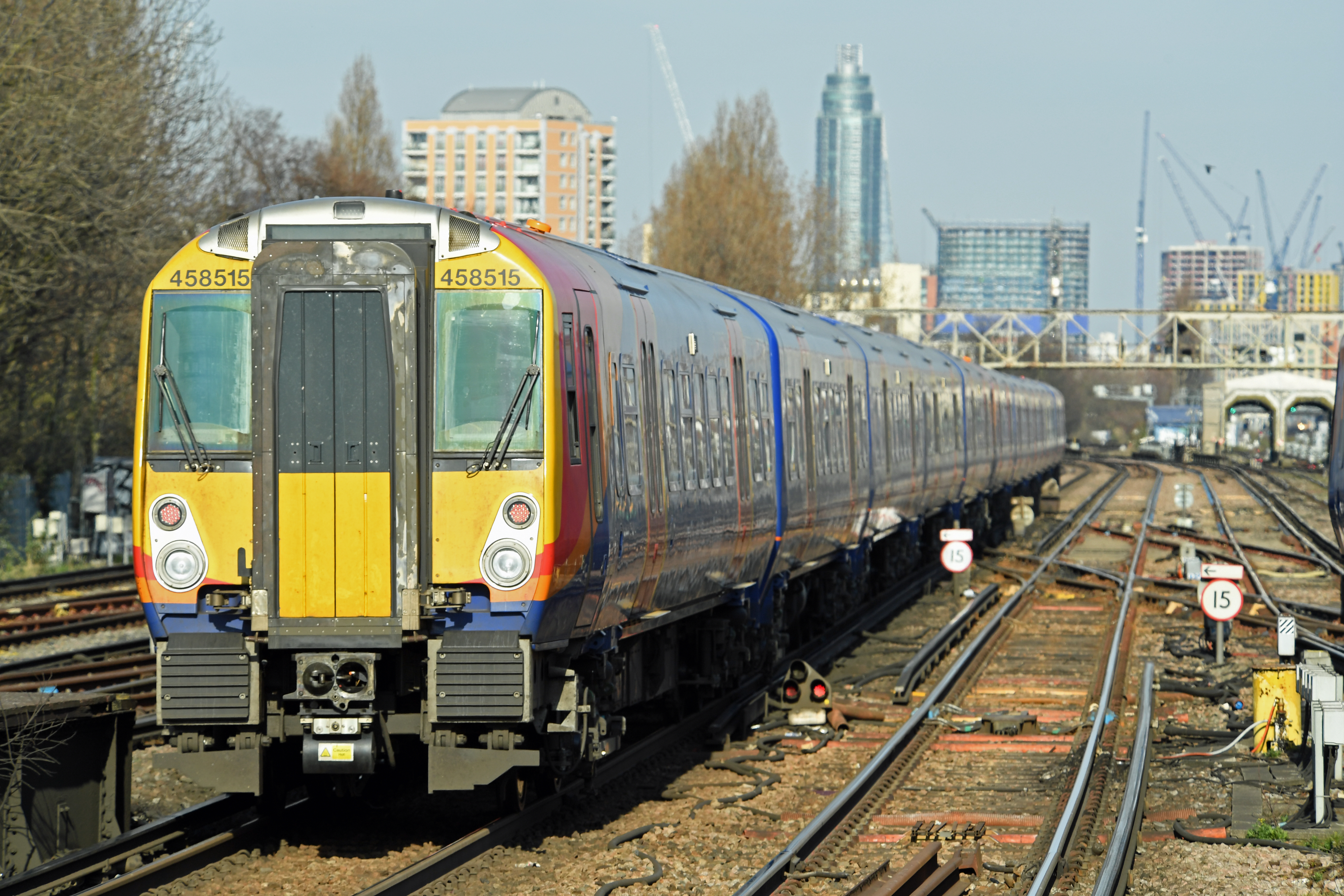
DG294029. 458515. Clapham Junction. 21.3.18
Rebuilt from the original Alstom Juniper Class 458 and their sisters, the Gatwick Express Class 460s between 2013-16, the 36 strong 458/5 fleet will be redundant.
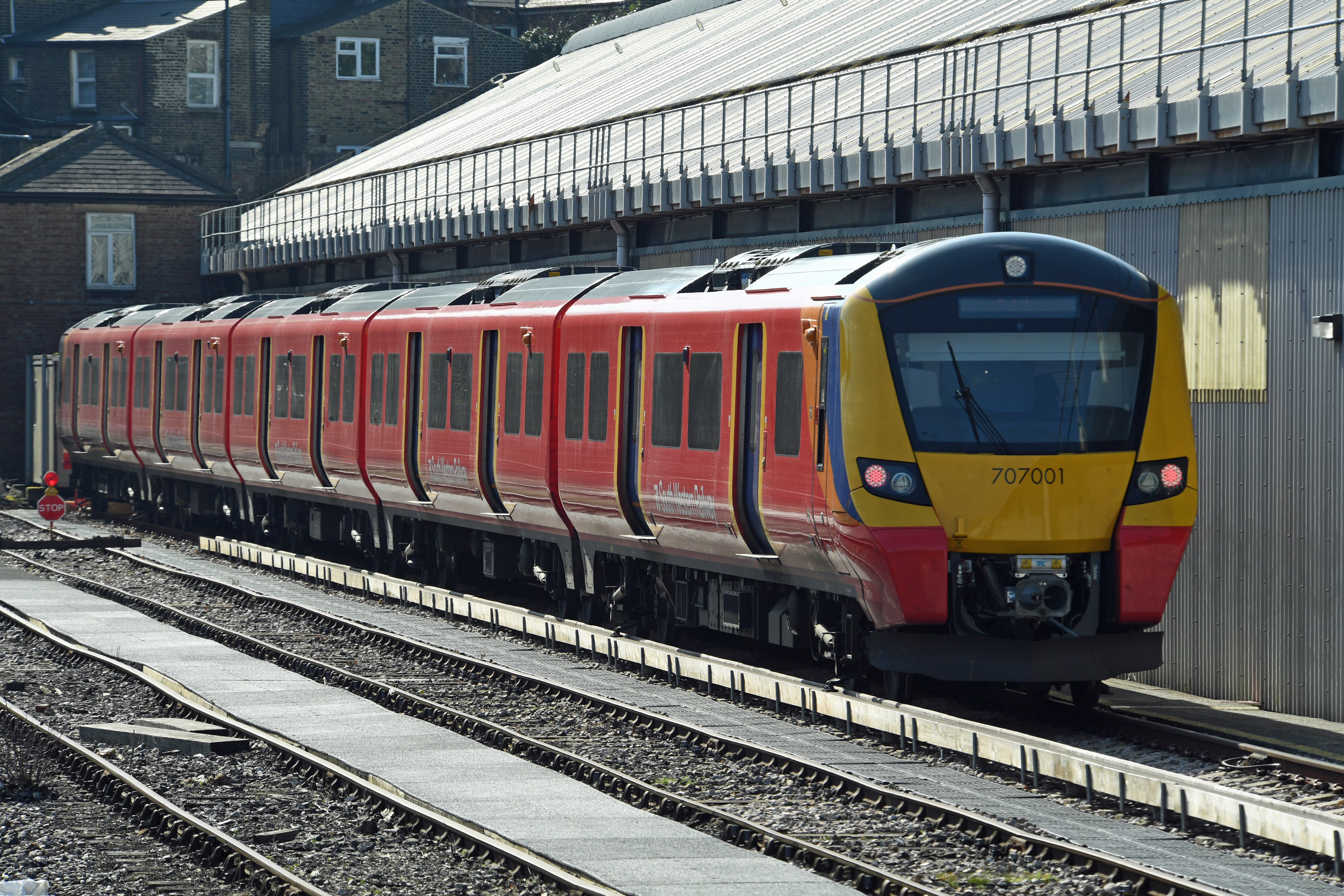
DG293981. 707001. Clapham Junction. 21.3.18
The last 2 of the 30 strong Class 707 fleet only entered service this month. SWR will be relinquishing them in 2020.
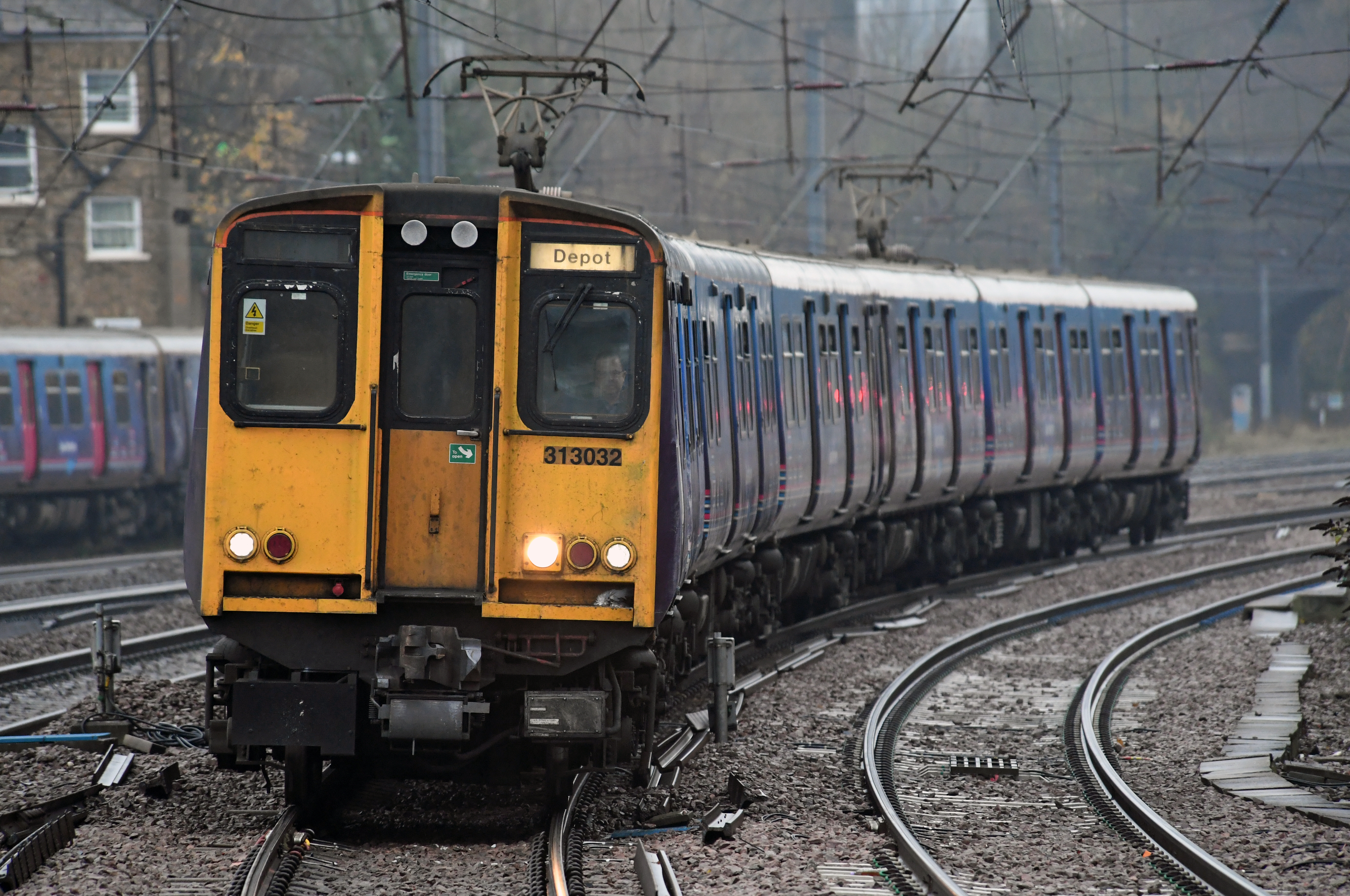
DG261592. 313032. Harringay. 13.12.16
The Class 313 fleet are currently the oldest trains operating on the national network (exc the IoW). Built in 1976-77, they’re being displaced from GTR services out of Moorgate and Kings Cross by new Siemens Class 717s at the moment
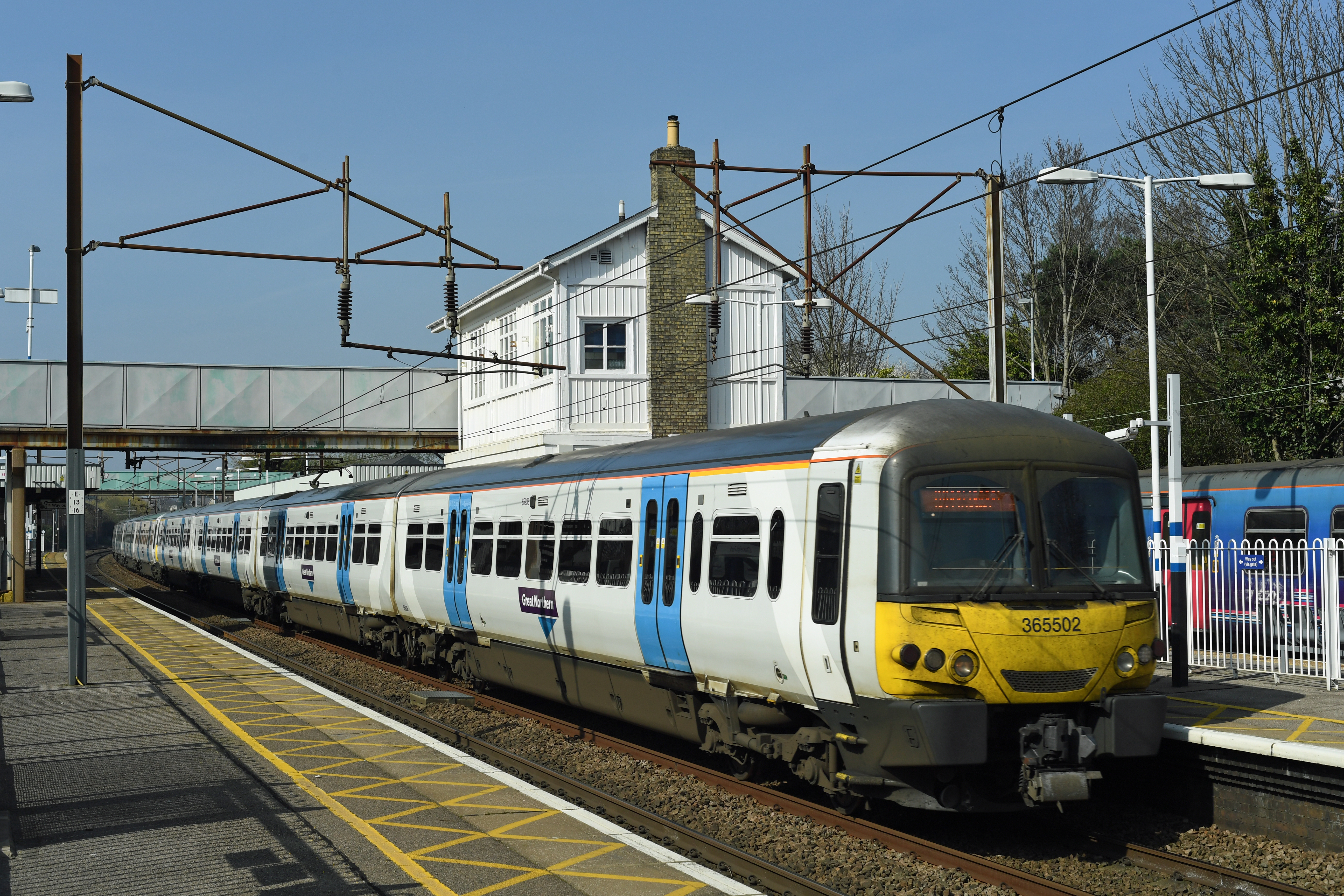
DG268088. 365502. Oakleigh Park. 27.3.17
The 41 strong Class 365 fleet were built by ABB York between 1994-95. They were last trains BR built before privatisation caused a hiatus in orders that led to the closure of York. They’re also my favourite of the BR fleet. 100mph capable, comfortable and with good visibility. Originally intended to go to GWR they’re now coming off-lease with no home to go to and handed back to the DfT by Eversholt as the original lease is DfT owned.
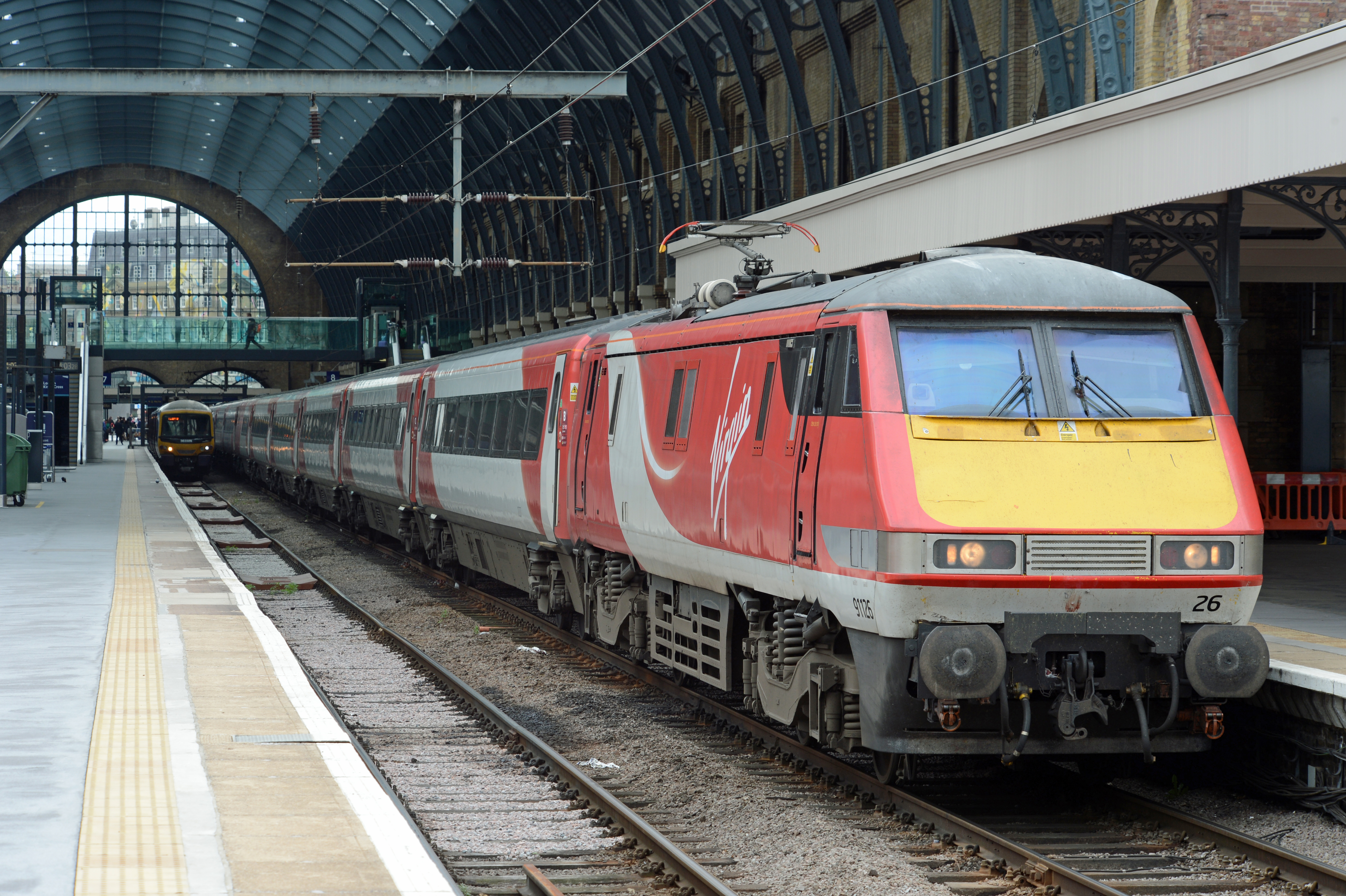
DG222573. 91126. Kings Cross. 27.8.15
The Class 91s and Mk4 coaches took over most East Coast workings in the early 1990s. They’ll be rendered redundant by the arrival of the Hitachi ‘Azumas’ in 2019. There’s no firm plans to cascade them elsewhere. Suggestions that they could be used on the Midland Main Line foundered because of the cost of gauge-clearance.

STOP PRESS!

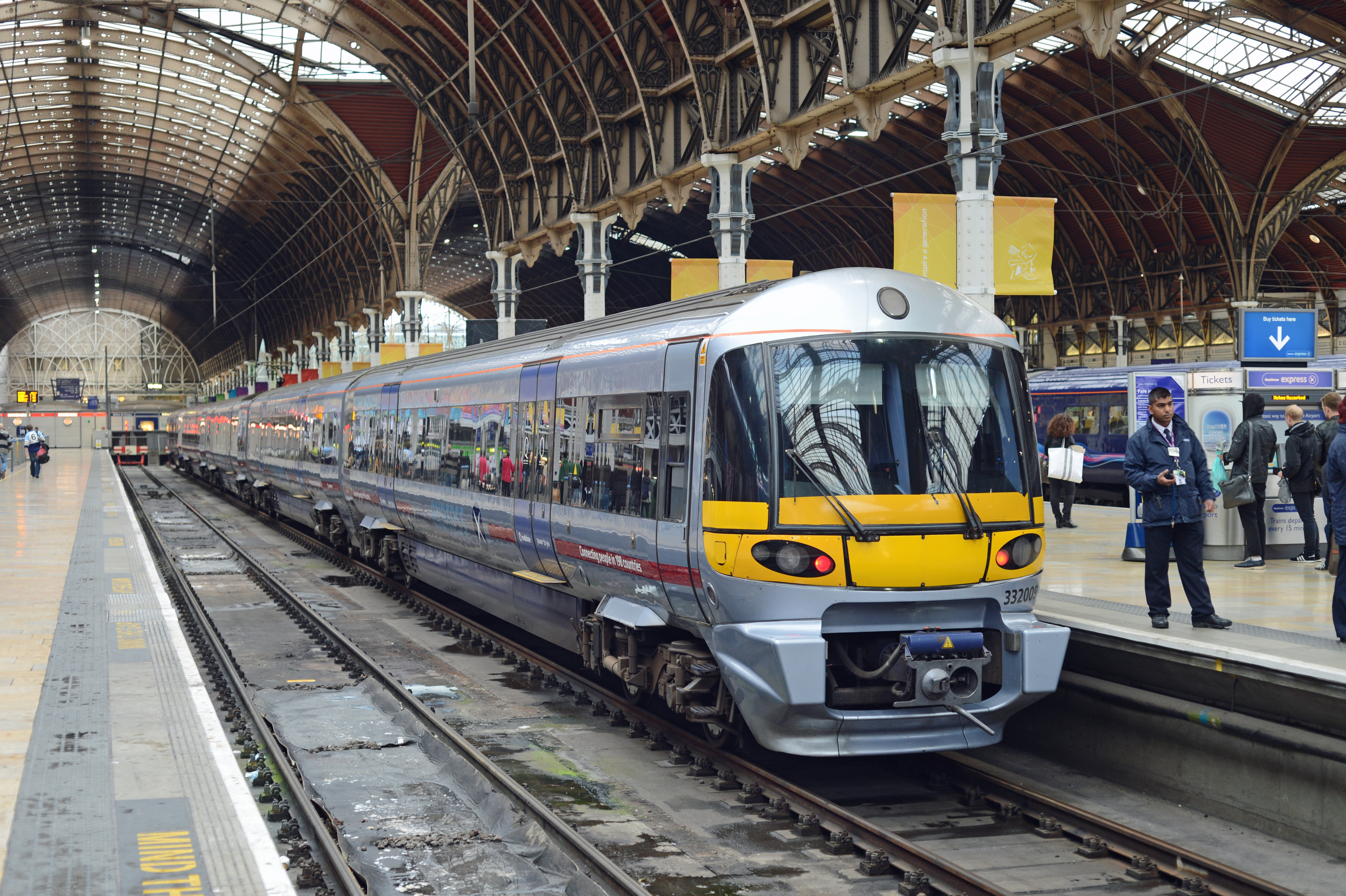
Just to show how quickly things change, whilst I was writing this came the announcement that Heathrow Express services will continue to operate until at least 2028 under a management contract between Heathrow Airport and FirstGroup subsidiary Great Western Railway. This means HEx will bid goodbyes to their 14 strong fleet of Class 332s as GWR will be using 12 specially modified Class 387s to run the service. That add another 61 100mph vehicles only 20-21 years old looking for a home….

DG125655. 332009. Paddington. 23.9.12.
A Siemens/CAF Class 332 used by Heathrow Express. Today was announced these units would be replaced by specially modified GWR Class 387s

Crunching the final numbers on the Stop Hs2 petition

22 Thursday Mar 2018

Posted by Paul Bigland in Anti Hs2 mob, Hs2, Rail Investment, StopHs2

≈ 1 Comment

Tags

Anti Hs2 mob, Hs2, Rail Investment, StopHs2

As sure as night follows day, the last daft Stop Hs2 Parliamentary petition ran out of time and signatures yesterday. Despite frantic efforts by the remaining anti Hs2 groups in the last couple of days they never managed to scrape together more than a few hundred of the 70,000 plus signatures they fell short by after 6 months of trying. Here’s the final (humiliating) total.

Final petition total

29,838 from a population of over 65 million is (quite frankly) pathetic. It’s less than the population of a small town like Bedworth in Warwickshire (30,001). Or, look at it another way. Hs2 will pass through 63 constituencies containing 6,567.433 people. Here’s a breakdown of those figures by the phases of Hs2. They make interesting reading.

percentages

Lets take the headline figure first. Of the 6.5m living on the Hs2 route, just a quarter of 1 percent signed the StopHs2 petition. That’s despite the anti Hs2 campaign having been running and organising for 8 years! 55.29% of all the petition signatures came from just 9.69% of constituencies! (63 out of 650).

This is what makes me laugh about these petitions. Tactically, they’ve never made the slightest bit of sense! They’ve never stood a chance of getting 100,000 signatures and even if they did they’re a waste of time because what’s on offer? – the chance for Parliament to do what it’s already going to do – debate Hs2. But, as Parliament has to vote on the various Hs2 Hybrid Bills anyway that’s a given! Add in the fact that Hs2 enjoys cross party support and there’s not a cat in hells chance of it being voted down by MPs. So you can see why all these petitions do is hand people like me a rich seam of data to drill down through and expose the weakness of the anti Hs2 campaign! For example. Just looking at the constituency map of where most signatures come from shows that (surprise surprise) it’s easy to work out where Hs2 will run. So much for the claims that StopHs2 isn’t a Nimby based campaign!

petition map

Now let’s look at the numbers for each constituency by phases, starting with Phase 1.

Final Phase 1 petition. 21 Mar

Initially I just kept a running total and percentage. At the end of November 2017 I decided to add monthly totals and last date of signings in order to examine trends. Here’s some headline figures.

The constituency with the most signatures is Chesham and Amersham with 1,723 (1.83% of constituents). The lowest is Birmingham Ladywood with 12 (0.01%). This reflects a trend across all 3 phases. The constituencies with the most signatures are rural and the lowest are urban. Look at the constituencies in Birmingham. The numbers are poor right across the board. They’re no better in London. Only Ruislip, Northwood & Pinner has over 1%. Camden has a measly 555 (0.3%) despite all the supposed opposition to Hs2 in the borough

These figures put to the sword the anti Hs2 campaign’s claims  that the majority of the UK opposes Hs2 and that ‘millions’ are blighted. What they show is areas where StopHs2 action groups are active – and where they’re not.

Of course, other people were calling for people to sign the petition, notably the Green Party. Estimates for their membership numbers vary but they’re certainly under 50,000, which suggests they had mixed success. The Greens have struggled to rally opposition to Hs2. I’d suggest the reason for this is twofold. One is their schizophrenic position on High Speed Rail, supporting it ‘in principle’ but opposing it in practice, plus the fact Hs2’s a railway and people rather like railways – it’s not fracking.

The other party (if you can still call them that) to oppose Hs2 was UKIP. Their membership figures can’t be trusted as most of the ones they claim are actually pushing up daisies, but they may still have managed to get a few hundred people to sign.

Now let’s look at the Phase 2 and 2a route from North of Birmingham to Manchester.

Final Phase 2 Mcr petition. 21 Mar

Compared to 0.36% of folk living on Phase 1, the number’s dropped by two thirds to just 0.12% on the Manchester leg. This reflects several things. One’s the weakness of organised opposition here. Stophs2 was always a Southern based campaign and its heartland was the Chilterns. There’s only a handful of ‘action’ groups up North and it’s easy to spot where they’re based on the Manchester leg.

The constituency with the most signatures is Stone with 368 (0.43%) and the lowest is Denton & Reddish in Manchester with 12 (0.01%). Yet again, the figures expose the fact this is a rural campaign, not an urban one. In fact, there’s not a single StopHs2 ‘action’ group in any town or city Hs2 will serve. You could add every single signature in Greater Manchester and it would still be less than the total for Stone, despite the disparity in population size! In fact, look at how few in Gtr Manchester signed each month. The figures are so small that one family signing could double the monthly numbers!

What conclusions can we draw from this? Well, the Phase 2a Hybrid Bill petition’s currently making its way though Parliament. This affects the first five constituencies on the list – 4 of which are in the top 5 signatures! I’d suggest that this means the Phase 2 bill for the leg to Manchester has very little to worry about in the way of organised opposition. The support for Hs2 far outweighs anything else. Now let’s go and look at Phase 2 to Leeds.

Final Phase 2 Leeds petition. 21 Mar

I’ve fleshed this one out with a bit more data. It includes population sizes, the names of the MP’s and which way they voted on the Hs2 Phase 2a Bill.

The constituency with the most signatures is Rother Valley with 1650 (1.74%) and the lowest is (yes, you’ve guessed it) an urban constituency – Nottingham North with 17 (0.02%). The picture on this leg is different to the others as the situation’s more mixed. The majority of the opposition to Hs2 has been driven by the 2016 route change – hence the figure for Rother Valley. Also of interest is that despite all the noise made by a vociferous but tiny ‘action’ group in Erewash, they could only muster 200 signatures (0.21%) and their MP, Maggie Throup is no pushover and voted FOR Hs2 phase 2a. The figures also show that the claims that Yorkshire is totally opposed to Hs2 (see one Johnathan Pile here) are very wide of the mark as of the 2,185.931 souls here, just 4793(0.21%) have signed the petition – and 34.4% of them are from one constituency!

These figures lead me to conclude that Yorkshire’s a bit “all mouth and no trousers”. There’s a handful of  tiny groups that make a lot of noise, writing cheques they can’t cash, but they’ve little support in the wider community or the political arena. Nor can they agree on a concerted course of action.

This leads me on to another observation. nationally, the anti Hs2 campaign’s collapsed. In 2010 there were 4 allegedly ‘national’ anti Hs2 groups. AGAHST (Action Groups Against Hs2, based in the Chilterns). 51m, a collection of councils (mostly Chiltern and phase 1 based). Hs2aa (High Speed 2 Action Alliance, based in Amersham) and StopHs2 (based in Warwickshire).

Now only StopHs2 survives – if in name only. Its two leading lights live in Bournemouth and Kenilworth, miles away from each other and where the action is nowadays! They’ve given up any pretence of leading a campaign and when they do appear it’s to moan about Hs2 on social media. They’ve no influence on proceedings on Phase 2 and I doubt they’ll survive long enough to even be around when the Phase 2 Hybrid Bill enters Parliament next year.

What’s left of the anti Hs2 campaign is a bunch of disparate local groups with no clear agenda to unite them and no national organisation worth its name to guide them.  Some are still re-running the tactics that failed to Stop hs2 on phase 1, others have given up and are fighting for mitigation (such as extended tunnels) and/or compensation.

In summary, there is no Stop Hs2 campaign anymore. It’s collapsed. To stop Hs2 a campaign needs money, organisation and most crucially – political support. The remaining folk opposed to Hs2 have none of these and the way many of the MPs who opposed Phase 1 voted FOR phase 2a is the most obvious example.

No doubt a few die-hards and the bandwagon jumping egotists who infest such campaigns via social media will continue to pretend otherwise, but it matters not. Cross-party support for Hs2 remains unbroken, Phase 1 is under construction, the phase 2a bill is unstoppable and the phase 2 bill is inevitable.

that's all folks


Holed up in Huddersfield

20 Tuesday Mar 2018

Posted by Paul Bigland in Huddersfield, Rail Investment, Railways, Travel, West Yorkshire

≈ Leave a comment

Tags

Huddersfield, Rail Investment, Railways, Travel, West Yorkshire

I’m taking a break from working from home to base myself at ACoRP’s water tower office at Huddersfield station today as I’m being interviewed about my ‘Cycle India’ trip for their e-magazine ‘Train Online’, which will be appearing shortly.
DG138747. ACoRP Office. Huddersfield. 17.2.13.
Not bad for an office, is it?

It’s good to be able to stretch my (metaphorical) legs as the bad weather has left me a little ‘stir crazy’. My Indian adventure already feels like a dream, despite it only being a couple of weeks ago. At least the snow’s melting and the thermometer’s reaching a balmy 5 degrees today!

Sadly, there’s little of interest to photograph at the nearby station. The Colne valley route sees hardly any daytime freight traffic nowadays, partly due to the intensity of passenger services but also because most traffic has vanished. The ‘binliner’ services from Manchester which were the backbone of daytime freight traffic have ceased to run and the replacement service from Knowsley (Liverpool) to Wilton traverses the Calder Valley instead. The only regular service, the afternoon Leeds Hunslet to Tunstead cement tanks runs ‘as required’ on a Thursday – which means it’s unpredictable.

DG288370. 66620. Huddersfield. 5.1.18

On the 18th January this year, Freightliner’s 66620 heads West through Huddersfield with the only regular daytime freight service through the town, the Hunslet (Leeds) to Tunstead empty cement tanks.

Whilst there’s little freight, there’s a regular diet of Transpennine Express Class 185s shuttling across the Pennines, plus Northern 142s, 144s, 150s, 153s, 155s and 158s (and the occasional 156) pootling to and from Manchester, Leeds, Sheffield and Wakefield. A few Manchester services are extended to ‘exotic’ destinations farther afield such as Wigan and Southport, whilst one evening service via the Penistone line to Sheffield pitches up at Retford (of all places).

DG115650. 142050. Huddersfield. 20.6.12.

Soon to be heading for the scrapyard, a Northern Class 142 ‘Pacer’ leaves Huddersfield for Wakefield on the 20th June 2012

The railscene at Huddersfield will be considerably enlivened later this year when TPE start running Class 68’s hauling new Mk5 coaches built by CAF in Spain, adding yet another chapter to Yorkshire’s railways. Electrification of the route is due to begin in 2019 which will have a massive impact on the local network, so there’s lots to look forward to (and document) over the next few years.

Basing myself in a large town like Huddersfield’s a bit of a luxury for me when I’m ‘office based’ as it gives me the opportunity to nip out at lunchtime and shop without travelling far. As this is a busy university town there’s a better selection of shops than in humdrum Halifax. It also alters the demographic because there’s far more younger faces around during the day. I nipped out earlier to visit the indoor Queensgate market. I love the variety of Northern markets. Queensgate is a modern example, opened in 1970 it was built with a bespoke roof system of 21 asymmetric curved shells. The design allows maximum light into the market and it’s considered to be the best example still standing of a retail market from the 1960s-70s. Grade 2 listed, it’s a interesting mix of traditional and modern. Fruit and veg and butchers stalls rub shoulders with nail bars and Thai cafes, whilst shoe shops are cheek by jowl with vaping supplies.

20180320_121643

Inside Queensgate market.


20180320_121946

Thai food’s a popular option in a few markets in Yorkshire.

Unlike some towns, the number of empty shops hasn’t hit epidemic proportions, gutting. I passed several vacant properties which were being outfitted for new tenants, keeping the vibrancy of the centre alive. Long may that trend continue in these troubled times. Of course, there’s an irony in this. Without immigration, there’d be a damned sight more empty shops. A significant proportion of convenience stores are run by people from Europe or Asia – as are many restaurants and fast food outlets. How they’ll fare in a post-Brexit economy without freedom of movement is a question many would rather not ask…

Whilst I was on my travels I popped into the station and found a cheese shop had set up store in readiness for the flood of homeward bound commuters. I normally visit on a Wednesday to purchase some of the artisan bread for sale, but I was sorely tempted to sample some of today’s wares. I have to be careful as my wife can’t eat cheese, so for me it’s a rare treat.

Now I’m back at work, where (as is often the case) my workload hasn’t gone to plan and I’ve been diverted into trawling my archives for a suitable cover for a magazine! Let’s see if I can come up with something suitable…

Rukin returns from the dead

12 Monday Feb 2018

Posted by Paul Bigland in Hs2, Rail Investment, StopHs2

≈ Leave a comment

Tags

Hs2, Rail Investment, StopHs2

You have to laugh. What passes for an anti Hs2 campaign nowadays is the Joe Rukin & Penny Gaines show formerly known as Stophs2. Penny lives in Bournemouth and Joe’s in Kenilworth so it’s easy to see why it’s not exactly a tight campaign. In truth, it’s a campaign in name only. Stophs2’s collapsed. They’ve gone from campaigning to moaning. They’ve no presence in the real world – they’re reduced to social media – and they’ve been pretty crap at that. They’ve a website, a Facebook page and a Twitter account, but lately they’ve abandoned them all apart from the occasional retweet.

Finally, Stophs2 ‘Campaign Manager’ (shurely shome mishtake. Ed) has broken his radio silence to post this on their website.

rukin

At least one MP was ‘paying attention’? His moan is that only 1 MP, Sir Kevin Barron (whose Rother valley constituency is on the Phase 2 route to Leeds) changed his mind to vote against Hs2.

OK, let’s dissect this nonsense. As usual, Rukin spins like a top but even he can’t disguise the fact that since the Hs2 phase 1 hybrid bill passed they’ve only ‘turned’ one MP. What Rukin fails to mention is that this one ‘win’ is more than cancelled out by the 7 MPs who voted against the Hs2 phase 1 bill but who voted FOR the phase 2 a bill. They were;

Steve Baker (High Wycombe)
Bob Blackman (Harrow Est)
Peter Bone (Wellingborough)
Chris Chope (Christchurch)
Mark Pawsey (Rugby)
Chris Pincher (Tamworth)
John Redwood (Wokingham)

Not exactly a victory, is it? Their campaign’s collapsed and seven of the tiny number of MPs who used to support them have changed sides. Let’s crunch the full numbers – when the Phase 1 Hybrid Bill stormed through 2nd reading it did so by 452 votes to 41, giving the project a majority of 411. Of the 41 MPs who opposed, 7 stood down or retired as MPs in 2015. Another two stood down before the 2017 election and another two lost their seats, so that’s 11 of the 41 gone. Now another 7 have changed their vote – which throws Rukin and StopHs2’s campaigning ‘skills’ into perspective. In the years since the Phase 1 bill passed they’ve lost, not gained political support & Barron’s change of heart is a pyrrhic victory at best. When you look through the spin and analyse the numbers, you have to ask – what the point of Stophs2 anymore?

The end is nigh for diesel trains? Don’t you believe it…

12 Monday Feb 2018

Posted by Paul Bigland in Jo Johnson MP, Politics, Rail electrification, Rail Investment, Railfreight

≈ 1 Comment

Tags

Jo Johnson MP, Politics, Rail Investment, Railfreight, Railways

Today Transport Minister Jo Johnson MP made a policy announcement on the future of the UKs diesel train fleets – sort of, ish…

Because the policy is more of an aspiration, not a firm commitment. Johnson told the BBC that “I would like to see us take all diesel-only trains off the track by 2040. If that seems like an ambitious goal, it should be and I make no apology for that. After all we’re committed to ending the sales of petrol and diesel cars by 2040. If we can achieve that, then why can’t the railway aspire to a similar objective?” Once doesn’t have to be a Professor of English to spot the caveats in that.

The inherent irony here is that his Government has recently scaled back electrification of routes like the Midland Mail Line (MML) and has ordered many more diesel-electric bi-mode trains like the Hitachi Class 802s for GWR. Bi-modes are the worst of all worlds as they’re hardly energy efficient, OK, they may run on electric power for most of the trip, but then they’re carting around a lot of dead-weight in diesel engines and fuel.

This also begs questions about the 55 new CAF built Civity DMUs which are on order for Northern. Can these be converted to EMUs and (even if they can be) what does this do for the economics of the Northern franchise? Elsewhere, Porterbrook leasing are converting all-electric Class 319 trains to bi-mode by fitting them with diesel engines. The rolling stock leasing companies must be scratching their heads right now. They’ve got 1000s of older EMU vehicles coming off-lease in the next few years but without an extension of electrification, there’s nowhere to run them! Instead, we’re going to the halfway-house of bi-mode.

DG288445. 800023. Reading. 16.1.18

GWR are currently taking delivery of these Hitachi Class 800 bi-modes to replace their HST fleet. Does the Government seriously expect the MTU diesel engines to be redundant in 22 yrs time, and if so – how?

Whilst the announcement (or should that be ‘thinking aloud’) will be welcome news for companies like Alstom who have developed a Hydrogen powered train, it leaves more questions than it answers.

There’s one very noticeable omission in the ‘plan’: Freight.

The majority of the UKs railfreight is moved by powerful ‘go anywhere’ diesel locomotives. How will they be replaced by 2040 without electrifying the main freight routes? As many depots and sidings aren’t electrified train builders have fitted ‘last mile’ diesel powerpacks to electric locos. Realistically, can these be replaced by hydrogen or battery power by 2040? And what about the miles of freight lines where diesel operation’s the only viable option? Freight operators exist on very small margins as it is. How would this proposal affect the economics of their operations?

DG246897. Siemens Vectron production line. Munich. Germany. 27.6.16

Siemens Vectron locomotives under construction in Vienna in 2016. These modular locos are can be built as diesel or electric. The version in VR livery is an electric fitted with a ‘last mile’ diesel power-pack.

The current workhorse of UK freight operators is the Class 66. Without widespread electrification, what else could deliver the power at rail needed to move heavy freight trains hundreds of miles at up to 75mph? A Canadian plan for a hydrogen powered locomotive shows that it would be two units, with the second carrying the hydrogen. Doubling the size of the locomotive increases maintenance costs and potentially leads to shorter trains due to the capacity of sidings and loops (also increasing costs).

DG279645. 66206. Golant. 21.8.17

A DB Cargo Class 66 hauls empty china clay wagons away form the harbour at Fowey, Cornwall.

So, I remain sceptical about the ‘plan’ as I don’t see a firm policy or long-term strategy from DfT or Ministers that will allow this to happen, which is a shame as Johnson’s aim is laudable. Recently, I blogged about the change to air quality at Paddington station which was evident now the HSTs and DMU’s were being replaced by electric traction. Sadly, with diesel bi-modes and back-tracking on electrification we seem to be going in the wrong direction.


Sunday miscellany

11 Sunday Feb 2018

Posted by Paul Bigland in Calder Valley, Environment, Flooding, Miscellany, Mytholmroyd, Rail Investment, Rail Moderinsation

≈ Leave a comment

Tags

Calder, Environment, Flooding, Miscellany, Rail Investment, Rail Modernisation

It’s another dismal day here in the Calder Valley as we’ve suffered from high winds and waves of sleet and snow showers. In fact the whole weekend’s been a washout due to the changeable weather. It’s prevented me cycle training and left me catching up with household chores, paperwork and some picture editing.

Some of the pictures are from Friday’s visit to nearby Mytholmroyd, which is still recovering from the devastation caused by the Boxing Day floods of 2016. For those of you unfamiliar with events, have a look at this article from the Guardian newspaper.

Whilst most homes and businesses have now been re-occupied, a row of shops that were sandwiched between the main road and the river Calder were seriously damaged and have been demolished by the Environment Agency, they’ve been replaced with these ‘Lego’ blocks which form part of the new flood defences that are still under construction around the town.

DG289401

The view from the road bridge over the River Calder, showing the new flood defences which occupy the site of former homes and shops.

A few hundred metres up the road, behind the Shoulder of Mutton pub the Environment Agency’s rebuilding the shattered banks of Cragg brook that were overwhelmed. Flooding the pub, nearby homes and the housing estate opposite.

DG289403

Looking upriver along Cragg Brook towards Cragg Vale. The housing estate behind the wall was under several feet of water after the floods.

DG289410

Looking in the opposite direction to the previous photo. The Shoulder of Mutton pub can be seen on the right. The River Calder is a few hundred metres beyond the railway viaduct.

I only hope that once the Environment Agency’s finished the work Mytholmroyd will be protected from such devastation in the future and the problem isn’t simply moved downriver…

On another front, the resignalling of the Calder Valley line is continuing apace. More and more new signals are springing up along the route. Some are straight replacements for older signalling such as this pair at Mytholmroyd where the new signal has been moved forwards

DG289394

Others are new, installed to reduce the size of the signalling sections, such as this one in Sowerby Bridge which is protecting the station.

DG289502

What’s immediately noticeable about the new signalposts is the absence of ladders that previously allowed S&T staff to reach the signal head. These have been made redundant as the post is hinged at the base so that it can be lowered to the ground.

It’s now Sunday evening and the weather’s deteriorated as the temperature dropped. One minute you could see the other side of the valley – the next you were lucky to see 50 metres!

20180211_152624

The calm before the next storm. Looking down over Sowerby Bridge from by the Wainhouse Tower. The next snowstorm is coming in from the West  (to the right of the picture).

The wind whipped the snow flurries so that they were almost horizontal. Then, suddenly – blue skies would appear, giving a blissful few minutes peace before the next lot of flakes stormed in. We abandoned attempts to go walking and sought solace in the local pub for an hour of fun and laughter with friends.

20180211_155200

The Big 6 is a traditional pub of the old school. There’s no wifi or TV, you go there to drink good beer and engage in conversation with people. Beer like this…

20180209_183602

After the pub the two of us settled in for a productive evening at home. Dawn had promised to make another batch of her Thai style chilli pickle so the pair of us spent ages cutting up a large bowl full of red and green chillies which produced these jars full of weapons-grade pickle for ourselves and some friends.

20180211_210429

This stuff isn’t for the faint-hearted & should probably be banned under the Geneva convention – especially the next morning when its had chance to work its way through your digestive system. Johnny Cash summed up the effects perfectly…

https://www.youtube.com/watch?v=It7107ELQvY

Goodnight folks!


← Older posts
Newer posts →

Recent Posts

  • 8th January picture of the day…
  • Rolling blog. Ribblehead bound…
  • 6th January picture of the day…
  • 5th January picture of the day…
  • 2nd January reservoir walk…

Recent Comments

ramakrishnanaidu400's avatarramakrishnanaidu400 on 2nd January reservoir wal…
Paul Bigland's avatarPaul Bigland on 20th December picture(s) of th…
Nathan Thompson's avatarNathan Thompson on 20th December picture(s) of th…
Unknown's avatarWelcome to the South… on Changing trains. Rebuilding th…
ramakrishnanaidu400's avatarramakrishnanaidu400 on London, HS2 and home…

Archives

  • January 2026
  • December 2025
  • November 2025
  • October 2025
  • September 2025
  • August 2025
  • July 2025
  • June 2025
  • May 2025
  • April 2025
  • March 2025
  • February 2025
  • January 2025
  • December 2024
  • November 2024
  • October 2024
  • September 2024
  • August 2024
  • July 2024
  • June 2024
  • May 2024
  • April 2024
  • March 2024
  • February 2024
  • January 2024
  • December 2023
  • November 2023
  • October 2023
  • September 2023
  • August 2023
  • July 2023
  • June 2023
  • May 2023
  • April 2023
  • March 2023
  • February 2023
  • January 2023
  • December 2022
  • November 2022
  • October 2022
  • September 2022
  • August 2022
  • July 2022
  • June 2022
  • May 2022
  • April 2022
  • March 2022
  • February 2022
  • January 2022
  • December 2021
  • November 2021
  • October 2021
  • September 2021
  • August 2021
  • July 2021
  • June 2021
  • May 2021
  • April 2021
  • March 2021
  • February 2021
  • January 2021
  • December 2020
  • November 2020
  • October 2020
  • September 2020
  • August 2020
  • July 2020
  • June 2020
  • May 2020
  • April 2020
  • March 2020
  • February 2020
  • January 2020
  • December 2019
  • November 2019
  • October 2019
  • September 2019
  • August 2019
  • July 2019
  • June 2019
  • May 2019
  • April 2019
  • March 2019
  • February 2019
  • January 2019
  • December 2018
  • November 2018
  • October 2018
  • September 2018
  • August 2018
  • July 2018
  • June 2018
  • May 2018
  • April 2018
  • March 2018
  • February 2018
  • January 2018
  • December 2017
  • October 2017
  • September 2017
  • August 2017
  • July 2017
  • June 2017
  • April 2017
  • March 2017
  • February 2017
  • January 2017
  • December 2016
  • November 2016
  • October 2016
  • September 2016
  • July 2016
  • June 2016
  • May 2016
  • April 2016
  • March 2016
  • February 2016
  • January 2016
  • December 2015
  • November 2015
  • October 2015
  • September 2015
  • August 2015
  • July 2015
  • June 2015
  • May 2015
  • April 2015
  • March 2015
  • February 2015
  • January 2015
  • June 2013

Categories

  • 'Green' madness
  • 'Think Tanks'
  • 144e
  • 2005 London bombing
  • 2017 General election
  • 3 peaks by rail
  • 3 Peaks by ral
  • 51M
  • 7/7
  • Abandoned railways
  • Abu Dhabi
  • ACoRP
  • Adam Smith Institute
  • Adrian Quine
  • Advertising
  • Air Travel
  • Aircraft
  • Airports
  • Airshows
  • Allan Cook
  • Alstom
  • Amsterdam
  • Andrea Leadsom MP
  • Andrew Gilligan
  • Andrew Haylen
  • Andy Burnham MP
  • Anti Hs2 mob
  • AONBs
  • Arambol
  • Architecture
  • Art
  • Australia
  • Avanti West Coast
  • Bali
  • Bangkok
  • Bank holidays
  • Barrow Hill
  • beer
  • Belgium
  • Bereavement
  • Berlin
  • Bigotry
  • Birmingham
  • Blists Hill
  • Blue passports
  • Boris Johnson MP
  • Bradford
  • Brazil
  • Brexit
  • Brighouse
  • Brighton
  • British Railways
  • British Railways (BR)
  • Buckinghamshire
  • Buses
  • Byline media
  • Calder Valley
  • Calderdale
  • Cambridge
  • Cambridgeshire
  • Canals
  • Cardiff
  • Carillion
  • Carolyne Culver
  • Censorship
  • Charities
  • Cheryl Gillan MP
  • Cheshire
  • Chester
  • China
  • Chris Packham
  • Claire Perry MP
  • Class 08
  • Class 155
  • Class 180
  • Class 313
  • Class 314s
  • Class 317
  • Class 319
  • Class 320
  • Class 321
  • Class 323
  • Class 365
  • Class 455
  • Class 456
  • Class 507
  • Class 508
  • Class 60s
  • Class 91
  • Climate Change
  • Communications
  • Community
  • Community rail
  • Community Rail Network
  • COP26
  • Corbynwatch
  • Coronavirus
  • Coventry
  • Covid 19
  • CP5
  • Crap journalism
  • Crazy anti Hs2 campaigner of the week
  • Crazy kippers
  • Crewe Hub
  • Crossrail
  • Cuba
  • Cumbria
  • Customs
  • Cyberattacks
  • Cycle India
  • Cycling
  • Dame Bernadette Kelly
  • Dawn
  • Democracy
  • Denmark
  • Derbyshire
  • Desiro City
  • Dewsbury
  • Diary
  • Dispatches
  • Doha
  • Donald Trump
  • Doomed
  • Dorset
  • Down memory lane
  • Duxford
  • East Lancashire Railway
  • East Midlands Railway franchise
  • East Midlands Trains
  • East-West rail
  • Easter fairy stories
  • ECML
  • Economic illiteracy
  • Economics
  • election2015
  • Elon Musk
  • Engineering
  • Environment
  • Essex
  • Eurostar
  • Euston
  • Extinction Rebellion
  • Fake News
  • Festivals
  • Film and TV
  • Flag shaggers
  • Flooding
  • Flora and Fauna
  • Food
  • Food and drink
  • Foot in mouth
  • Gardening
  • GBRf
  • GCRE
  • General election
  • General election 2019
  • General election 2024
  • Georgetown
  • Germany
  • Glasgow
  • Glossop
  • GNGE
  • GNRP
  • Goa
  • Goole
  • Grand Central trains
  • Grant Shapps MP
  • Great Western Railway
  • Greater Anglia franchise
  • Greater Manchester
  • Greece
  • Green issues
  • Green madness
  • Green Party
  • Grok
  • Gt Missenden
  • GTR
  • Guido Fawkes
  • GWML
  • GWR franchise
  • Gwyll Jones
  • Halifax
  • Hampshire
  • Harvil Rd Hs2 protest
  • Harz railway
  • Heathrow 3rd runway
  • High Speed 1
  • High Speed UK
  • History
  • Hitachi
  • Hong Kong
  • House of Lords
  • HS North
  • Hs1
  • Hs2
  • Hs2 Bow Group
  • Hs2 petitions
  • Hs2 Phase 2B
  • Hs2 to Crewe
  • Hs2aa
  • HS2Rebellion
  • HSUK
  • Huddersfield
  • Humberside
  • Humour
  • Hurricane Ophelia
  • Huw Merriman MP
  • Hypocrisy
  • I love my job
  • Imperial College London
  • Imperial War Museum
  • India
  • Indonesia
  • Infrarail
  • Innotrans
  • Internet
  • Iolo Williams
  • Ireland
  • Islamophobia
  • Istanbul
  • Jacob Rees Mogg
  • jakarta
  • Jeremy Corbyn
  • Jeremy Corbyn MP
  • Jo Johnson MP
  • Joanne Crompton
  • Joe Rukin
  • John McDonnell MP
  • John Poyntz
  • Johnathan Bartley
  • Journalism
  • Kanchanaburi
  • Kemi Badenoch
  • Kent
  • Kuala Lumpur
  • Labour election
  • Lancashire
  • Laos
  • Law and order
  • Lazy journalism
  • Leicestershire
  • Levelling up
  • Liam Halligan
  • libel
  • Lilian Greenwood MP
  • Lincolnshire
  • Liverpool
  • LNER
  • Local elections
  • Local elections 2018
  • Lockdown
  • London
  • London Underground
  • Lord Berkeley
  • LRT
  • M62 motorway
  • Major Projects Authority
  • Malaysia
  • Manchester
  • Manchester Airport
  • Manchester Victoria
  • MAPA
  • Mark Keir
  • Marketing
  • Martin Tett
  • Mediawatch
  • Melton Mowbray
  • Memory Lane
  • Merseyrail
  • Merseyside
  • Michael Dugher MP
  • Michael Fabricant MP
  • Mid Cheshire against Hs2
  • Miscellany
  • Modern Railways
  • Monorails
  • Music
  • Musings
  • Mytholmroyd
  • Natalie Bennett
  • National Rail Awards
  • National Trust
  • Nepal
  • Network Rail
  • Never a dull life
  • New Economics Foundation
  • New trains
  • New Year
  • New York
  • New Zealand
  • Newcastle
  • NHS
  • Nigel Farage
  • Norfolk
  • Norland scarecrow festival
  • North Yorkshire
  • Northern Powerhouse
  • Northern Rail
  • Northumberland
  • Norway
  • Nostalgia
  • Nottingham
  • Obituaries
  • Old Oak Common
  • ORR
  • Ossett
  • Our cat, Jet
  • Oxfordshire
  • Pacers
  • Paris terror attack
  • Parliament
  • Pasenger Growth
  • Patrick McLouglin MP
  • Penny Gaines
  • Peter Jones
  • Peterborough
  • Photography
  • Photojournalism
  • Picture of the day
  • Poetry
  • Politics
  • Porterbrook
  • Portugal
  • PR nightmares
  • Preston
  • Protest
  • Public Accounts Ctte
  • Pubs
  • rail ale
  • Rail electrification
  • Rail fares
  • Rail Investment
  • Rail Live 2021
  • Rail Live 2022
  • Rail Live 2024
  • RAIL magazine
  • Rail Moderinsation
  • Rail PR
  • Railfreight
  • Railstaff awards
  • Railtex
  • Railway Benefit Fund (RBF)
  • Railway preservation
  • Railways
  • Rant
  • Religion
  • Reservoir blogs
  • RFEM
  • Richard Wellings
  • Ride India
  • Rishi Sunak
  • Road accidents
  • Rolling blogs
  • ROSCOs
  • Royal Mail
  • Royal Wedding 2018
  • RSPB
  • Rugby Observer
  • Rushbearing
  • SAIP
  • Sarah Green
  • Scores on the doors
  • Scotland
  • Scotrail
  • Sheffield
  • Ships
  • Shrewsbury
  • Shropshire
  • Siemens
  • Signalling
  • Silly season
  • Simon Heffer
  • Simon Jenkins
  • Singapore
  • Sleeper trains
  • Snail mail
  • Social media
  • South West Trains
  • Southport
  • Sowerby Bridge
  • Spectator magazine
  • Sri Lanka
  • St Pancras station
  • Stafford
  • Stamford
  • Station buffets
  • StopHs2
  • Surabaya
  • Surrey
  • Swansea
  • Talgo
  • Teresa May
  • Terrorism
  • Tesla
  • Thailand
  • Thameslink
  • The 'Beast from the East'
  • The BBC
  • The Big 6
  • The Cludders
  • The Daily Express
  • The Economy
  • The end of the line
  • The fog
  • The Grauniad
  • The Great Central railway
  • The Green Party
  • The Guardian
  • The Independent
  • The Labour Party
  • The Moorcock Inn
  • The Piece Hall
  • The PWI
  • The Railway Children
  • The Rodelblitz
  • The USA
  • The Woodland Trust
  • Tilford
  • Tony Allen
  • Torquay
  • Tourism
  • TPE
  • Traffic congestion
  • Trams
  • Trans-Pennine electrification
  • Trans-Pennine Route Upgrade
  • Transport
  • Transport Committee
  • Transport for Wales (TfW)
  • Travel
  • TRU
  • Turkey
  • Twilight years
  • Twitter
  • Twitter (and how not to use it)
  • UK
  • UK steel industry
  • UKIP
  • Uncategorized
  • Uxbridge
  • Vandalism
  • Victoria Prentis MP
  • Virgin Trains
  • Virgin West Coast
  • Vivarail
  • Wales
  • Walking
  • Warwickshire
  • WCML
  • Weather
  • West Yorkshire
  • Wigan
  • Wildlife Trusts
  • Wiltshire
  • Worcester
  • Work
  • World car-free day
  • World War 1
  • World War Two
  • Yorkshire
  • YorkshireStopHs2

Meta

  • Create account
  • Log in
  • Entries feed
  • Comments feed
  • WordPress.com

Blog at WordPress.com.

Privacy & Cookies: This site uses cookies. By continuing to use this website, you agree to their use.
To find out more, including how to control cookies, see here: Cookie Policy
  • Subscribe Subscribed
    • Paul Bigland
    • Join 475 other subscribers
    • Already have a WordPress.com account? Log in now.
    • Paul Bigland
    • Subscribe Subscribed
    • Sign up
    • Log in
    • Report this content
    • View site in Reader
    • Manage subscriptions
    • Collapse this bar
 

Loading Comments...