I’m on the move once more, this time heading for a break in Surrey, where Dawn’s been for the past few days, house-sitting for her brother whilst he takes a much-needed holiday in Greece. Right now I’m on a Northern service from Leeds that should have been going to Chester, but for reasons unexplained it’s terminating in Manchester – which is fine for me. Like many services I’ve been on recently, the train’s busy with people of all ages having a day out. We’ve had walkers heading for the Pennines, families heading for the sights and young people off shopping. The days of empty trains are well behind us. Most passengers are still wearing masks, which is reassuring, especially as Covid cases are very much on the rise at the moment. It’s almost as if some people have forgotten that and think it’s gone away. I’ll be blogging throughout the day as my journey unfolds, feel free to pop back later to see how I get on…
12:00
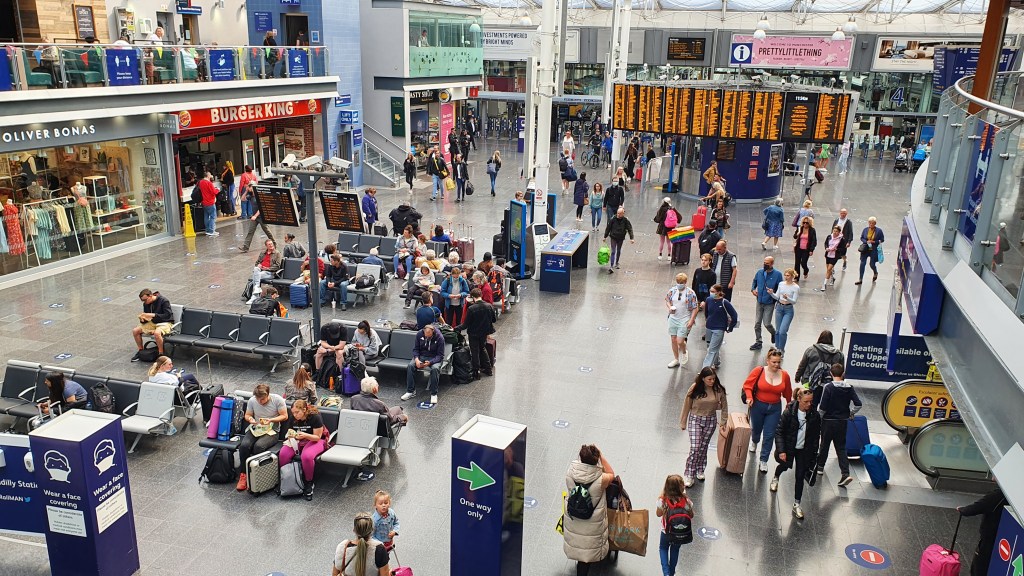
Walking across Manchester from Victoria to Piccadilly was an eye-opener in more ways than one. The city centre was packed! I’ve not seen such crowds since before lockdown. Two things struck me, one was that there’s an awful lot of young people with backpacks about, presumably because the August bank holiday weekend’s well known as the festival season and these events have reopened again. The other thing that stuck me was young women’s fashions, which have changed a lot during the pandemic. The word ‘skimpy’ springs to mind. Maybe it’s a reaction to being locked down and cooped up for so long? On arrival at Piccadilly I didn’t hang around at the numbers of passengers milling around gave me the impression the London train would be busy. True enough, platform 8 already contained dozens of people waiting for the incoming Pendolino that would form the 11:55 service, which I’m sat on now.
Manchester Piccadilly this morning.
13:25.
We passed through one of my old haunts (Rugby) a few minutes ago. I once spent Xmas and Boxing day working trackside here for Network Rail during the ill-fated Rugby upgrade, part of the West Coast Route Modernisation. It didn’t go well. In those days the ‘Sentinel’ scheme which monitored people’s PTS (Personal Track Safety) competencies wasn’t too sophisticated. A lot of the Overhead Line Engineers were subcontractors and many simply never turned up as they’d been offered better money to work elsewhere. Ironically, one of the pictures I took that Christmas is still being used by the media on a regular basis. Those in the know can tell the pictures age as full PPE (including high-vis trousers) wasn’t mandatory.
13:55.
We’re now South of Watford on the way in to Euston so I’m going to shut-down the laptop and blog from the phone…
15:45.
That was an interesting interlude in London. Whilst I was there I checked out progress on building High Speed 2 around Euston. Every time I visit the area’s changed due to more old buildings having vanished or streets moved. Today was no exception. Now the West side of Euston station’s disappeared, including the old signalbox. I took time to get some shots of the work pinning the Western retaining wall which is having rows of ground anchors added to it. You can see it as your train arrives (look to the right). Wandering on through Somers Town to St Pancras I caught a busy Thameslink service to London Bridge, then an equally busy Southeastern service to Waterloo.
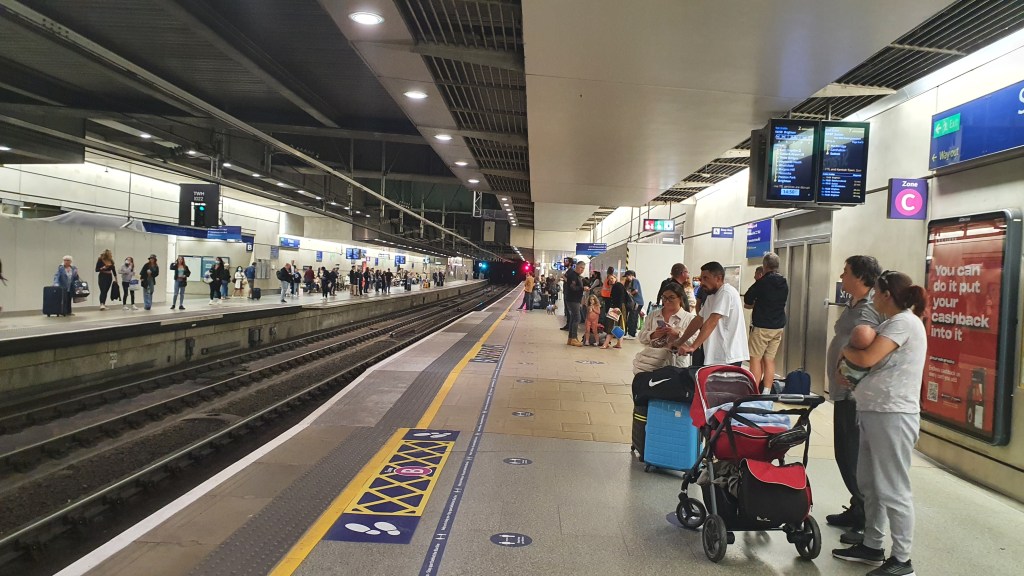
Passengers throng the platforms at St Pancras Thameslink station this afternoon.
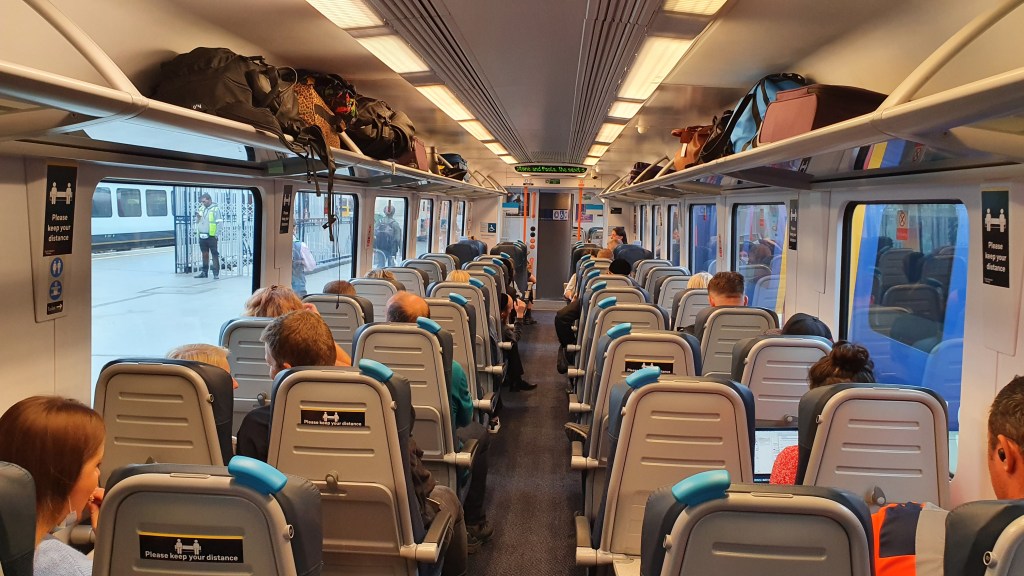
I’m now on a packed 10 car Southwestern train to Woking. Even I’m surprised at how quickly passenger numbers are bouncing back.
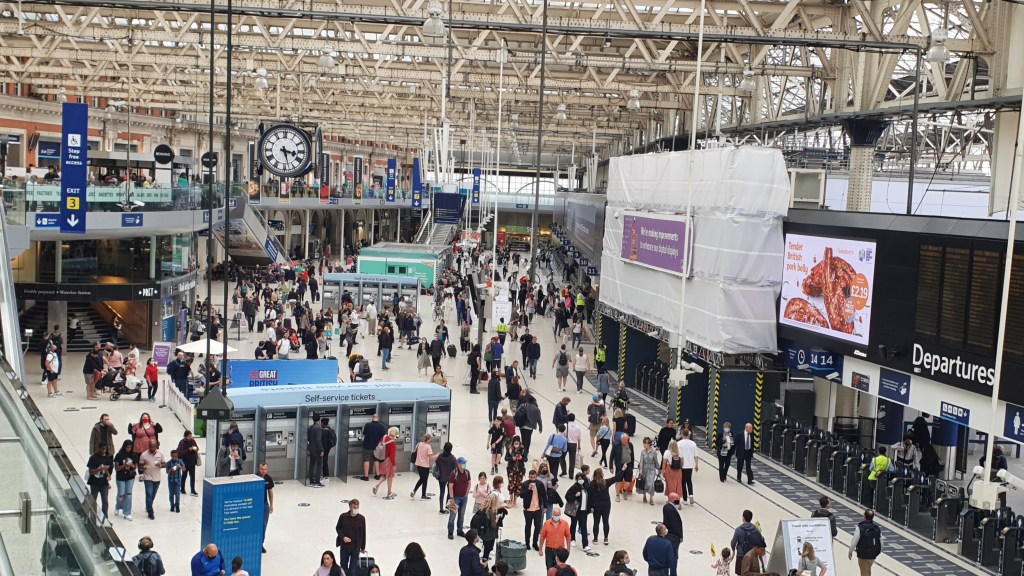
I caught this Poole train as far as Woking where I changed for an Alton service which was less busy but had far more passengers than when I was here in July. The stations have recovered from their slumbers too as shops and cafes have reopened. Here’s how Waterloo station looked this afternoon.
I’ll be very interested to see how the railways look over the holiday as I’ll be heading back North on Bank holiday Monday, which could prove interesting.
22:15
Time to bring this blog to a close. I’m now safely ensconced in Surrey after a busy but enjoyable day. Dawn picked me up from Farnham station and the pair of us have had a lovely evening catching up whilst taking my Brother-in-Law’s dog for a walk along some of the footpaths surrounding Tilford before having night chilling at home in front of the TV – which is why this blog went dormant. I had a night off!
Welcome to a new week. I had it scheduled in my diary as one I’d been spending entirely at home as I had to finish judging entries in three different categories for the 2021 Community Rail Awards. As Dawn wasn’t at work today because she was driving down to Surrey I decided to get up at Sparrowfart, let her sleep and get on with the marking. So, coffee made – I was in the office at 06:30 this morning, reading and annotating the final entries out of the three groups I’m judging for, which meant I was finished before lunchtime. There’s some excellent entries but there’s nothing I can say at this stage – for obvious reasons. Tomorrow my fellow Judges and I come together on ‘Zoom’ to see what we’ve each shortlisted and agree the final shortlist and placings. I’ll be fascinated to see if we near enough have the same people placed!
Having completed my effort and seen Dawn off on her travels I decided to make the most of the sunny weather and escape with the camera for a few hours. There’s a huge amount of subjects on my shot-list, but today I decided to stay local. Well, within Yorkshire anyway! Having walked into Halifax I caught a train to Bradford then walked between the city’s stations to take the long way around to Leeds. On the way I stopped to grab a few pictures at Kirkstall Forge station as the light was ideal. What was less than ideal is the frequency of the stations automated announcements. The station has a half-hourly service, which means there’s several trains per hour that pass non-stop. Not a problem in itself, apart from the fact ‘Digital Doris’ seems to have no idea when they’re due so fills the air with ‘Stand well back from the platform edge, the next train is not scheduled to stop here” every minute. Great, but no train’s due to pass for 7 minutes! I timed them! It’s like the boy who cried wolf. You get so sick of hearing the announcement that you turn off. Then suddenly, a train does whizz past. The old expression ‘less is more’ springs to mind.
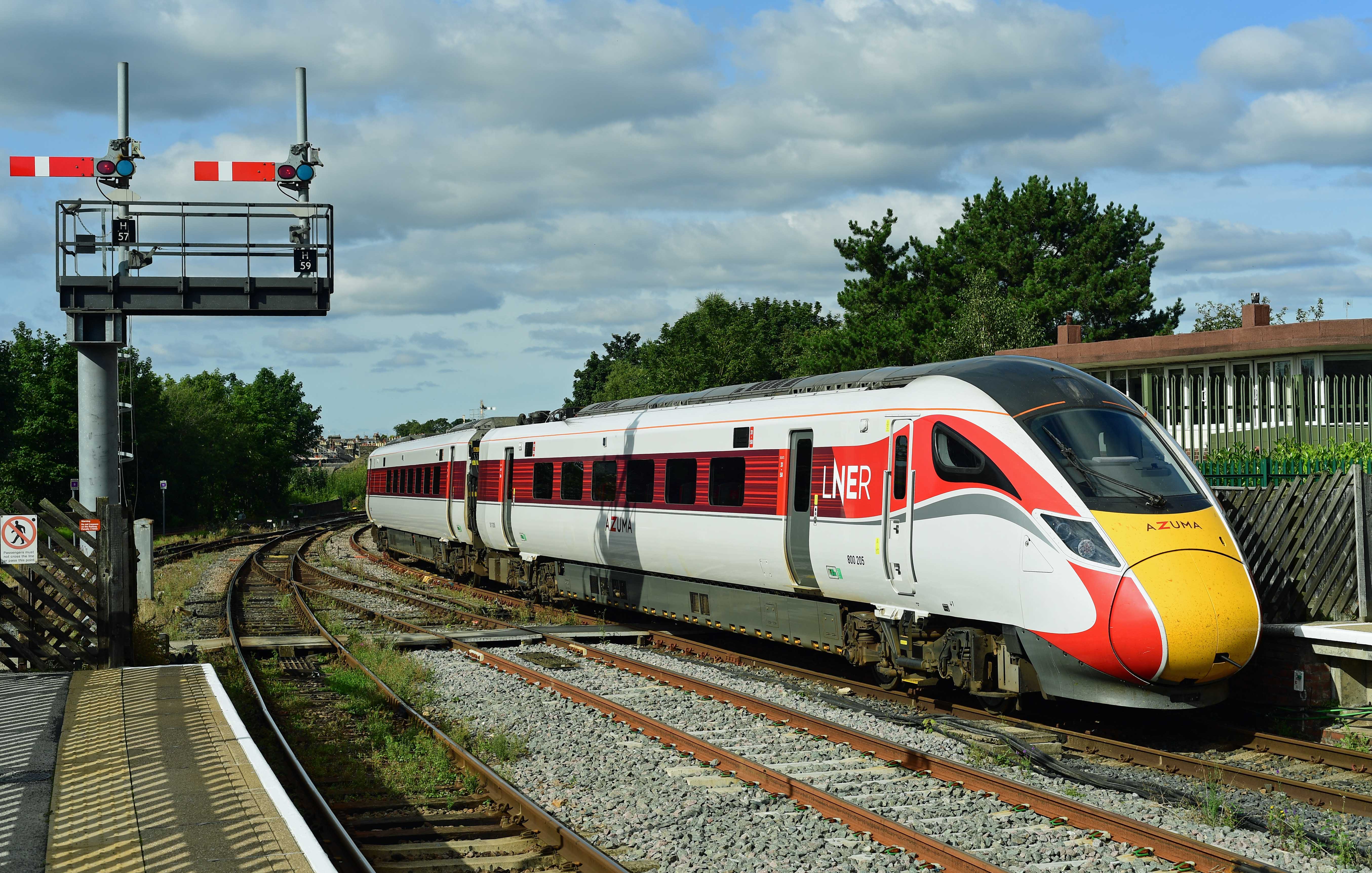
Anyway, gripe aside, I continued my trip into Leeds in time to catch one of the trains I was after. LNER used to have a daily service from Harrogate to London Kings Cross. Essentially it was one out in the morning that would return in the evening. I never managed to get pictures of them, but now the service runs roughly every two hours, so I thought it was time to get this one in the can. Besides, the chance to juxtapose new intercity trains with traditional (albeit a renewed version) semaphore signalling isn’t that common. Here’s one of the shots.
Having worked 1D16, the 1333 London Kings Cross to Harrogate, set 800205 slinks off to the refurbished and renewed turnback siding before returning to London as 1A46, the 1736 Harrogate to London Kings Cross. To the left is a replicated bracket semaphore signal which was installed as it was easier than replacing it with modern signalling as the station’s still controlled from the old BR built signalbox behind the train to the right. The signal has all the aesthetics of a car-crash compared to a (once elegant) LNER lattice structure beyond. The semaphore arms look like they’ve been mounted on standard-length scaffold pole that no-one could be bothered to cut to size or cap-off.
Signalling aside, seeing these units at Harrogate makes a change from the standard diet of ‘Northern’ multiple units , even if they have gone more upmarket since the demise of the ‘Pacers’. Here’s a case in point. this is a shot of 800205’s return working passing an ex-Scotrail Class 170 which has been cascaded to Northern. The pair are seen at Horsforth, the only other station between Harrogate and Leeds that LNER call at.
Right, enough from me tonight. I’ve another early start tomorrow in order to clear the decks for Judging. Depending on how it goes I *may* venture out again tomorrow. If not, there’s still plenty of old pictures to keep you entertained with. So, for now – goodnight…
I’ve a favour to ask… If you enjoy reading this blog, please click on an advert or two. You don’t have to buy anything you don’t want to of course (although if you did find something that tickled your fancy that would be fab!), but the revenue from them helps to cover some of the cost of maintaining this site – and right now (because of Covid), us freelances need all the help that we can get. Remember, 99% of the pictures used in my blogs can be purchased as prints from my other website – https://paulbigland.zenfolio.com/
I’m not used to doing this anymore! I was up at 05:00 preparing to head off for this morning’s job over in Wakefield. Getting up whilst it’s still dark is a novelty nowadays, although the with days getting shorter it’s going to become all too familiar soon. Right now I’m sipping coffee whilst I finish getting my kit together whilst trying not to disturb Dawn and Jet, who’re still curled up in and on a warm bed it was hard to leave! Still, let’s see what the day brings, eh?…
07:10.
I gave myself plenty of time to walk to the station so that I could enjoy the trip without breaking into a sweat. Hardly anyone was about except for a few dog-walkers and the odd early-bird like me, which made made for a pleasent trip where I could enjoy the birdsong rather than the noise of traffic.
Halifax station was rather different. It’s much busier than I’ve seen it at this time of day for quite some time. Many folk are waiting for the Grand Central service to London which is good to see. As an open access operator GC had a terrible time during the pandemic. Unlike the franchises, they receive no government support, leaving them totally reliant on ticket sales. This left them no option but to suspend operations for several months. Now they’re bouncing back. This service was a lifeline for me when I moved from London to West Yorkshire and I’ve got to know many of the staff so I’m really happy to see them recovering.
07:25.
When we pulled in to Brighouse it was great to see a few dozen people waiting for our train. This really is starting to feel like the ‘old days’! The station platforms are looking very attractive right now as the planters maintained by the local station friends are looking resplendent. The local history boards on each platform added earlier this year add another nice touch.
07:31.
We’ve picked up well over a dozen people at our next stop (Mirfield). Most look like holiday makers – the people who’ve been returning to the railway in droves..
08:45.
Wakefield Kirkgate also held droves of passengers waiting for us. As I degraindd I bumped into Alan, an old friend from Grand Central. We had time for a quick chat (he confirmed my suspicions about passenger growth) before I wandered off to my job. I’m there now, soI’ll be offline for a few hours. Catch you later…
11:45.
I’m back! I’ve spent a couple of hours taking staff portraits for a rail industry magazine and now I’m back on the rails at Wakefield Kirkgate, a station I once christened Britain’s worst. But look at it now!
Even the area outside the station’s been brightened up as the derelict pub has been rebuilt for residential use. Sadly, the excellent little station cafe remains closed, but Alan informs me it’s due to reopen next month.
14:00.
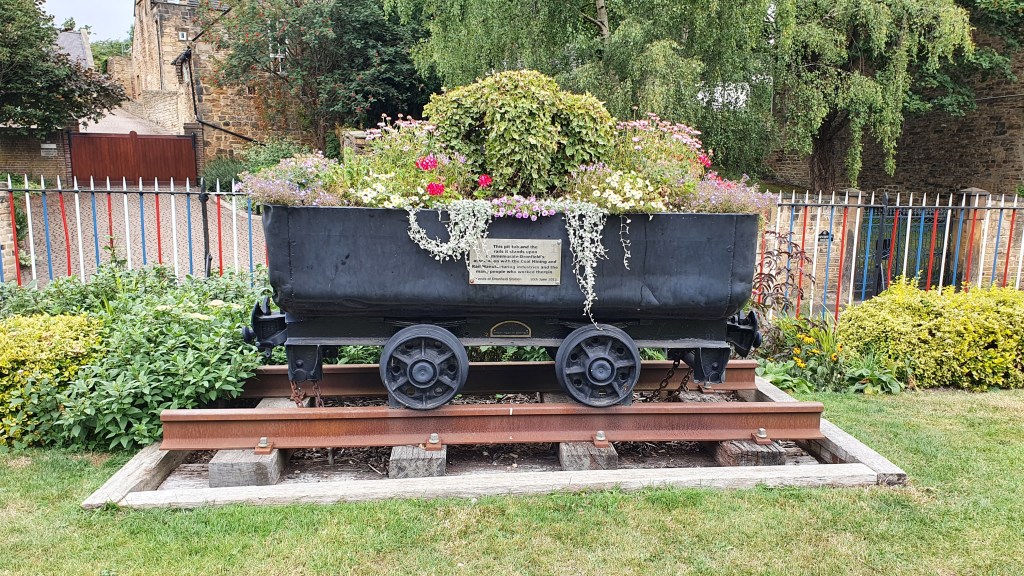
I’m currently taking a break in Sheffield as the warm and sunny weather I enjoyed in Wakefield is being disturbed by a band of rain crossing the country. I’d headed down this way to visit a station that I’ve not been to for several years but was on my list due to the excellent work the local station friends group has done on keeping it attractive whilst also explaining the area’s industrial heritage with history boards. There’s an lovely old tub wagon in the garden outside with celebrates the history of mining and steelmaking. What I never knew is that the pretty village was once *the* centre for making rails for the railways. The Wilson Cammell works opened in 1873 and became the foremost rail making plant in Britain, exporting worldwide. Then, in 1882 the decision was taken to move the plant wholesale to Workington in Cumbria (where I was last week) which led to the industrial decline of the village.
Having had time to explore the village in-between trains I can safely say it now earns its money from three less than industrial sources. Cafes, boutiques and hairdressers!
18:00.
That was an interesting few hours – although most of it was governed by the weather. I headed back to Sheffield with half a mind to traverse the Penistone line as there’s pictures I need, but the weather defeated me. Instead I made a sideways move to Doncaster where conditions were more condusive. As always, there was a large contingent of railway enthusiasts adorning the platform ends or camped out under the canopies using camping chairs. Such a number of people used to be common at major junctions a few decades back but Doncaster is now one of the last bastions.
Ironically, I bumped into two people I knew purely by accident, although one was rail-staff rather than a platform-ender.
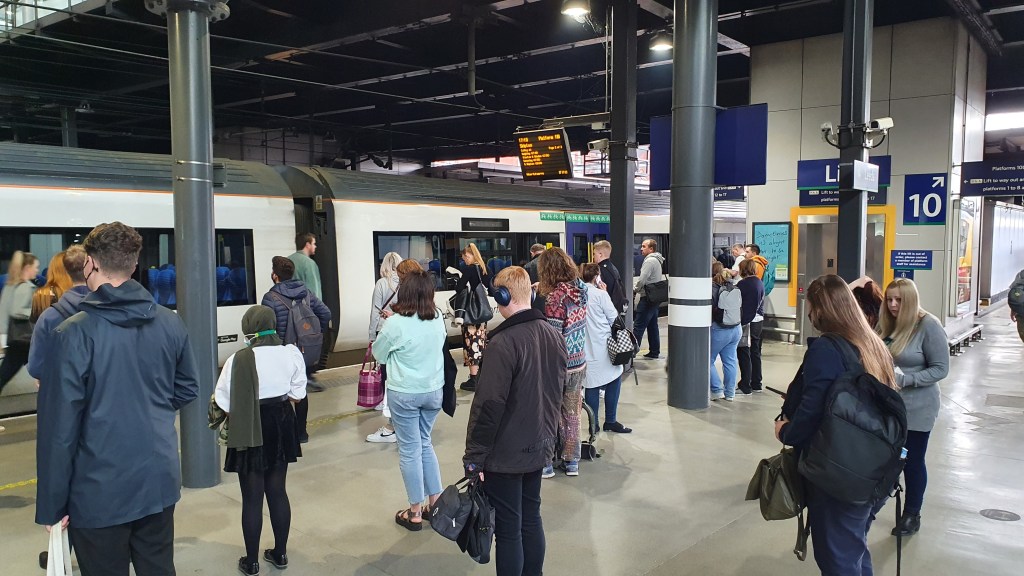
Moving on again I headed home via Leeds in order to see how the rush-hour’s shaping up. The answer? Well. It’s the busiest I’ve seen the station since before lockdown. There was a real mix. Commuters on their way home mingled with people having a night out or returning from shopping. The feeling of vibrancy that’s been missing for so long was back. The only thing giving away thd changed times was the amount of folk still wearing masks (including me)
21:30.
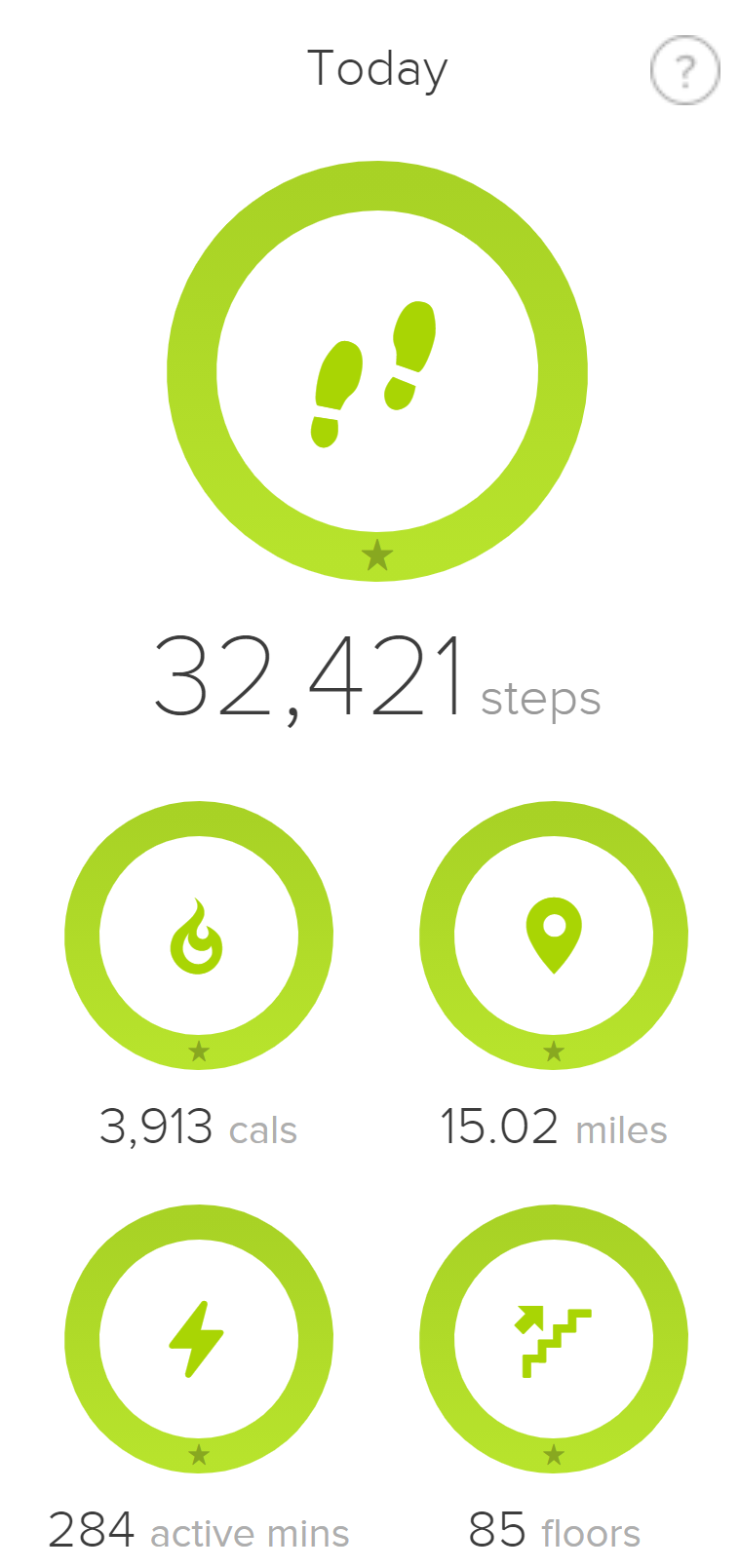
Time to draw this rolling blog to a close. I’ve finally made it home after walking just over 15 miles today – including a minor detour via our local pub. Well, after covering that distance with a camera bag on my back I thought I deserved it! Especially when you consider that this part of the world isn’t exactly level. The caps might be flat, but bugger all else is – as my Fitbit stats demonstrate.
I’ll be back working from home tomorrow as I’ve a shedload of pictures to process. I’m sure there’ll be a blog involved too as I’ve plenty of new ammunition for ‘picture of the day’. In the meantime, enjoy your day/night/morning!
I’ve a favour to ask… If you enjoy reading this blog, please click on an advert or two. You don’t have to buy anything you don’t want to of course (although if you did find something that tickled your fancy that would be fab!), but the revenue from them helps to cover some of the cost of maintaining this site – and right now (because of Covid), us freelances need all the help that we can get. Remember, 99% of the pictures used in my blogs can be purchased as prints from my other website – https://paulbigland.zenfolio.com/
Lat week HS2 Ltd released their corporate plan. Running to 76 pages it details the progress on the project so far and the key milestones which will be achieved over the next few years as construction of the new railway ramps up. It’s a great reality check to the manufactured media spin and speculation that we’ve been seeing over the past few days in advance of the September 13th non-event where a few MPs will debate HS2 in a room in Westminster Hall – with no vote at the end of the talking shop!
I’ve been reading though the report (which you can read here) to bring you the highlights. Right from the beginning the report acknowledges the impact of the global pandemic has had when it says “Inevitably, Covid-19 has had an impact on schedule, cost and productivity but the programme remains on schedule” – which is good news! Having personally visited two of the main construction sites (at Calvert and South Heath) I can attest to the lengths HS2 Ltd and its Joint-Venture construction partners have gone to in order to ensure a Covid-free workplace and the difficulties and expense this has led to. The challenges were especially strong in London, where most workers would be using public transport to/from work. Thankfully, all these challenges are now subsiding.
There is another challenge mentioned that may people would rather ignore. Brexit. Whilst the first two multi-million pound Tunnel Boring Machines (TBMs) were imported from Germany before January 1st 2021 (saving time and import duties) another 8 are yet to arrive. There’s no doubt our new relationship with the EU (being outside the single market and customs union) will add costs to HS2.
Moving on, the report mentions another significant milestone that’s already been achieved. Piling work has started on one 3.4km long Colne Valley viaduct. Over the next year, 292 piles will be sunk, some as driving as deep as 55 metres into the ground to support the viaduct. Initially, engineers sank 12 piles at two locations and used the geological and structural data to refine the design of the viaduct. This has allowed them to reduce the depth of piles by 10% to 15%, saving time, money and Co2 emissions. The viaduct piers and sections will be built at the HS2 site at South Heath and the factory for making them is currently under construction. Construction of the viaduct itself is expected to start in the second half of 2022 with the superstructure complete in late 2024.
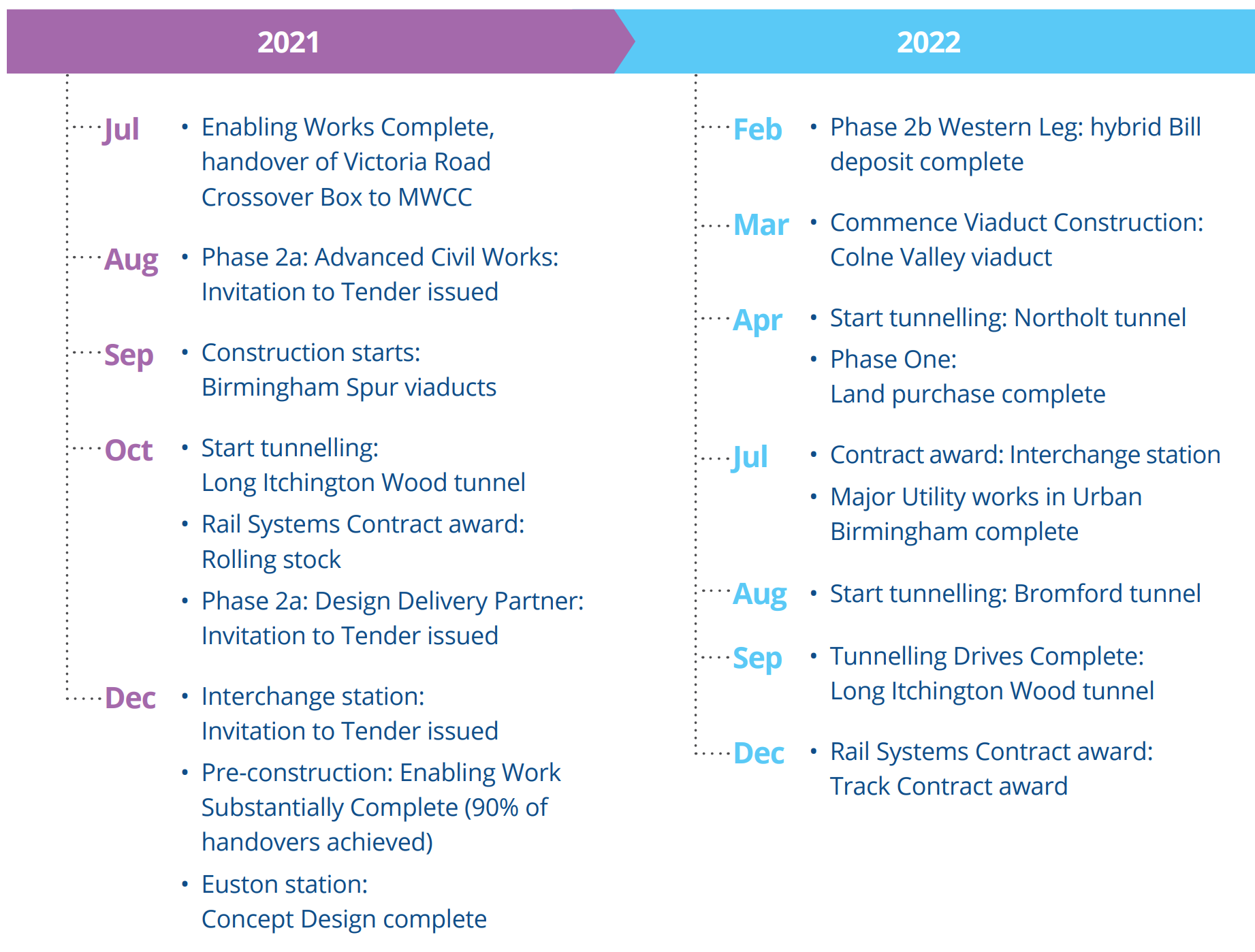
The report contains a handy graphic outlining the time table for the next few years. Here’s 2021-22.
As you can see – there’s an awful lot going on! There are other works which have only recently started that haven’t been mentioned. For example, at Wendover construction of the cuttings and other major earthworks at what will be the North portal of the Chiltern tunnel began this month. Of course, work still continues at other sites such as Calvert, where East-West rail crosses HS2.
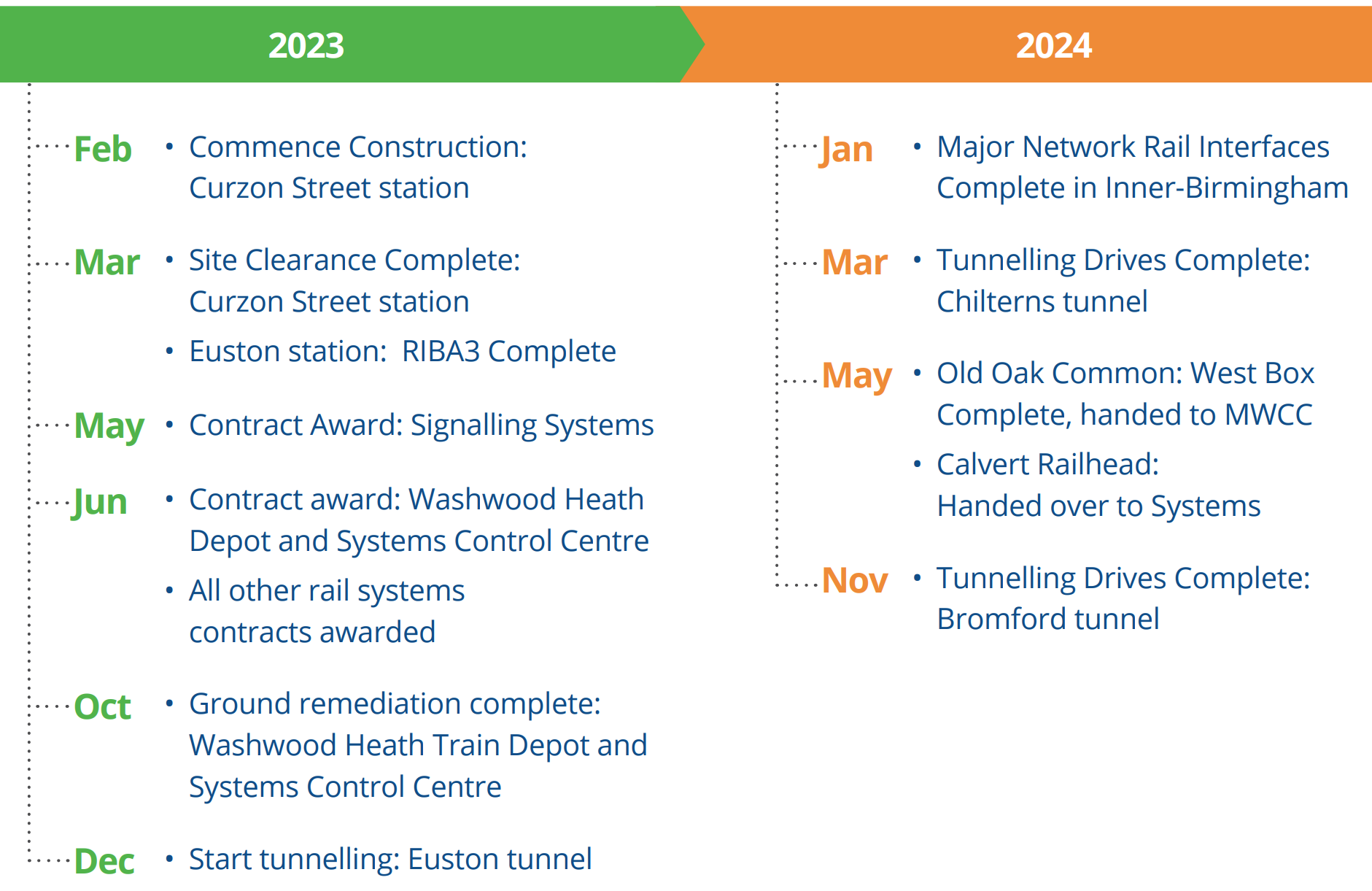
Here’s the 2023-24 time table.
The update does highlight one area of concern – Euston station. It says this on page 34;
“Following the DfT’s instructions in November 2020, we have been exploring design options to reduce cost and speed up delivery by building the station in a single construction stage. This includes considering options to reduce the number of platforms at Euston from 11 to 10 while maintaining 17 trains per hour (tph) operations for the full Phase Two service. If this design option is adopted, the station construction programme will become a single-stage build, reducing the impact of our works on local communities”.
Whilst speeding up the delivery of redevelopment of the Euston site, reducing the number of HS2 platforms is seen by many people (including myself) as a retrograde step that sacrifices the long-term operational future of HS2 for short-term expediency. I would really hope this temptation is resisted. The good news is that the decision doesn’t appear to have been made. Yet…
The report has more to say about Euston.
“MDJV has started work on-site preparing for early works and has completed installing the first 161 piles for the station’s west wall. Enabling works will continue to the end of 2023. Network Rail will undertake demolition works on the Euston conventional rail station through to the end of 2025. This will allow the construction of the east side of the HS2 station. Following the enabling works and design, the main station construction will start in spring 2023 with piling and excavations works”.
There’s more…
“Work on the 4.5 mile Euston tunnel, which will be built up to 50 metres underground, is scheduled to begin in early 2024 and be completed in mid-2025”
But it’s not just tunnels in the centre of London. The report mentions work at West Ruislip, saying;
“West Ruislip will be the first site to launch tunnel boring machines (TBMs) in London. The machines will be assembled at the end of 2021 and launched in 2022, travelling five miles east to create the western section of the Northolt tunnel. Piling works at the site have been progressing well, with the second piling rig installed in April this year. A base slab for the TBM launch will be created in the autumn and the launch portal is due to be complete by the end of 2021”.
Delivery of the new station at Old Oak Common is discussed (pages 38-41) and one particular piece caught my eye, which was the section on Co2 emissions.
“The roof covers an area larger than three football pitches and will be mounted with 3000m2 of solar panels to generate green energy for the station. Together with a number of sustainable design and construction innovations, the solar panels will allow us to cut the station’s emissions by more than 144,000 tonnes of CO2 equivalent across its 120-year design life compared with the original designs”
This puts into perspective opponents dishonest claims that HS2 won’t be carbon neutral for 120 years. This claim (based on a 60 year rough calculation of HS2 Phase 1 from 2011) has been completely overtaken by detailed design work and a continual focus on reducing the Co2 produced in the building and future operation of HS2.
The report has some interesting things to say about the 50 mile rural section of the route being built by EKFB which includes Calvert. There’s this insight into the haul-road system.
“As this stretch of HS2 mainly runs through the countryside, the closest existing access to the route is often via minor roads through villages. Our construction team developed the concept of building a temporary access road to join up the whole 50-mile (80km) section. We are building a hard-surfaced road, with standard road signs and traffic lights, instead of a traditional earthworks haul road to reduce dust and noise and take traffic off local roads. The internal access road will be used to move people and materials and provide more efficient vehicle movements, cutting emissions, energy use, dust suppression measures and maintenance costs. Some sections of the internal access road will be removed when the site footprint is reduced but others could be retained for rail maintenance, farm access, or as a cycleway”.
On pages 55-57 details are given of another tunnel further North on the route – at Long Itchington.
“We started excavating the TBM launch portal at Long Itchington in April 2020. This involved 120 people and was completed in February 2021.
The first components of the 2,000-tonne variable density slurry TBM arrived in December 2020. The TBM is set to launch from the north portal in the autumn and is planned to break through about six months later. It will be extracted at the south portal ‘reception’ box, which is under construction, before being transported by road back to the north portal for the second bore. We plan to complete tunnelling in summer 2022. The north portal is also the site of the slurry treatment plant, which was built in six months. It will be used for processing the spoil excavated by the TBM so it can be reused for landscaping for HS2. At the south portal, we have started building the diaphragm walls for the green’ tunnel which will be about 160 metres long and forms the final section of the Area North scope before linking into the works by EKFB. The ‘green’ tunnel will blend into the landscape and be completed next year”
There’s also news of a tunnel extension and other green initiatives on page 58 that show how the detailed design work that continuing to be developed throughout the project means it’s always evolving.
“It is proposed that a second twin-bore tunnel, the Bromford tunnel, near Birmingham, be extended by 1.4 miles (2.2km) to 3.6 miles (5.8km) to run next to the M6 between Water Orton and Washwood Heath. Extending the tunnel has ecological benefits as it will reduce disturbance to Park Hall Nature Reserve. It will also take up to 250,000 lorries off roads in Birmingham city centre. Earthworks and enabling works started in February 2021 at the east portal, from where the TBM will launch. It is due to start its first ‘drive’ in August 2022 with the breakthrough expected a little over 12 months later. To overcome constraints at the tunnel’s western end, the TBM will then be returned to the east portal for the second tunnel.
We will start setting up piling platforms and the batching plant for the 522-metre Burton Green tunnel in Warwickshire, the shortest on the Phase One route, in October 2021. Piling works are set to begin in early 2022. This ‘green’ tunnel involves a cutting being created in the ground before a tunnel ‘box’ is built inside it. The space around the box is then filled to create an area of land on the surface. We have revised the design of the railway through the Canley Brook area, near Kenilworth, so it will travel in a slightly shallower and longer cutting. A viaduct can be built over the brook, reducing the diversion of the river from 700 metres to just 80 metres. This means we will excavate 600,000 cubic metres less earth and save 28,000 cubic metres of concrete by removing the retaining wall for the Canley Brook realignment. Less excavation and building work will cut the number of lorry movements by 2,500. Avoiding a major realignment of the waterway will help to preserve the home of otters and bats and we plan to create a wetland habitat either side of the realigned section of the brook”.
Page 59 contains this insight into the initial HS2 Phase 1 train timetable.
“Initially there will be at least three trains per hour between Curzon Street and Old Oak Common, which will act as the temporary London terminus for HS2 pending the completion of Euston. We are working with the DfT to assess whether a maximum of up to six trains per hour could be operated from Old Oak Common”.
The timetable for construction of Curzon St station is also discussed.
“We will build on the design vision as we work with Mace Dragados to agree a target price and we expect notification of Stage 2 in mid-2022, signalling the start of the detailed design and construction of the station. Construction activity will step up from summer 2022 to 2024 as we set up a site compound and start extensive works including excavation and piling. We will need to hit the key dates for the delivery of Curzon Street to make sure other contracts for the high-speed railway remain on schedule. Elements of the station building need to be completed by the end of 2025 to allow the Rail Systems team to access the station from January 2026. The station is currently scheduled for completion in 2028”.
Reducing the Co2 footprint is also mentioned.
“Revisions to the original designs for Curzon Street mean we will reduce carbon emissions by an estimated 55% during the ‘whole life’ design of the station and we will achieve net zero carbon emissions from regulated energy consumption. We will cut the station’s emissions by more than 87,000 tonnes of CO2 equivalent – similar to removing the emissions of more than 10,000 houses”.
Moving on to Phase 2a between Birmingham and Crewe the report has this to say (page 64-67). I’ve gone into detail here as people don’t always understand that much about what’s being built on this phase of HS2.
“Our goal to deliver HS2’s national benefits as quickly as possible was boosted by Royal Assent for the Phase 2a hybrid Bill, achieved in February 2021. Activity is now ramping up along the 36-mile (58km) route connecting the West Midlands and Crewe, clearing the path for the railway in readiness for the start of main construction work in 2024”.
The report mentions a new approach on Phase 2a than 1. Early Environmental and Civils contracts are being let to speed up construction.
“Our new model also includes two early civils work packages. Early Civils Work package 1 (ECW1) includes two major junction improvements in Staffordshire at M6 Junction 15/A500 (Hanchurch Interchange) and the widening of Wood End Lane/A515 Tewnalls Lane near Lichfield for construction traffic. Early Civils Work package 2 (ECW2), due to start in Q4 2021 and valued at £50 million, will be awarded via the Government’s Construction Works and Associated Services framework. ECW2 includes a range of enabling works such as major highways work, utility diversions and a new bridge over the M6 near to Stone. This work will take place alongside environmental and other surveys. The package represents HS2’s first major civils work north of the West Midlands and will help us accelerate delivery as we build towards the handover to main civils construction in 2024″.
Page 62 contains a schedule for and details of the mains civils work to Crewe.
“We will start major earthworks in spring 2024, excavating cuttings and building embankments. The main civil engineering works include the IMB-R, 17 viaducts, 26 cuttings, 36 embankments and 65 bridges. We will build two twin-bored tunnels, totalling about 1.2 miles (2km), at Whitmore and Madeley. A short section (about 200 metres) of the southern part of the Whitmore tunnel will be a cut-and-cover or ‘green’ tunnel. The TBMs are set to be launched in 2025 and will tunnel from south to north. Both tunnels will have porous portals to control noise and make sure there is no adverse effect on the surrounding area as trains exit the tunnels. Both tunnels sit high in their respective hillsides and require significant works to secure access to start the building. Other significant structures include the River Trent and Kings Bromley viaducts which stretch for about two miles (3.5km) through flood plain and are separated by a large embankment. The Great Haywood viaduct spans the Colwich to Macclesfield line, the River Trent and the Trent and Mersey canal. It requires significant temporary works including a 230 metre temporary access bridge to allow articulated dumper trucks to pass over the rail and waterways to build the viaduct.
The River Lea viaduct sits in a valley between the two tunnels and has to span the WCML and Silverdale branch line. This will require two temporary crossings of the WCML for construction. The landmark Meaford viaduct will cross the M6 just north of the IMB-R. The three-span structure includes a 130 metre span over the motorway. The viaduct will be built off site before being transported into position and will be one of the most visible structures on the Phase 2a route. The complex spurs and main line which gives HS2 connection into Crewe station and onto the conventional rail network require major engineering, including a diversion of the WCML. The portal for the Crewe tunnel will need to be constructed at the same time due to space constraints with the tunnel being built as part of Phase 2b, subject to Parliamentary and government approval.
Following the completion of the track bed, we will install the railway systems, including slab track, signalling and the power supply. Testing and commissioning is expected to take place over two years from 2029 to 2031. Testing will start at the southern end of the Phase 2a route to allow us to test the train operating systems at the earliest opportunity. The route does not feature any new stations and the Phase 2a trains are part of the classic compatible fleet that will be shared with Phase One. The total estimated cost range for Phase 2a is £5 billion to £7 billion and the funding range will be finalised alongside the construction works delivery model.
So, on to Phase 2b. What’s the plan? Well…
“In line with the Government’s instructions, we are continuing to develop a hybrid Bill for the Phase 2b western leg, extending the railway from Crewe to Manchester with a connection to the West Coast Main Line (WCML) south of Wigan. The western leg will allow HS2 trains to serve destinations including Preston, Carlisle, Liverpool, Edinburgh and Glasgow”.
This means the Golborne spur South of Wigan is still very much part of the project. Despite local opposition claiming it’s ‘unnecessary’ the spur provides a relief route to the the heavily used two track section of the WCML at Weaver Junction where the Line to Liverpool diverges and also by-passes Warrington with its freight yards, junctions and congested station.
In his recent briefing to the Transport Select Committee Mark Thurston stated he expects the Phase 2b Hybrid Bill to be submitted to Parliament in February 2022. I won’t go into detail about what the 2021-24 report says about Phase 2b to Manchester and Wigan as plans could change once the Bill starts its journey through Parliament and the Petitioning process begins. However if you want to read about it, check out pages 66 and 67 of the report.
I hope this has been a useful insight into how things stand with HS2 now.
Cheers,
Paul
I’ve a favour to ask… If you enjoy reading this blog, please click on an advert or two. You don’t have to buy anything you don’t want to of course (although if you did find something that tickled your fancy that would be fab!), but the revenue from them helps to cover some of the cost of maintaining this site – and right now (because of Covid), us freelances need all the help that we can get. Remember, 99% of the pictures used in my blogs can be purchased as prints from my other website – https://paulbigland.zenfolio.com/
Well, the new week certainly dawned – and it wasn’t a bad one too! In fact the weather here in the Calder valley’s been far sunnier than expected, although someone seems to have forgotten it’s still August and dialed-down the temperature to an October setting! I can’t really complain as most of my day’s been spent staring at a computer screen in order to finish editing all last weeks pictures from my Cumbrian trip and get them on my Zenfolio website. You can find the full selection and which galleries they’ve been added to by clicking on the ‘recent’ button, here’s a shortcut that will take you straight to it!
I’ve another day planned where I’ll be chained to my desk again tomorrow, but as the weather’s meant to be wet I’m hardly going to complain. There’s no shortage of pictures to scan, paperwork to shuffle, blogs to write or trips to plan. Hopefully I’ll be out and about again by Thursday.
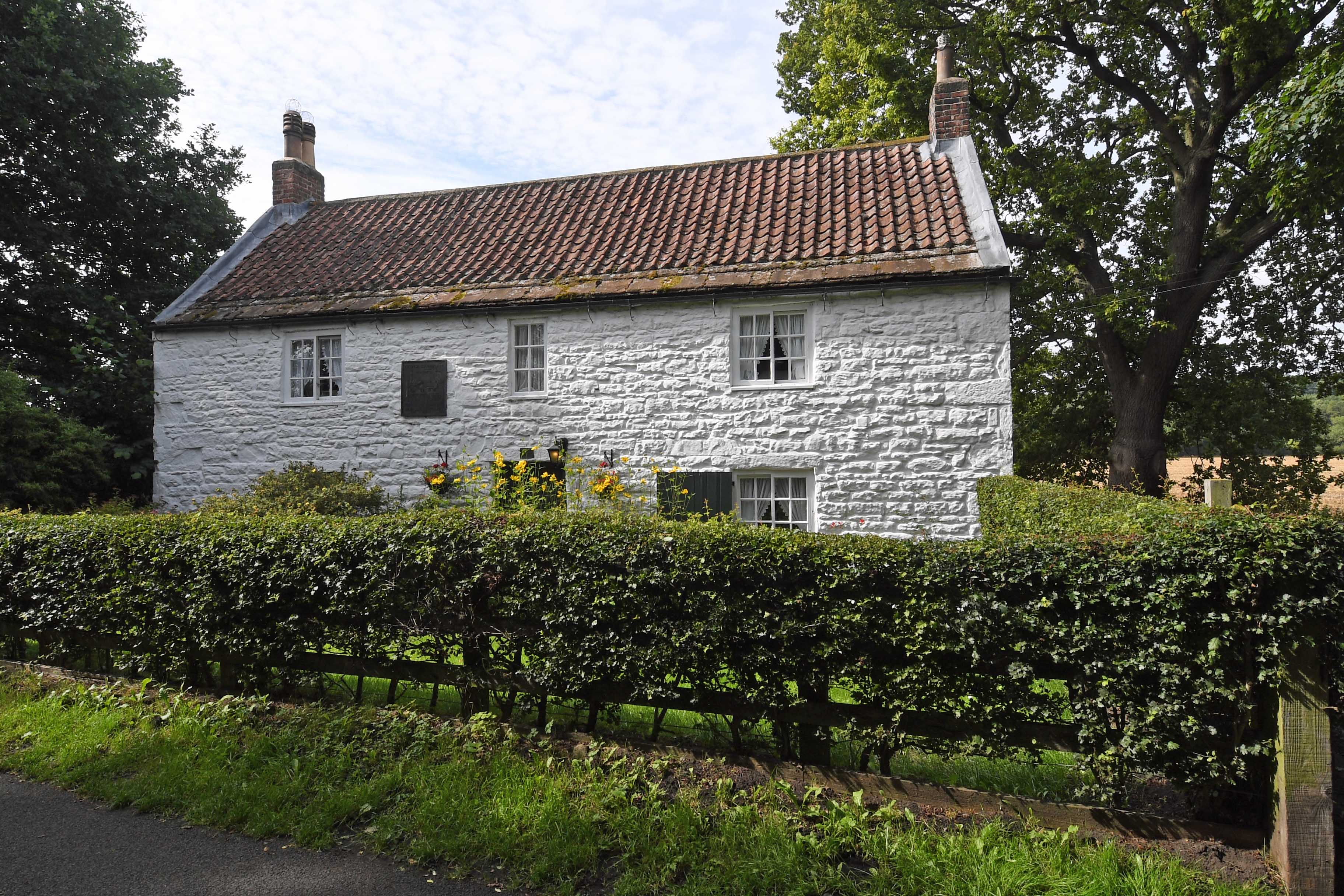
In the meantime, here’s the picture of the day, which I took last week. It’s of an unassuming house on the outskirts of Wylam on the Tyne valley. The Wylam waggonway (an early railway) ran past the front of the house, right where I was standing to take the picture.
What’s special is not the house but the person who was born there. On the 9th June 1781 a boy was born to Robert and Mabel Stephenson, they christened him George. George Stephenson became famous as the ‘father of the railways’ – not bad for a child born to illiterate parents who was unable to read and write himself until he was 18! Yet he became world famous as a civil and mechanical engineer. His son Robert (born on the 16th October 1803) followed in his footsteps and the father and son team helped railways conquer the world and the industrial revolution to change the face of Britain.
I’ve a favour to ask… If you enjoy reading this blog, please click on an advert or two. You don’t have to buy anything you don’t want to of course (although if you did find something that tickled your fancy that would be fab!), but the revenue from them helps to cover some of the cost of maintaining this site – and right now (because of Covid), us freelances need all the help that we can get. Remember, 99% of the pictures used in my blogs can be purchased as prints from my other website – https://paulbigland.zenfolio.com/
Back in February this year I was asked by RAIL magazine to write an article on the Platform 1 charity based at Huddersfield station. They do some fantastic work helping men who’re struggling. I’m reproducing the article on my blog as I think it’s important the work they do gets to as wider an audience as possible…
If you’ve ever travelled from Huddersfield to Manchester by train you may have noticed an old BR coach half-hidden by fencing just as you pull out of the station. Once home to the Association of Community Rail Partnerships (ACoRP, now Community Rail Network) the site has had a new occupant since 2018. It too is about community, but the services it offers are very, very different…
The compound is now the base for ‘Platform 1’ – a mental health and crisis charity that specializes in helping men. As the banner over the entrance to the yard proclaims it’s a place where men can ‘fix, grow, build or chill’. As anyone who’s ever had to engage with Mental Health services will know, it’s a ‘cinderella’ arm of the NHS, and men especially can find themselves unable to find the help and support they need, hence the importance of charities like ‘Platform 1’.
Having talked to the charity’s Project Manager Bob Morse on the phone a couple of times I arranged to visit the yard to see the work the group is doing and talk about how the Pandemic and Lockdown had affected them and the people they help.
Bob greeted me at the entrance to the site which is adjacent to the ‘Head of Steam’ pub. It’s very eerie to see the Grade 1 listed station so quiet nowadays. A station that has a footfall of 4.7m a year is reduced to a virtual ghost-town. Bumping elbows in greeting, he gave me a tour of the site which contains a ramshackle mixture of second-hand portacabins, a shipping container, raised vegetables beds and bicycles. Lots and lots of bicycles!
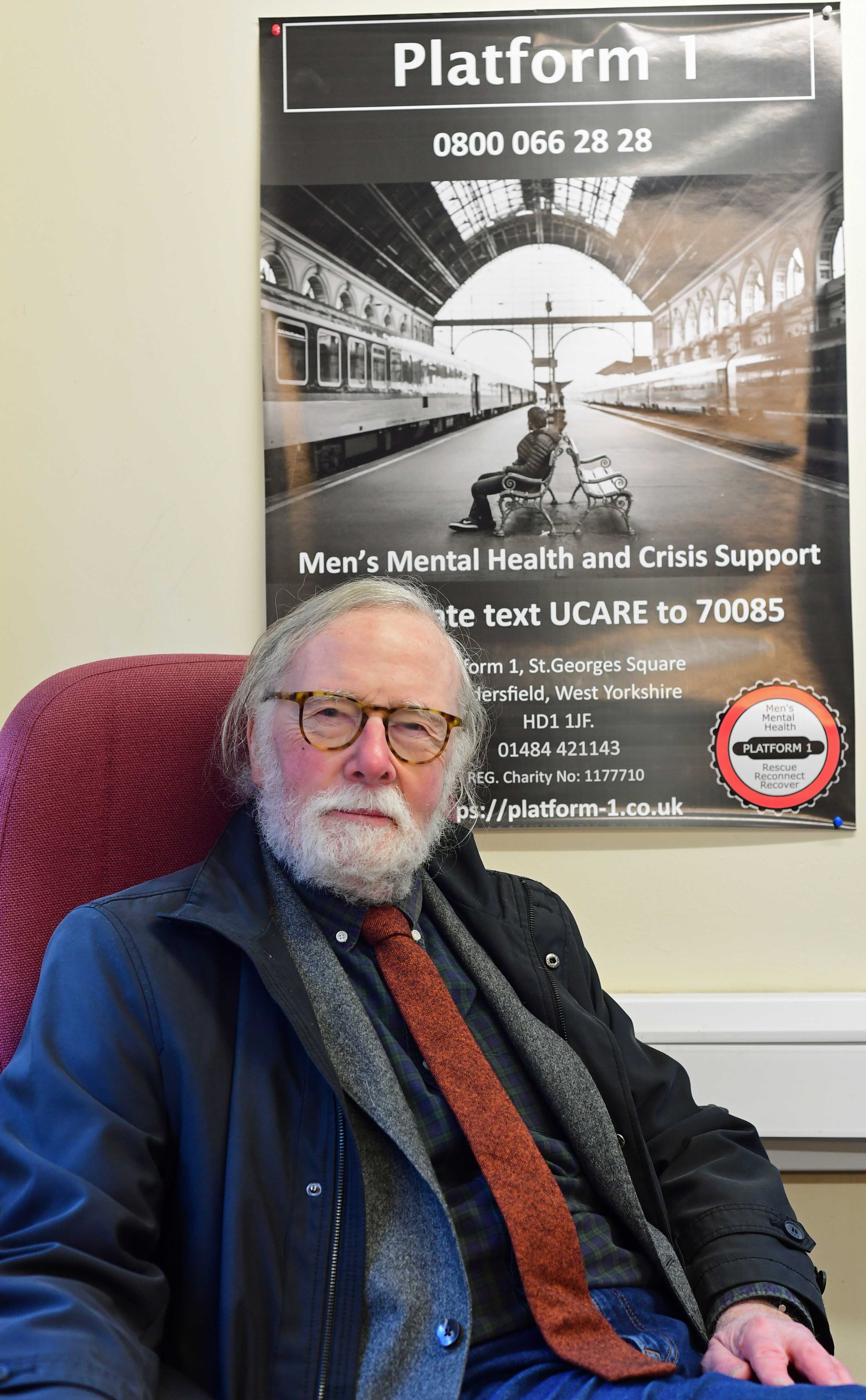
Bob Morse in the portakabin that serves as the main office.
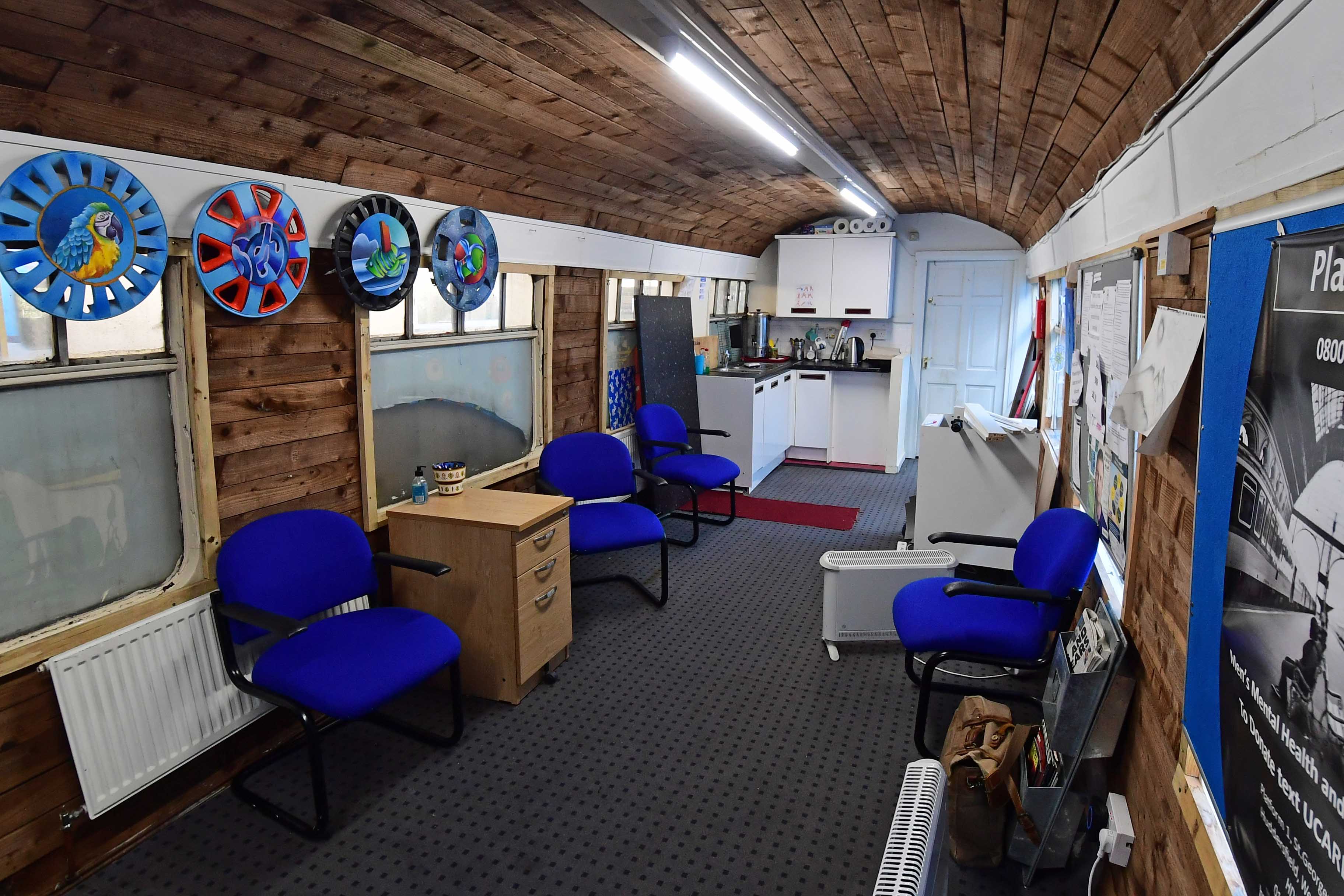
Our first stop was at a tiny two-roomed building that’s used for interviews with people who want to be able to talk privately about the problems they’re experiencing. As access to the site is by appointment only due to Covid it was virtually deserted except for staff and volunteers, as was the old coach where we sat for a (socially-distanced) coffee and chat. Lined with wood planking and fitted with a small kitchen it’s decorated with old hubcaps that have been decorated by a local artist who visits the project. The coach is ‘cozy’ but as the Mk1’s now on its 3rd incarnation it’s seen better days…
Bob explained that pre-pandemic they might see 30 men a day using the vehicle as a refuge where they could chat, read, play computer games, drink tea or just enjoy the company of other people “No-one who comes here is judged” Bob said, “This is neutral ground, they can leave their problems at the gate and be themselves whilst they’re here. There’s no expectations of them. You’d be surprised at the way guys from different backgrounds and educations mix and treat each other”.
The old railway carriage that was formerly the office of the Association of Community Rail Partnerships (ACoRP). Now renames Community Rail Network they occupy the old water tower at the opposite end of the station.
I asked how Covid had affected the charity. Bob told me “the need for our services has exploded as people’s isolation has grown. There’s a ticking time-bomb of mental-health issues out there that’s mostly hidden”. Previously, Bob had previously mentioned that they had 14 clients on ‘suicide watch’ (where volunteers make regular contact with the men involved). “There’s 15 right now, and we lost one last week”. It’s a horrific statistic but it’s clearly only the tip of the iceberg. As well as providing a safe space the charity offers counselling and help with what seem like simple things but to people under pressure they can appear mountainous. Bob elaborated, “we help a lot of people make and keep hospital or other appointments. Some clients aren’t computer-literate or don’t have phones. Others can’t understand why they have to wait so long to see someone and that an appointment doesn’t always mean they’ll get the help they need in the time they need it, which means they just give up. How do you explain to a man who can’t see past tomorrow that they’ll have to wait weeks to see someone?”
Covid has magnified the problem as many ‘contacts’ with social and health services aren’t in person but by phone which increases misunderstandings and feelings of isolation. Because of this, Bob and his team are spending more time reaching out to people who can’t just drop in anymore. This outreach work is a mix of phone calls, ‘Zoom’ and also home visits as well as looking out for the homeless, a phenomenon that’s grown in the austerity years.
The sheer variety of their work caused me to ask if they were seeing different types of people now? “Yes, we’re counselling more and more people who work in the Health Services, including women. We’re also getting more referrals from primary care networks, not just people coming in off the street” The charity’s recruiting new volunteers to cope with the demand and whilst they do get donations and assistance from local companies and the rail industry it’s clear they need more help, both financially and in kind – especially now due to Covid and their role in supporting the support workers – a role they never expected to have to fulfil.
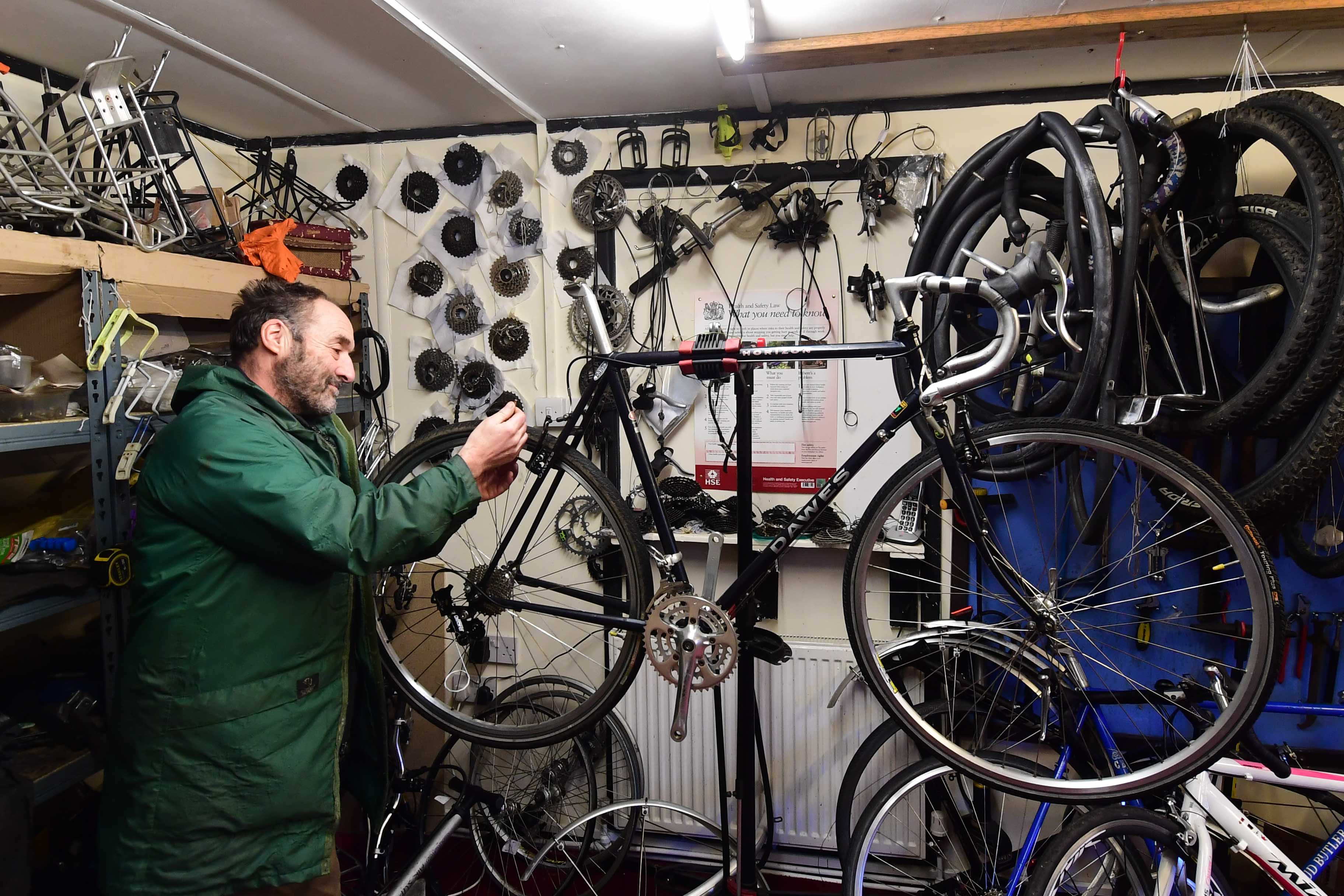
Moving on, Bob introduced me to the 3 man team in one of the cabins which forms the cycle hub. Here, old bikes that have been donated to the charity are stripped for spares or rebuilt and sold. The sheds walls and shelves are a mass of tools and bike spares. Two bikes were in the course of being rebuilt. I chatted to a former cycle magazine editor who was busy repairing one machine. Like many volunteers he’d had his own mental health battles but used his skills and the charities support and facilities to aid his own recovery whilst also helping others. During our chat he explained that whilst they reuse as much as they can some parts like chains or gears have to be purchased which is getting harder and more expensive due to Covid, and Brexit. I also discovered the charity does bike servicing and contract repairs for companies. On another stand Shane was occupied repairing a kids bike. He told me that the bikes are resold for anything from £20-£200 depending on type and quality, which helps low-income families as well as the coffers of the charity. Kids bikes are a staple as they’re often discarded as children grow up and they’re rarely looked after, so there’s always a ready supply.
Shane repairing a bike in the workshop.
Having chatted to the guys I was impressed with the really positive easy-going atmosphere, it was great to see people who were obviously proud of what they were achieving, both for themselves and others.
Popping in next door to the main office (another old portacabin) I met more members of the team. Like most small charities everyone wears more than one hat. Justin, the Admin Officer also doubles as crisis support. He has a degree in games design and his love of gaming allows him to connect with people through those mediums which is especially useful with younger users of their services. Bridget, the Pastoral Support Lead was busy on the phone trying to help a client. An ex-teacher, she’s retrained as a counsellor to offer a range of help, from bereavement counselling to assisting people build up their confidence to tackle the problems that can overwhelm them. It’s a tough job.
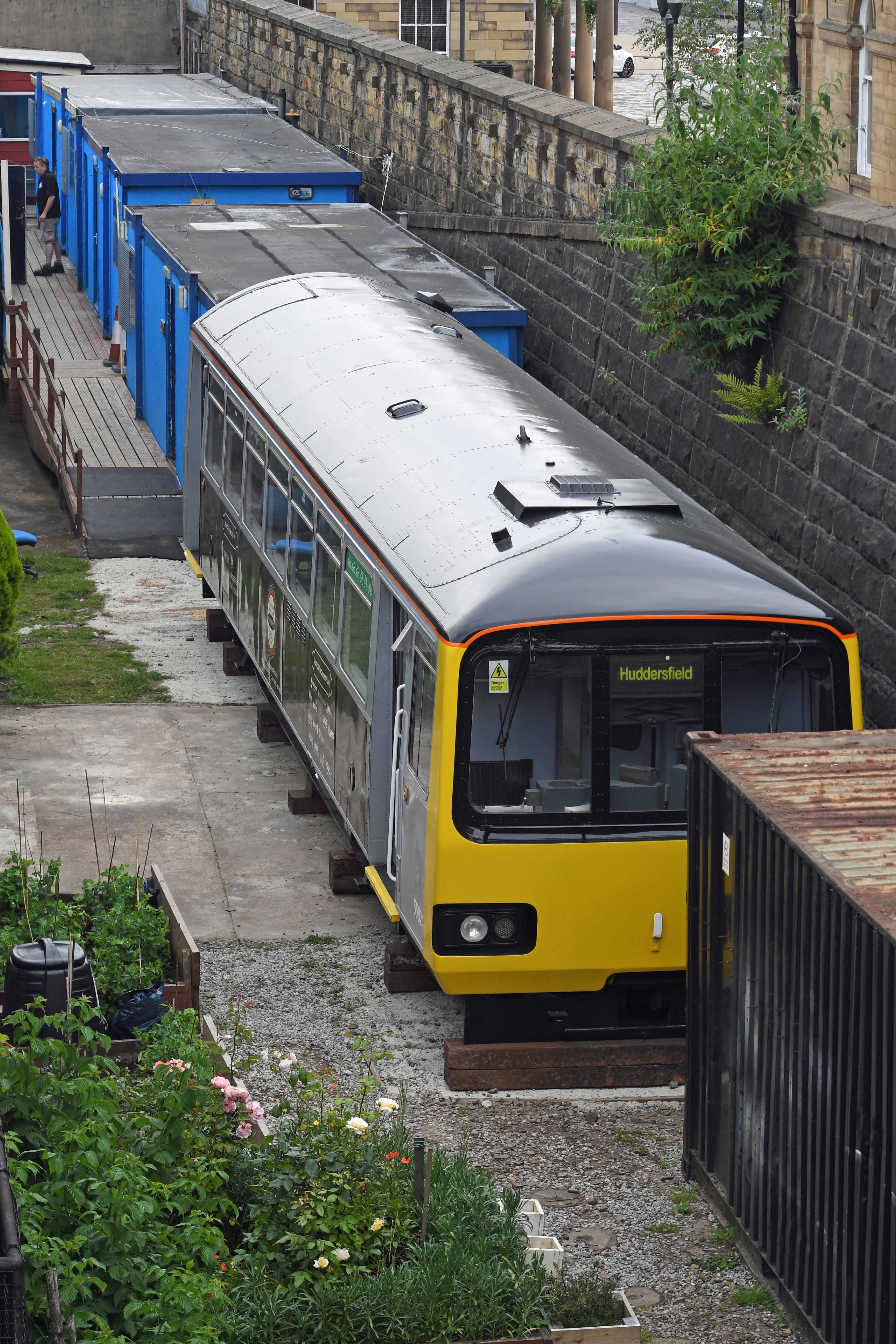
We didn’t stay long as space was at a premium and we didn’t want to interrupt so Bob showed me around the rest of the site. On a snowy February morning the garden wasn’t exactly looking at its best, but the raised vegetable beds clearly provide a great place for some gardening therapy and the outdoor space, sheltered as it is by a tall retaining wall holding up St Georges St makes an ideal area to get away from it all – even if you are right next to the station. Whilst we were there Bob pointed out the spot that will soon be graced by the presence of a donated ‘Pacer’ car. Friends of the charity had entered them in the competition to win one of the Porterbrook donated trains and they were one of the winning bids. Craning the coach onto its final resting place is going to be quite a challenge due to the cramped nature of the site (and that retaining wall) so Bob promised to invite me back to see it being installed when Covid restrictions permit – hopefully in the summer. The Pacer will provide a welcome addition to the indoor space available and also be quite a talking point as these vehicles spent much of their working life in the area.
My brief visit gave me a valuable insight into how much this charity is doing and the challenges it faces whilst doing it – especially at the height of a pandemic which is storing up problems for the future. Isolation is a problem even for those of us who’re well-connected. Try and imagine what it’s like for a single man living on his own who’s been cut off from the last vestiges of social contact and interaction that he may have had, with no idea whether (or when) these things may return. Charities like ‘Platform 1’ quite literally provide a life-line and deserve all the support that we can give them.
Oh, the old Pacer did eventually arrive (on the second attempt). Here it is in situ!
I’ve a favour to ask… If you enjoy reading this blog, please click on an advert or two. You don’t have to buy anything you don’t want to of course (although if you did find something that tickled your fancy that would be fab!), but the revenue from them helps to cover some of the cost of maintaining this site – and right now (because of Covid), us freelances need all the help that we can get. Remember, 99% of the pictures used in my blogs can be purchased as prints from my other website – https://paulbigland.zenfolio.com/
After two days on the road I’ve hardly moved more than a quarter of a mile today as I’ve been busy trying to edit the pictures from my travels as well as sort out all the mundane stuff life throws at you. Despite that, the day’s flown. One thing I have enjoyed has been spending some time in the kitchen, cooking up a Thai Green curry. Admittedly, I ate Asian food in Carlisle but it’s a cuisine I never tire of so the chance to cook my own is never missed.
I’ve another day at home tomorrow before heading back to my old home town (Southport) for a sad event. I blogged about the death of an old friend (Mike Smith) back this time last year. On Sunday, a few of us are going to get together to scatter his ashes in a local park. He was always a short, skinny bugger so I can’t imagine there’s going to be much to scatter, but there you go. No doubt I’ll do a rolling blog of the day and my thoughts. What will be strange for me is that one of the people who’ll be there is an old school friend whom I’ve not seen since the late 1980s after he and I had a ‘parting of the ways’ in India back in 1986. Another long story….
Still, funny old world isn’t eh?
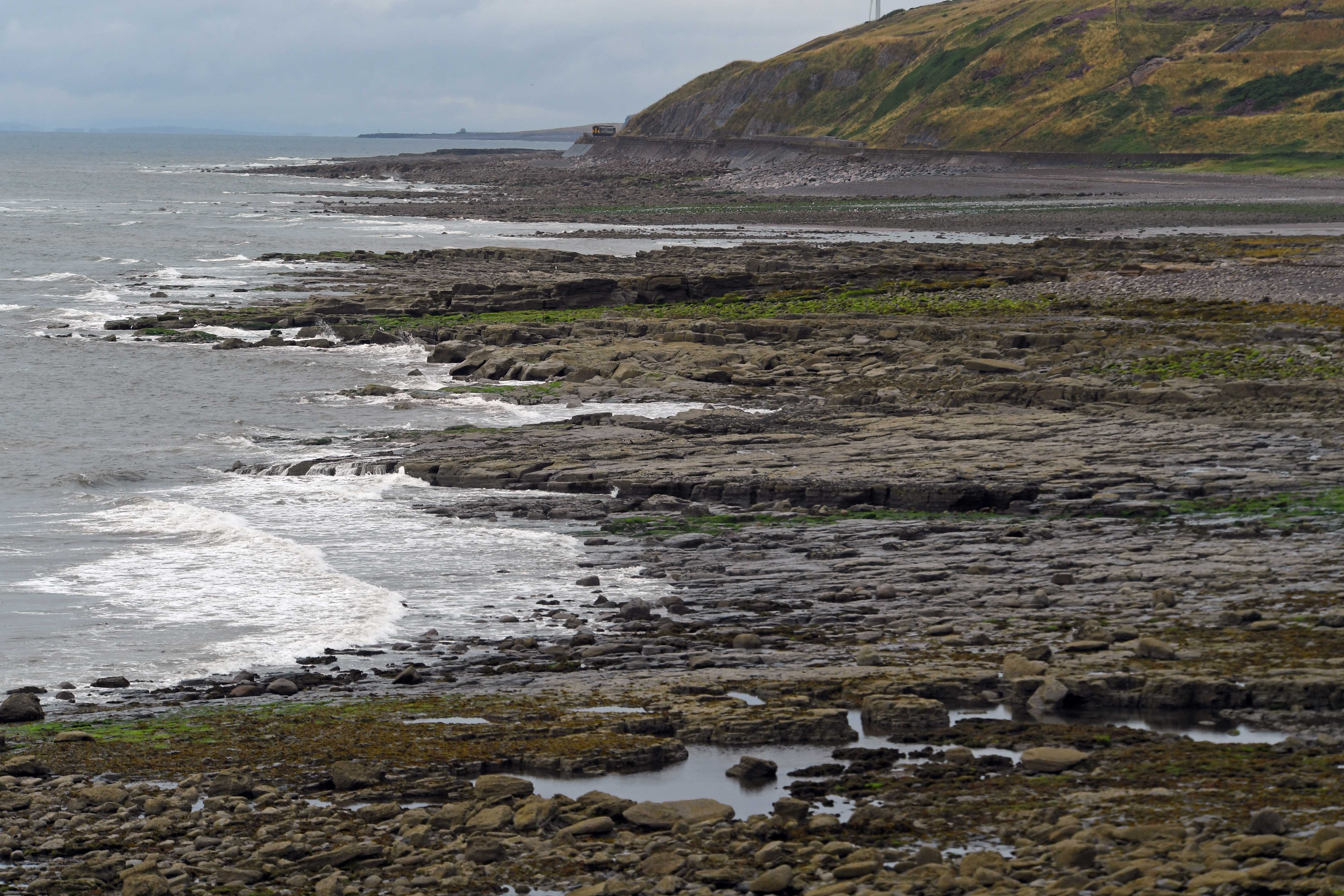
Today’s picture of the day has nothing to do with any of this, it’s from my trip to the Cumbrian coast with another old friend from a slightly different vintage. I mentioned Parton on the Cumbrian coast. Here’s on of the pictures I was after, even if the light wasn’t as good as I’d liked. The railway hugs the coast here. So much so it’s in constant danger of slipping into the sea and has done so on several occasions. It’s the classic conundrum that faces the railways in the age of global warming. The Victorian engineers though this was a good (cheap) way of driving a railway though this part of the world. Those decisions are coming back to haunt us now…
Still, spot the train in this image of the beach at Parton.
Hopefully I’ll have the rest of the several hundred pictures I took added to my Zenfolio website in the next few days. If not – I’m sure there’s other stuff I’ll be able to find to bore you with!
I’ve a favour to ask… If you enjoy reading this blog, please click on an advert or two. You don’t have to buy anything you don’t want to of course (although if you did find something that tickled your fancy that would be fab!), but the revenue from them helps to cover some of the cost of maintaining this site – and right now (because of Covid), us freelances need all the help that we can get. Remember, 99% of the pictures used in my blogs can be purchased as prints from my other website – https://paulbigland.zenfolio.com/
My day’s travels are having a later start than normal as I’m currently waiting for a check-up at the Royal Calderdale hospital’s Dematology department. After forty-odd years of backpacking and beach-bumming around the world in exotic, sunny places you’ll find more moles on me than on the average golf course! So far, all have proved to be benign but recently a new one’s appeared on my cheek below my left eye. My GP reckons is OK but has sent me to get it checked out by experts – just in case. Once this is done I’ll be on my way, heading North. Of course, the problem with hospitals (especially ‘cos of Covid) is that you’ve no idea how long things will take. I’m not a great fan of hanging around hospitals (after all, they’re full of sick people!) but I really can’t complain about the Royal Calderdale. Whenever I’ve been here in the past the staff have been excellent.
It’s my first visit since the pandemic broke and it’s odd to see the place quieter than usual and waiting areas stripped to the bare minimum to enable social distancing. This is a big hospital with a large catchment area so it’s normally buzzing.
11:40.
Everything’s A-OK. The Dermatology nurse who examined me was a chippy and cheerful Yorkshire lass. After quizzing whsre I was going with such a large bag she waxed lyrical about a trip she’d taken along the Settle-Carlisle railway with her husband! In examining me she told me what I had under my eye was a seborrhoeic keratoses (a name that doesn’t exactly trip off the tongue!) and the good news? They’re harmless!
As my visit was mercifully short I managed to catch an earlier train. I’m now on a busy 3-car Class 195 working the 11:32 Halifax – Blackpool North. Leisure travel’s returned with a vengance. I was nearly mown down by a fleet of women with prams who were leaving the train to head the ths towns ‘Eureka’ childrens museum. Even with them disembarking the train remains busy.
12:30.
We’ve just left Blackburn and the train’s packed. We’ve lots of families aboard who’re on their way to Blackpool for a holiday. I feel rather sorry for them as the weather’s not looking very promising over the next few days, but then that’s why budget holidays to Spain became so popular!
14:30.
I’m now on the final leg to Carlisle after changing trains at Preston and Lancaster. All the services I’ve used today have been busy. It’s true that Preston station was quieter than I’d usually expect this time of year, but then there’s rather a dearth of foreign tourists – for obvious reasons! From Preston I caught a TPE Class 397 working a Manchester Airport – Edinburgh service, which was well loaded. If it had been on one of the old 3-car Class 185s used on the route it would have been rammed. I’ve not travelled on a 397 on the WCML before so I was pleasantly surprised at the quality of the ride at linespeed – especially as I was stood over a bogie on the trailing vehicle!
I had half an hour at Lancaster, long enough to grab a couple of pictures, notice that all the station’s catering outlets had reopened (bar the WH Smiths by the ticket office) and have a quick word with an old friend who was on dispatch duty before catching Avanti West Coast’s 13:55 Northwards. Station announcements warned that it would be busy and advised those on flexible tickets to get a later train. 390104 rolled in to do the honours and it was indeed busy. I was lucky, a family of four were detraining so I managed to blag their table which is where I’m sat typing this. Having flown through a gloomy Lune Gorge we’ve hit mist and rain at Shap summit, so I’ve no idea what to expect in Carlisle…
15:15.
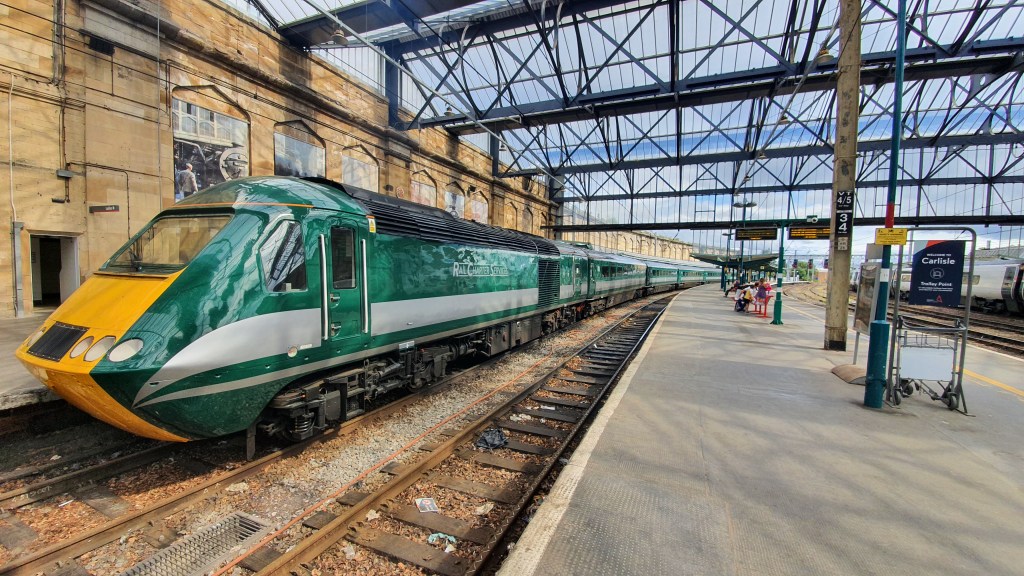
In fact, the weather in Carlisle is changeable, but OK. The sun put in an appearence for this beastie anyway. Rail Charter Services green HST working the 15:09 to Skipton via the Settle and Carlise line.
Epilogue!
After meeting up with Hassard at Carlisle the lair of us headed off to territory he’s never explored before – the Cumbrian Coast line as far as Whitehaven. We’d planned to walk along an old tramway from there to Parton but the rain lashed our train as it made its way to the coast, so we dicided to be flexible. The 2-car 156 we were on was really busy with a mix of locals on their way home from work and tourists. Two young couples opposite were heading to Whitehaven with their bikes to begin the popular coast to coast cycle route.
Fortunately for us (and the cyclists) the weather broke en-route. As we headed South the rain headed North so our plan came together after all. The old tramway runs parallel to and above the railway, giving excellent views of line, rocky beaches and out to sea. The route’s tarmac’d as it’s part of the national cycle network, so it’s an easy walk.
Not a bad day here in Bigland Towers even if I didn’t get through 3/4 of the things I’d hoped to – as is often the case as life just seems to keep getting in the way! At least the weather’s improved, which lifts the mood. I managed to tear Dawn away from her computer at lunchtime and the two of us had an amble through the local woods which was lovely. The recent rains have encouraged a real growth spurt in some plants so it looks like we’ll be having a bumper crop of Blackberries this year. The only downside is the brambles are throwing out so many tendrils they’re making some of the woodland walks awkward to navigate – especially if you’re wearing shorts! If the brambles don’t get you, the Nettles will!
Back at home I’ve been ploughing through various work projects and organising the diary which (thankfully) is looking a lot fuller than this time last year. Admittedly, there’s no plans for getting abroad right now, but I’ll be ‘on tour’ in the UK again for the next couple of days, so expect a rolling blog or two. Tomorrow I make my way to Carlisle to meet up with an old friend from London who’s on a business trip to the area. Having company on one of these jaunts will be fun as Covid’s meant I’ve normally been flying solo. We’ll be taking a photographic trip down the Cumbrian coast. I’m I’m hoping the weather Gods will smile upon us. I’ve not had the opportunity to visit the area for a couple of years so I’m looking forward to it. I’ll be making my way back to Yorkshire on Thursday and I’ve a couple of places I could do to visit to get shots for a client so I’ll be watching the weather forecast and hoping it performs to expectations. But hey, this is Britain after all, I could end up with floods or blizzards!
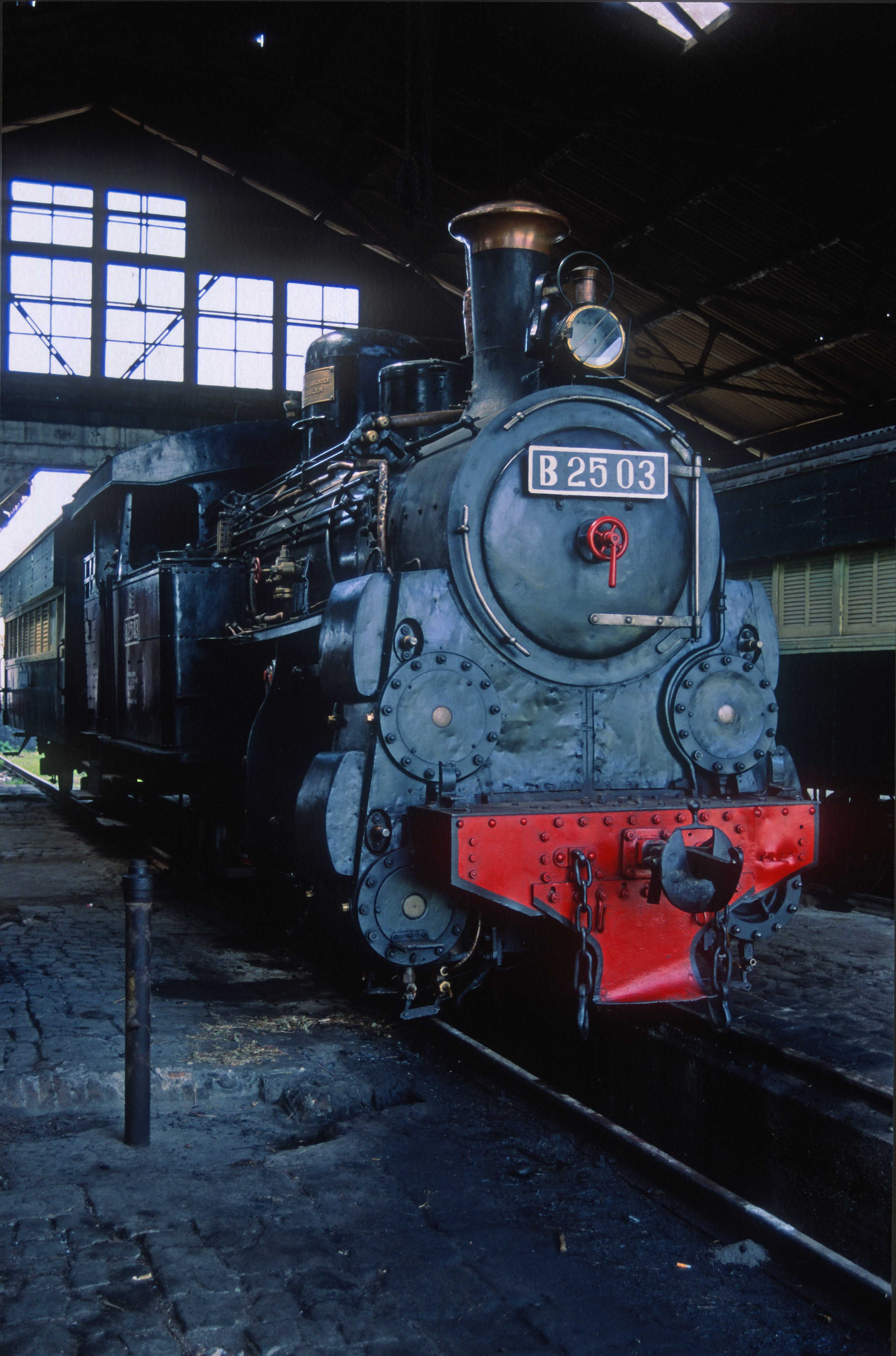
Whilst I’ve been slaving away back in the office I discovered a stash of old slides from my 1991-92 world trip that I’d never got around to cataloguing as the emulsion on some of them had been attacked by fungus before I could post them back to the UK. Now, with the wonders of modern technology – and a lot of patience in Photoshop, most of them can be restored, so here’s the picture of the day…
I took this shot in the old loco shed at the Amberawa Railway museum in Java, Indonesia on the 11th July 1992.
I was staying in nearby Yogyakarta in Central Java and was determined to fit in a visit, even though it meant catching a packed local bus to get there as the operational railway between the two towns had closed back in the 1970s. It was well worth the trip as the museum houses a fascinating collection of old Indonesian steam locomotives of all shapes and sizes, including a few British built examples. This one was (and is) still operational. B2503 was built by Esslingen of Germany (Works number 3244 of 1902). It’s a rack and adhesion type of engine, which means that on the steep gradients around Amberawa the locomotive gripped a rack rail between the two conventional rails, pulling itself and its train along on the rack via a powered cog-wheel rather than relying on simple adhesion. This 0-4-2 wheel arrangement tank locomotive looks small, but it weighs in at 31 tons! Sadly, on the day I visited, none of the engines were in steam. Nowadays the museum’s and its locomotives are a lot better kept so I’m determined to get back there again once the present pandemic has subsided. I really enjoyed travelling in Java, both then and during my last visit in 2017. It’s a beautiful island rich in history and with some great food too. Oh, and the odd railway gem like this!
I’ll eventually get around to restoring all these old pictures when time permits. Maybe that’s a job for those long dark winter nights. Right now there’s too many contemporary shots on my list to keep me occupied.
I’ve a favour to ask… If you enjoy reading this blog, please click on an advert or two. You don’t have to buy anything you don’t want to of course (although if you did find something that tickled your fancy that would be fab!), but the revenue from them helps to cover some of the cost of maintaining this site – and right now (because of Covid), us freelances need all the help that we can get. Remember, 99% of the pictures used in my blogs can be purchased as prints from my other website – https://paulbigland.zenfolio.com/
Every so often Guardian columnist Simon Jenkins bile duct overflows and he releases a torrent of vituperative and bombastic nonsense about the HS2 rail project. He’s been doing this on a regular basis for years now. The fact he’s always proved spectacularly wrong and fact-free never stops him as the man clearly believes his own myths and is unashamed by the fact his fictional tirades never age well.
Crewe based blogger Tim Fenton has punctured Jenkins hot air balloon several times in the past. Notably here in 2014 and here in 2015. Sadly, the fact nowadays he’s in the fairy story business rather than real Journalism hasn’t stopped the Guardian publishing him. I’m assuming their Editor no longer cares about trivial things like facts and the truth as clicks are more important. The rubbish Jenkins writes are good enough to generate those as his rants against HS2 are guaranteed to be shared by the projects opponents – even ones whom aren’t natural Guardian readers! It’s a win for the Grauniad and a loss for those who like decent, factual journalism, analysis – and the truth.
Let’s have a look at Jenkins latest fact-free farrago shall we? I’d suggest wearing a peg on your nose whilst doing it as the smell of bullshit is overpowering. It’s entitled “Depleted and unwanted, HS2 hurtles on as Johnson’s £100bn vanity project” – which is a good start as that’s three untruths in the headline and we haven’t even got to the article yet! The first paragraph is no better…
“Britain’s new high-speed railway will not – repeat: not – get to the north of England. It will go back and forth from London to the Midlands and its chief beneficiaries will be London commuters. All else is political spin”
Really? Jenkins seems unaware that contracts for building HS2 Phase 2a from Birmingham to Crewe have already been let. Contractors have already started on preparatory work as Phase 2a gained Royal Assent on the 11th February 2021 after flying through both Houses of Parliament with a huge majority – just as Phase 1 did. Now, what was that about “unwanted”? HS2 has always commanded huge-cross party political support. So much so that the handful of opponents in the Lords didn’t even bother calling for a vote on the Phase 2a bill as they knew they were completely outnumbered.
Oh, and “London Commuters”? Hs2 is a long-distance railway. Like all other long-distance railways that means the vast majority of passengers will be leisure travellers, NOT commuters. The HS2 business case is based on 70% of travellers doing so for leisure. How can that be predicted? Easy, because we know who uses the existing Long-Distance services.
Meanwhile, Jenkins continues to dig a hole…
“This became certain last week as the government’s internal major projects authority declared phase two of the HS2 project, to Manchester and Leeds, effectively dead. While the already-started London-to-Birmingham stretch is still marked at “amber/red” for “successful delivery in doubt”, anything north of Crewe has been designated “unachievable”.
This is complete cobblers of course and will come as real news to people on the leg from Crewe to Manchester (and HS2 Ltd themselves) as the Government announced the timetable for the Phase 2b leg in the Queens Speech at the state opening of Parliament. The bill will be deposited in Parliament next year.
As for this amber/red and ‘unachievable’ nonsense, this is Jenkins failing to understand what the ratings (given by the Infrastructure and Projects Authority) actually mean. For example, we have two ‘unachievable’ Queen Elizabeth class aircraft carriers floating around right now that the IPA rated red. Oh, and the new Intercity Express Programme (IEP) trains built by Hitachi that are ploughing up and down the East Coast and Great Western main lines? They were rated ‘unachievable’ as well.
What’s next? Oh yes,
“Since HS2 has always been politics-driven – no rail strategy ever gave it priority”
This is more complete bollocks. The origins of HS2 are in several studies looking at the needs for future rail capacity that were carried out by the likes of Network Rail. In fact, it was this study. “Meeting the capacity challenge: The case for new lines” which was published by NR in 2009 that was the basis for HS2. It was the rail industry who established the need for HS2, not politicians.
Next?
“The only way of conveying the scale of Johnson’s vanity in this vanity project is to convey its opportunity cost, a projected £106bn (and rising) over 20 years.”
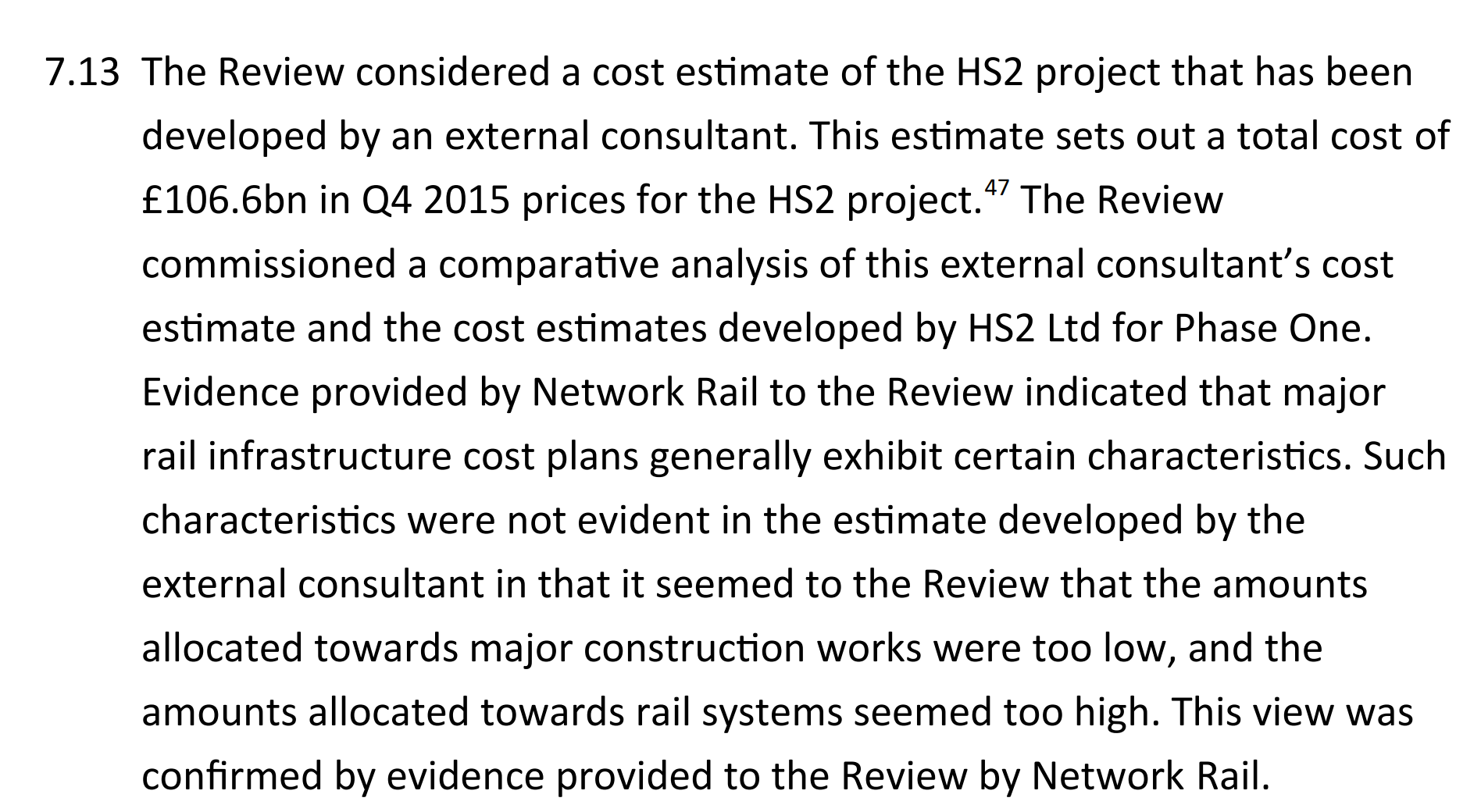
More cobblers. The cost of HS2 is not a ‘projected’ £106bn. Yet again Jenkins resorts to fiction as he’s just too idle and sure of himself to fact check but he’s not alone in filching figures from others without checking so I’ll cut him some slack. This number has been bandied around an awful lot in the media. That’s because the media is so incestuous as well as lazy. Nicking other people’s copy is endemic. It’s like Chinese whispers and ‘send three and fourpence, the General’s going to a dance’, an error’s circulated, magnified and becomes a ‘fact’. It’s claimed the £106bn is an ‘official’ figure because it was in the Oakervee Review of HS2. There’s just one teeny problem – the actual figure (£106.6bn) was mentioned in the review so that Oakervee could specifically dismiss it! Here’s a link to the Oakervee review. Here’s what Oakervee actually said.
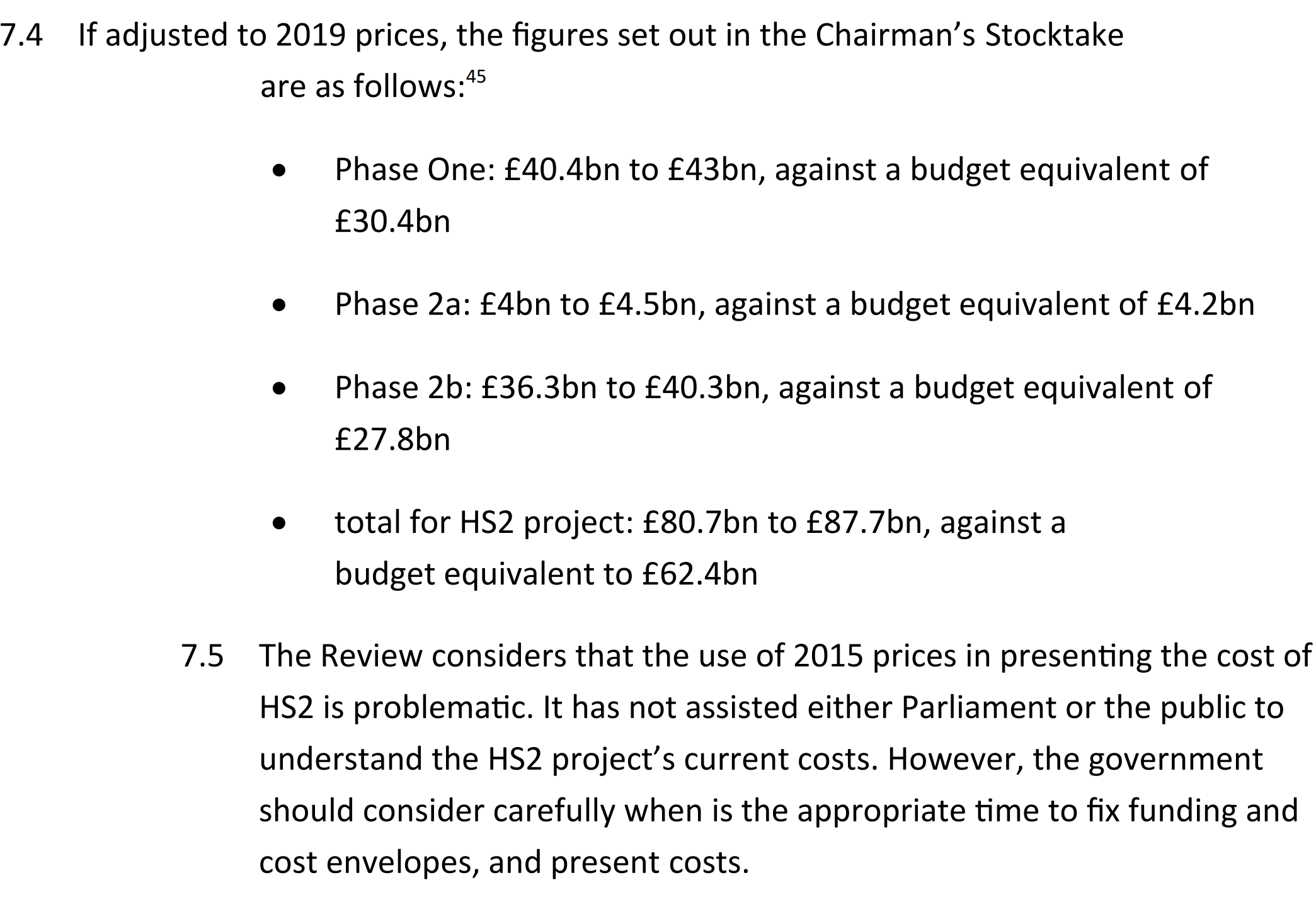
Here’s what Oakervee ‘really’ said about the costs (there’s a range, not a single figure).
So, £80.7 – 87-7bn. Not figures you’ll see the press using as it’s not a single number that’s scary enough!
Jenkins then goes into the standard economic illiteracy about what spending funds for HS2 could do for the NHS, neatly showing he doesn’t understand the fact there’s no pot of money sat in the Treasury labelled ‘For HS2’ that’s waiting to rebadged, that he doesn’t know the difference between operational expenditure and capital expenditure, and thirdly, that Hs2’s funded by borrowing, not taxation. I’ve covered all those points in this blog in the past.
Continuing with his nonsensical claims, Jenkins than says;
“This one train line will consume the equivalent of Britain’s entire projected railway investment budget during its two decades of construction. Even the initial phase to Birmingham, at roughly £70bn, is twice the £40bn cost of the “northern powerhouse” rail system”
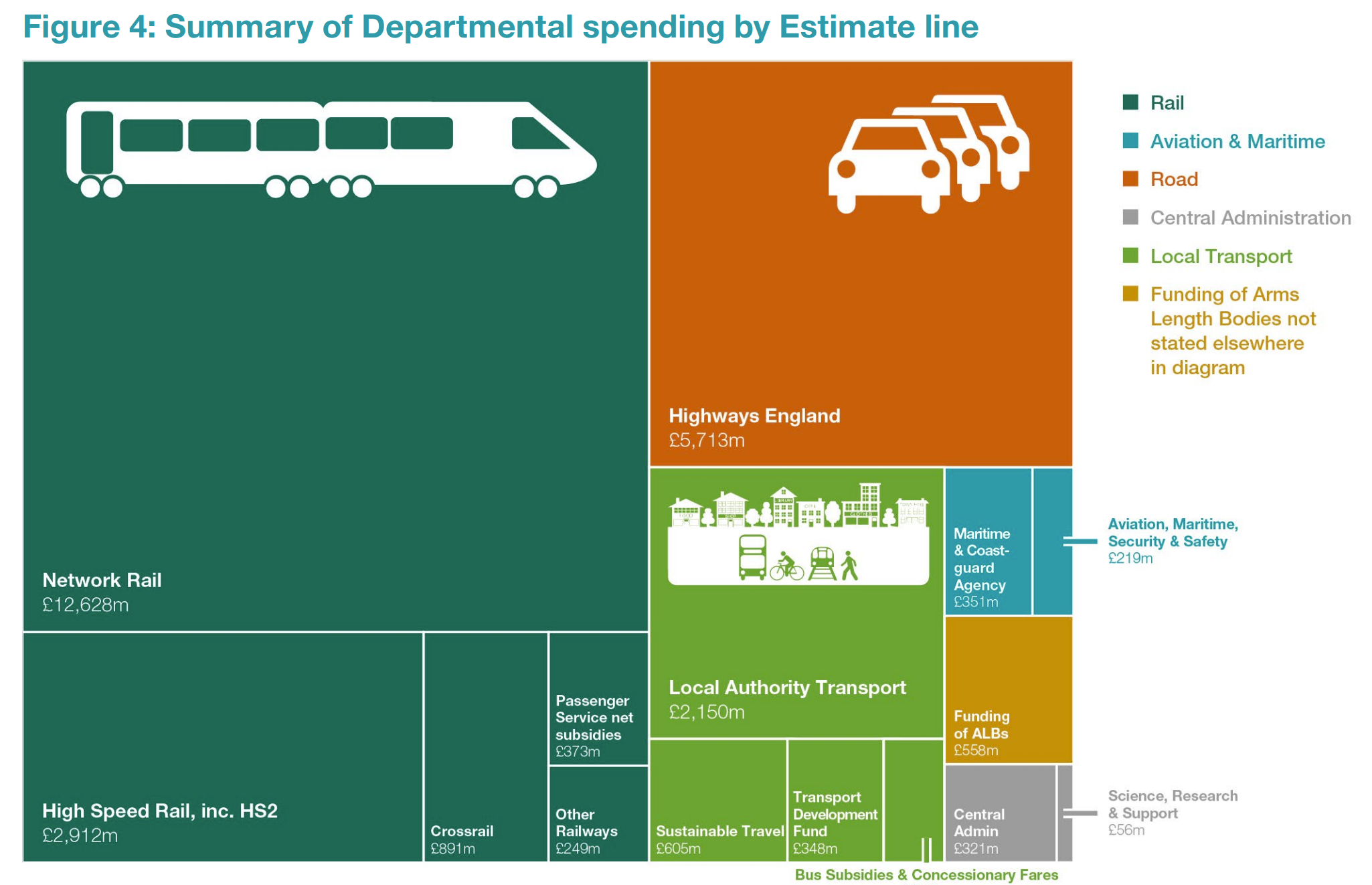
Firstly, Phase 1 is budgeted at £40-43bn (see above) £70bn is a number Jenkins has invented. Secondly, No-one knows that the UKs projected rail budget is for the next 20 years as it’s not set that far in advance. Network Rail’s budget is set in 5 year periods, known as ‘Control Periods’. The current one (CP6) runs from 2019-2024. That was set at 47bn. Of course the line between maintenance and ‘investment’ is blurred. For example, is replacing life-expired signalling with an upgraded system maintenance or investment? Here’s a link to the Department of transport’s budget 2019-2020. It makes it clear that the amount spent on Hs2 is dwarfed by what’s spent on the existing national rail network.
Oh, and that doesn’t include what others (like the Welsh and Scottish Governments, or train builders) invest in the railways either. Jenkin’s claim is simply more spherical objects..
Jenkin’s diatribe of nonsense continues with this tosh.
“Meanwhile arguments continue over the trains themselves. They are not planned to tilt, which means that any time saved on a new track to Birmingham will be lost on winding track further north. A re-signalled King’s Cross line could even get to Scotland faster. HS2 is more a taxpayer-funded theme park ride”.
*Sigh*. Where to start on this rubbish? 1. HS2’s already being built North of Birmingham to Crewe. 2. The trains don’t need to tilt to keep time as the new Hitachi Class 802s operated by Transpennine Express have already proved, (technology has moved on) plus Network Rail are proposing some track upgrades on the route to Scotland anyway. 3. Re-signalling The East Coast won’t speed it up in any meaningful way as you’d need to close all the level and foot crossings which would cost a fortune and you still wouldn’t get HS2 speed – plus – you’d devastate capacity on the route by running faster trains! This crucial factor is missed by armchair experts like Jenkins. Speed up trains on the existing main lines which are already overflowing with services and you reduce capacity as slower trains have to be ditched from the timetable to leave room for the faster ones. It’s the raison d’être for HS2, by removing those non-stop high-speed services you free up large chunks of capacity on the existing network. Jenkins ignores that crucial point because it doesn’t fit his narrative. As for the final tosh about ‘taxpayer funded’ – we’ve been over this until we’re blue in the face. HS2 is funded by borrowing against future GDP increases, not taxation!
Jenkin’s continues with his ‘vanity project’ tosh with this statement;
“What is intriguing is how HS2 has mutated from from a transport project to political machismo – “infrastructure” that is good in itself.”
Trying to label HS2 as a ‘Johnson’ project simply won’t wash – because by the time HS2 opens Johnson (hopefully) will be long gone. HS2’s been in development for over 11 years. In that time we’ve had Gordon Brown, David Cameron, Teresa May and Boris Johnson premierships. The project was kicked off by a Labour Government, taken forward by a Coalition Government and now construction’s started under a Tory Government. It’s hard to think of many schemes as apolitical as HS2. By the time the whole project’s completed that will be nearer 25 years. Who know who’ll be the Prime Minister cutting the tape when the first phase opens in 2029!
Jenkin’s final canard is this, the old “Hs2 is stealing your investment money”
“(Andy Burnham) will now find Birmingham blessed with cash that might have renovated his dire northern powerhouse rail network three times over – money he may now never see”
Playing regional mayors off against each other I see. It won’t wash. That money comes from Whitehall anyway. They make the investment choices as funding powers and budgets haven’t been devolved by the Government – much to the North’s annoyance – and that’s not exclusively to do with Burnham either. The Government set up Transport for the North but didn’t give it control of its budget. This is a Government decision but it’s nothing to do with HS2 which has a separate funding stream. Still, facts eh? You’ll never get ’em from Jenkins!
No doubt Jenkins latest pile of cobblers will keep the Grauniad happy as it’s done it’s job creating clicks and comments. It won’t stop HS2 in the slightest of course, the only effect it will have in the long term is to continue the downwards trajectory of the reputation of English journalism. Next time you see a Jenkins article on HS2, save yourself some time and file it straight in the bin…
I’ve a favour to ask… If you enjoy reading this blog, please click on an advert or two. You don’t have to buy anything you don’t want to of course (although if you did find something that tickled your fancy that would be fab!), but the revenue from them helps to cover some of the cost of maintaining this site – and right now (because of Covid), us freelances need all the help that we can get. Remember, 99% of the pictures used in my blogs can be purchased as prints from my other website – https://paulbigland.zenfolio.com/




 Paul Bigland