Travel memories part 1

Tags

, ,

It’s Wednesday, so this must be…
One of the beauties of my job is that I get to travel – a lot. The days of being stuck in a Council office in London are long behind me. So far, this month has seen me in Edinburgh, Inverness, Peterborough, briefly at home in Yorkshire – and now I’m kicking my heels in Southampton in preparation for a big press event tomorrow. There’s a hell of a lot going on in the rail industry right now which means I get to see some of the best & worst the UK’s towns & cities have to offer. Edinburgh is one of the gems, Inverness less so – especially if you arrive in the evening & don’t want a restaurant meal. It’s not difficult to see why Scotland has the reputation as the heart attack epicentre of the UK as I spent an hour looking round for a place selling food that wouldn’t cause immediate hardening of the arteries. Is there a law in Scotland that says you’re not allowed to sell vegetable based products after 6pm?

Peterborough was rather better. I used to spend many a weekend there back in the late 1980s – early 90s as a friend had moved there for work. She was attracted by the cheap flats the Development Agency was offering for sale. So, for a couple of years I spent quite a bit of time getting to know the flatlands of Cambridgeshire. We explored many a pretty pub in the area – and a few not so pretty ones too! 25 years later I found myself at a loose end one night so I went looking for old haunts. Most had disappeared & some I simply couldn’t find, but a few did remain – including the Wortley Alms Houses a fine old Sam Smiths pub with some of the cheapest beer I’ve found in a long time – £1.44 a pint for their Old Brewery bitter. Despite the cheapness of the beer the place was dead. Gone are the days when pubs were busy with young & old escaping from a family Sunday!

To my eyes the fabric of Peterborough town centre hadn’t changed that much, although some pubs had morphed into eateries. One that jogged my memory was one on Cowgate that’s turned into a Prezzo. I remember it as a rather down at heel pub in a beautiful building with distinctive large curved glass windows in the frontage. It was these that made me remember an incident when I saw it again. One Weekend afternoon Nancy & I were having a quiet drink in there. It was a normal somnambulant Saturday until 12-15 Hartlepool supporters stumbled in. Wearing the traditional attire of shaven heads, fairly crap tattoos & paunches they managed to double the pubs lager sales in the space of a few minutes. It wasn’t a problem until they’d supped up, then they suddenly kicked off in an obviously pre-planned attempt to wreck the pub. They’d clearly worked out where the exits were. One group wrecked the pub towards the front door whilst others headed for the back door. Tables flew & punches were thrown at bemused locals unlucky enough to be in the way – although no-one was seriously hurt by these lard-butts. On their way out, one of them shouted ‘You softy Southern bastards’

Nonplussed but unruffled by this show of mindless Northumbrian testosterone the bar staff & customers began to put the pub back together. As we did I remarked ‘Southern softies? I wouldn’t mind, but I’m from Liverpool!’ Talk about a Spartacus moment – within moments nearly a third of the pub admitted they were from North of the Watford Gap & weren’t local at all (one Scot was particularly offended!)

Funny how your memory’s triggered isn’t it? -I hadn’t thought about this for decades until I saw the pub again.

So, if any of our old gang is reading this, hello Nancy, Mike, Lynn & Jackie!

Why the anti Hs2 campaign won’t be celebrating Hs2’s 5th birthday..

Tags

, , , , ,

Ironically, today the campaign against Hs2 is ‘celebrating’ the 5th anniversary of the announcement of the project.  You would have thought they’d have known better as all they’re doing is drawing attention to their five years of failure in trying to stop it!

With nothing new to say & having no cunning plans now all their previous ones have ended in disappointment & failure StopHs2 are trying to bring back their ‘No votes for you with Hs2’ campaign from the dead.  Bad move. The rotting corpse is too far gone to resuscitate, not least because the anti Hs2 campaign has too few supporters who command too few votes.  I’ve looked at this in two previous blogs;

https://paulbigland.wordpress.com/2015/01/17/the-anti-hs2-campaign-dying-by-degrees-pt1/

&

https://paulbigland.wordpress.com/2015/02/22/the-anti-hs2-campaigns-numbers-dont-add-up-again-social-media-edition/

In the intervening time, things have got worse for their campaign.  The Hs2 Hybrid Bill Committee continue to plough through petitions & remain on course for the Bill to gain Royal Assent by December 2016.

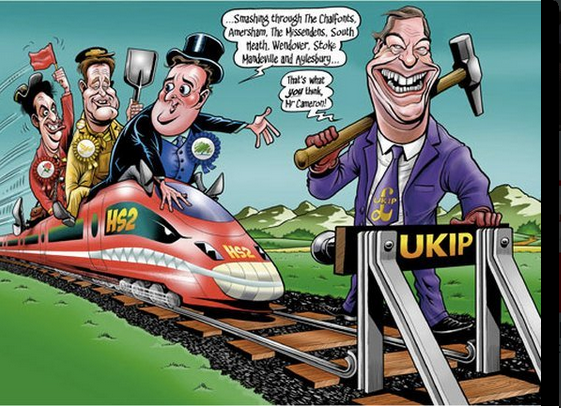
On the political front, all three major parties remain committed to the Hs2 project. The anti Hs2 campaign constantly predicted party political U-turns.  None have ever materialised as no-one is actually frightened by their campaign.  There might be a couple of nervous Tory MPs on the Chilterns Hs2 route but even there the challenge from UKIP seems to be receding after UKIP’s hopeful Chris Adams was exposed in the national media for packing his Twitter feed with fake followers;

https://paulbigland.wordpress.com/2015/02/08/ukip-the-anti-hs2-mob-are-at-it-again/

You can see why UKIP & the anti’s get on, can’t you? Both groups largely rely on imaginary friends!

Meanwhile, Labour’s Shadow Transport Minister gave an interview to February’s ASLEF Journal, where he said: “We are absolutely committed to HS2”

Click to access 1502aslefjournal.pdf

Absolutely no sign of a U-turn there then…

The national opinion polls offer nothing positive either.  The real political race is between parties who all support Hs2, whilst the two that oppose UKIP & The Greens have both had a torrid time.  There’s an almost weekly drip of stories about racism within UKIP (where trying to stop them popping up is like playing a game of ‘whack a mole’) & the Greens have had their Leader, Natalie Bennett, implode in a radio interview that’s gone viral.  The Greens rail policy doesn’t exactly stand up to scrutiny either.  I’ve dissected it here;

https://paulbigland.wordpress.com/2015/03/08/the-greens-rail-policy-is-a-dogmatic-mess/

UK polling reports predict that, between them (at best) the Greens & UKIP will have less than half a dozen MPS. That’s meant to Stophs2?  Oh, please…

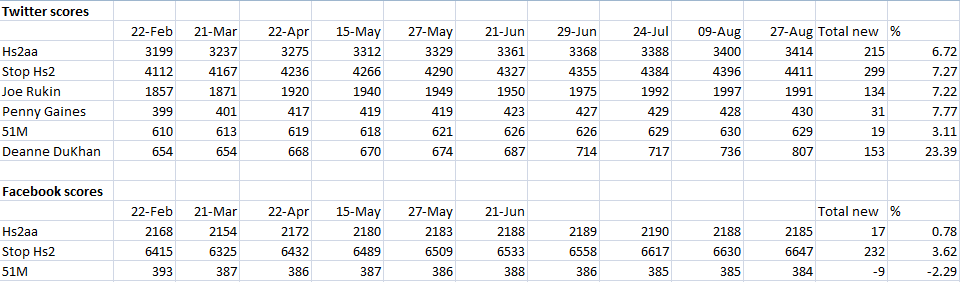
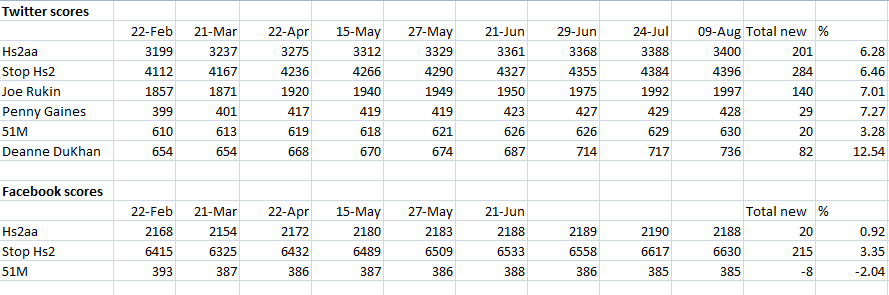
Meanwhile, things continue to get worse at home.  At the Hs2 Committee hearing on the 10th March, Denham Against Hs2 Chairman Frank Partridge let the cat out of the bag about the number of Hs2 ‘Action’ groups.  The likes of Hs2aa are still pretending there are over 90.  Frank admitted to the Committee that the real number is ’40 to 50′ – around half the numbers claimed!  More proof (if it were needed) that the campaign’s been exaggerating the size of its activist base.

All this leaves the anti Hs2 campaign with bugger all to celebrate on Hs2’s 5th birthday.  If I was Joe Rukin, I’d be too busy looking through the ‘situations vacant’ columns to be boasting about how a lot of imaginary voters are going to Stop Hs2….

The Greens rail policy is a dishonest, dogmatic mess…

NOTE: Much of this blog was written in 2015 with updates added in later years.

Buoyed by dissatisfaction with the major political parties over Brexit the Greens are placing themselves as a serious political party rather than just another pressure group.

Their problem is their policies & the way they choose them haven’t kept up. They also have a nasty habit of being rather authoritarian & don’t seem to like listening to advice – unless it’s from people they want to hear.

Personally, when I lived in London I would often vote Green, especially in the Mayoral elections where they normally got my secondary vote. Like many people I liked the idea of the Greens but what I’ve seen & heard these past few years has changed my opinion. The Greens made a mess of running Brighton & their pronouncements on rail transport (and Hs2 in particular) have combined hand-wringing, daft ideas & very dodgy assumptions. Then we saw their then leader, Natalie Bennett implode in an interview with LBC radio’s Nick Ferrari.

This has led me to cast a critical eye over their policies relating to rail transport. What I’ve found is less than impressive. In parts, it’s downright dishonest. You see, the Greens have become obsessed with who owns the railways rather than understanding how they operate. They seem to have fallen for the populist rather than the pragmatic. They’ve ditched the chance to genuinely do things that will help the environment in favour of tub-thumping to gain votes.

I’ve cast a critical eye over the policy statements which they’ve displayed on their website. The one for Transport dates from 2009. It was amended in 2014 and again in 2017, more than two years after I originally wrote this critique.

http://policy.greenparty.org.uk/tr.html

Now, there is some good stuff in there but what amazed me is how nothing is costed. It’s one huge statement of intent, a shopping list – with no idea how much any of it will be paid for other than a few glib phrases about ‘the polluter pays’, then mention of road charging & fuel taxes. It’s probably no wonder. Can you imagine spelling out detailed costs to the electorate & then expect them to vote for you? The Greens answer to everything seems to be ‘well, we’ll stick a tax on it’.

But my alarm bells really sounded when I read this on rail;

“TR231 The division of rail and track companies into a competitive rather than a cooperative organisation, and the fragmentation of the rail industry into 100 companies by privatisation, has been disastrous for safety and reliability and the provision of an integrated service. The Green Party would overcome this through public ownership (see TR230), but also by making the rail service more democratically accountable at local and regional levels.”

What? Say again? “privatisation, has been disastrous for safety and reliability and the provision of an integrated service”

What a complete and utter load of ideological tosh – and also plain wrong! Note that I wrote this critique way back in March 2015. That totally false statement is still on the Green Party’s website now (April 2018).

First, let’s look at safety. The experts are the Rail Standards & Safety Board (RSSB) who monitor rail safety & collate the statistics in their annual reports. Here’s their 2014 report.

Click to access 2014-07-aspr-2013-14-full-report.pdf

It states: “There were no passenger or workforce fatalities in train accidents in 2013/14. This is the seventh year in succession with no such fatalities. At 0.2 events per year, the ten year moving average for these train accidents is at its lowest ever level”

Hear that? Its lowest ever level. There’s more.

“There were no passenger train derailments. This is the first year with no such derailments since recording began more than 20 years ago”.

More than 20 years ago. Remember that date. That’s pre 1994 – the year the railways were privatised. Now, what was that The Greens said? Oh yes, “privatisation, has been disastrous for safety and reliability”

Some ‘disaster’…

In fact, the truth is that rail safety has been steadily improving for decades & that improvement has continued under privatisation. The Greens are not telling the truth about rail safety.

Now let’s take a look at punctuality. This is more complex due to the fact the way performance is measured has changed over the years. Before privatisation it wasn’t really monitored. BR used to publish a performance figure in their annual report but how it was calculated is a mystery, it certainly wasn’t transparent. The figure never got above 90%. Privatisation brought in a standard method of calculating punctuality called the Public Performance Measure (PPM) it’s monitored independently & published openly.

Rather than supply you with a single chart, I’d suggest you look at this which will give you a whole host of information on punctuality & performance:

Click to access rail-trends-factsheet-2012-13.pdf

There’s no doubt that there was a major setback after that Hatfield crash in 2000. Yet this led to the demise of Railtrack & the establishment of Network Rail, which turned the situation around & punctuality rose even higher. Since privatisation, there’s been a huge increase in the numbers of trains run every year & we’ve seen a massive increase in the numbers of passengers being carried.

Today, punctuality is far better than under BR but it is starting to fall back as our old network is put under increasing pressure. We’ll come back to this point later, but yet again the Greens have been shown to be deceiving people with their claims. Their attitude to privatisation appears to have nothing to do with the reality on the ground & everything to do with grandstanding in the hope of gaining some votes.

Now let’s move on to their attitude to High Speed 2 (Hs2). The Greens claim that:

“TR244 The Green Party believes that long-distance service provision should not concentrate on high speeds where this will affect local service provision or take up an excessive amount of limited resources. The Green Party supports the principle of a new north-south high speed line which would reduce the number of short-haul flights within the UK.”

Well, that’s nice! But what do those fine principles mean in practice? Opposing building a new North-South high speed line, that’s what!

The utterly bizarre thing about this position is that it contradicts many of their other high-sounding ideals about extending rail use, getting more freight on rail, reducing air travel – and protecting the environment (amongst others).

Hs2 is designed to relieve the pressure on the UK’s major rail artery, the West Coast Main Line (WCML) which is the busiest mixed use railway in Europe. The line is already running drastically short of spare capacity at the Southern end between Rugby & London but it will be full by 2024 at the latest. That means we need to be need to do something now. That something is phase 1 of Hs2 which was planned to be open by 2026. Incredibly, the Greens oppose building Hs2. The effect of not building is will be rail gridlock on the WCML, followed shortly after by the East Coast Main Line (ECML). Allowing this to happen defies logic & commonsense. It’s anything but ‘green’, yet this is what the Greens want to do.

The Greens ridiculous situation of facing both ways at the same time came about due to a vote at their 2011 conference. Yes, rather like the old Labour party, conference decides what Green party policy is. Labour were sensible enough to ditch this as it led to such things as the infamous ‘longest suicide note in history’ (Labour’s 1983 manifesto).

The Green Party spokesperson on sustainable development is Professor John Whitelegg, a man who has always opposed high speed rail in the UK, he was influential in getting the Greens to oppose Hs2. He’s hardly an independent expert. He’s a member of the Greens who was a Green Councillor in Lancaster. At the Greens 2011 conference he made a series of statements that simply don’t stand up, such as:

“The proposed HS2 trains would burn 50% more energy mile-for-mile than the Eurostar”

How he can justify this when the specifications of the new Hs2 trains hasn’t been decided on is a mystery. It’s also a remarkably simplistic soundbite as the reality is these are quite complex calculations which contain a host of variables. To reduce it to such a simplistic level renders it meaningless. For example, comparisons between different trains are most usefully made in terms of the average energy used per seat-kilometre (i.e. total energy used per kilometre for the whole train divided by the total number of seats). Where does Prof Whitelegg make this comparison? He doesn’t. It would be impossible. The new Hs2 trains haven’t even been designed yet!

Another soundbite was ““HS2 would produce more than twice the emissions of an intercity train”

Really? Shouldn’t we first define which intercity train? After all, there’s more than one, diesel & electric! Again, this is a complex set of calculations simplified to the point of meaningless. It ignores the fact train design is continually evolving & that high speed trains are getting faster – yet use less energy. It also ignores the fact that emissions are only part of the story.

But my favourite was this, “HS2 is a ‘rich person’s railway’ – the business case assumes that a third of passengers will be on incomes of £70,000 or more”

Clearly, what Prof Whitelegg was doing here was pandering to some good old class prejudices (including his own, he was a long-standing member of the Labour party before joining the Greens). Does anyone seriously think any Government of any political colour would spend billions building a high speed, high capacity railway between our major cities, then price everybody but the ‘rich’ off it? Hs2’s 18 trains per hour will provide 26,000 extra passenger seats per hour, it’s essentially a high speed, long distance metro service. It would be economic & logistical folly to price it only for the ‘rich’ but this is the nonsense that Prof Whitelegg has sold to the Greens, based on an out of context quote taken from the HS2 business case!

So, it seems that, based on hearing only one side of the story – and a story simplified & prejudiced as to be almost worthless, the Greens voted to reject High Speed 2.

I found further evidence of Prof Whitelegg’s crazy attitude to UK railways in this Green party press release;

http://sheffieldgreenparty.org.uk/2012/01/12/press-release-on-hs2-from-green-party-nationally-and-locally/

In it, Prof Whitelegg airily asserts that;

“Capacity problems on the West Coast Main Line can be solved by more trains, longer trains, passing loops and intelligent city regional planning. Going for extra capacity with a new high speed line ignores the impressive development of sophisticated teleconferencing, videoconferences and on-the-move IT solutions. The demand for rail transport is not an immutable physical law and can be reduced by promoting IT solutions. High speed rail is not a ‘get out of jail’ free card for carbon emissions and climate change. The proposed HS2 trains would burn 50% more energy mile-for-mile than the Eurostar and HS2 would produce more than twice the emissions of an intercity train”.

Isn’t it wonderful when, with a flourish of their pen, an academic can ‘solve’ problems like that, without being troubled by the reality on the ground? Let’s have a look at the reality Whitelegg has ignored. A problem with academics is they rarely seem to talk to people at the coal face. If Whitelegg had, he’d have heard a few pithy home truths about his claims about the WCML.

More trains? The WCML is almost at capacity, especially the Southern section between Rugby & Euston. So where’s Whitelegg’s evidence that we can fit more trains on it? He offers none. How on earth he thinks the busiest mixed traffic main line in Europe can fit more & more trains on it for the next 20,50 or 100 years is beyond me.

Longer trains? We’re already doing that. The problem that Whitelegg ignores is you can’t keep extending trains indefinitely. London Midland are already running the maximum length they can – 12 cars. To extend them any more would be horrendously expensive as it would require platforms to be extended. In many places there simply isn’t the physical space to do that as tunnels, bridges & junctions are in the way. Virgin trains have extended most of their Pendolino’s to 11 cars. You could maybe get away with extending them to 12 but they would only be able to be used on certain routes. A great example is Liverpool Lime St station. The approaches are in a very deep cutting under the city with limited space for the crossings that allow trains to use different platforms. Extend the platforms & you can’t fit in the tracks so you render much of the station unusable! It’s the same at Birmingham New St and several other locations. Of course, HS2 doesn’t just help take the pressure off the WCML, it does the same for the ECML. I’d love to take Prof Whitelegg to Kings Cross, stand him on the end of the platform looking towards the Gasworks Tunnels & ask him to explain to me how, exactly, he would extend platforms there! Here’s a picture to illustrate the problem. This is the view from the end of one of the platforms.

DG89612. 365511. Kings Cross. 7.8.11.

There’s also another problem with longer trains. They eat up capacity. With shorter trains you can have more than one using a platform at the same time. Good examples of this are Manchester Piccadilly & Birmingham New St. Stick much longer trains in and you run out of space, so you either have to cut services or build more platforms. Anyone who knows New St station will know building new platforms would be an expensive nightmare.

As for more passing loops…

Whitelegg’s lack of knowledge of rail operations & the situation on the ground has let him down again. He ignores the fact that all of the first 82 miles of the WCML out of Euston is essentially already four tracks, like this:

DG10121. WCML from the cab. Atherstone. 23.4.07.

These run parallel all the way from Euston as far as Hanslope Junction, 56 miles out of Euston. The tracks are in two pairs, the gap between the two sets (known in railway parlance as the ’10 foot’) is closer than on many later railways. This led to difficulties when the route was modernised (at a cost of £9bn) as it wasn’t possible to safely close one pair of tracks & keep the other pair running – the whole line had to be closed. Also, much of the line is built on embankments or traverses deep cuttings (like the famous one at Tring). So, where is the space for Whitelegg’s loops. The simple answer is – there isn’t. Not without spending some very serious money & causing huge disruption. Also, let’s not forget this railway was built over 175 years ago & a lot of it passes through densely populated areas with no spare land either side of the tracks. You’d have to demolish a lot of homes to build loops.

People with knowledge of rail operations could have told Whitelegg & the Green party these problems. What a pity they’ve never bothered to talk to them. But then that’s academia for you. In the real world you ignore the devil in the detail at your peril.

Whitelegg’s airy dismissal of the need for Hs2 & belief we can just keep fitting more & more traffic on our existing Victorian network is nonsense that ignores practical reality. Even if possible, how much capacity would Whitelegg’s hair-brained ideas add to the WCML? He doesn’t say. In contrast, Hs2 will add 143% & massively cut journey times, which will encourage exactly the sort of modal shift the Greens want.

Oh, one last thing. Let’s look at Whitelegg & the Greens claims that we don’t need Hs2 because of “sophisticated teleconferencing, videoconferences and on-the-move IT solutions” We’ve had these for many years now. This little graph shows what impact they’ve had on rail passenger growth. None. At all.

DG206958

Rail travel continues to grow. This week the Office of Rail Regulation (ORR) released the latest figures which shows that we’ve hit record levels;

http://orr.gov.uk/news-and-media/email-alerts/2014/new-orr-data-shows-passenger-journeys-at-record-high

So much for IT removing the need for travel!

2017 UPDATE: The above chart only dates to 2011-12. Has the growth stopped? No. Here’s the latest chart from the Dept of Transport which tracks growth to 2016.

rail growth

You can find more 2016 data here.

One more thing. Whilst I was researching this blog I came across this, which is the speech of an unnamed Green party leader, delivered in 2013;

“There’s been one flagship leading the way in English transport policy in recent years – High Speed Two. Yet it is increasingly clear that HS2 not only should not be built, but will not be built.”

https://www.greenparty.org.uk/news/2013/07/24/hs2-is-dead-green-party-leaders-transport-speech-at-green-economics-institute/

The irony of this confident assertion was that a year later the all party consensus on the need for Hs2 prevailed and the Hs2 Hybrid Bill was passed with 452 MPs voting for and only 41 against! The bill is now passing through the petitioning state & will receive Royal Assent in 2016. UPDATE. Royal Assent was actually granted in February 2017.

So, where does all this leave the Greens? Well, with their green credentials shot to pieces really. Let’s be honest – Hs2 is the only game in town. If we’re not going to end up with rail gridlock we need to be getting on with planning & building a new rail spine now. As it is, the first stage of Hs2 won’t be ready until 2026 & phase 2 won’t be open until possibly 2033. The Greens fine words on encouraging modal shift & getting people out of cars will remain just that – words. They have no credible alternatives to offer. They’ve failed to listen to the rail industry & a wider cross section of transport experts & fallen for the siren words of one of their own with an axe to grind. It’s left them with no credibility & no solutions to offer on transport. In fact, it will only make things worse. Without sufficient rail capacity for the future we’ll be even more reliant on road & air transport. Is that what they really want?

Further reading;

Energy consumption & carbon: http://www.greengauge21.net/wp-content/uploads/Energy-Consumption-and-CO2-impacts.pdf

Hs2 Capacity: http://www.parliament.uk/documents/commons-committees/hs2/oral-evidence/110215_Uncorrected_Afternoon.pdf

Just build moreloops?http://www.appghsr.co.uk/upload/Chiltern%20Railways%20submission.pdf
HSR speeds & carbon; http://tinyurl.com/myx3vxf

Faster trains increase CO2?. The Japanese prove otherwise; http://www.uic.org/cdrom/2008/11_wcrr2008/pdf/R.1.3.3.3.pdf

Good news for the Calder valley & other Northern railways

Tags

, , ,

Yesterday was a good day for railways in the North. As well as the start of the Northern electric service a report from the Northern Electrification Task Force, set up by the Transport Secretary to advise the government on which areas it should focus its investment was published.

You can find it here.

Click to access EFT_Final_Report_FINAL_web.pdf

Schemes were prioritised into three tiers. Tier 1 (the highest priority) are as follows:

  • Calder Valley (Leeds to Manchester and Preston via Bradford and Brighouse)
  • Liverpool to Manchester via Warrington Central
  • Southport/Kirkby to Salford Crescent
  • Chester to Stockport
  • Northallerton to Middlesbrough
  • Leeds to York via Harrogate
  • Selby to Hull
  • Sheffield (Meadowhall) to Leeds via Barnsley / Castleford & connections
  • Bolton to Clitheroe
  • Sheffield to Doncaster/Wakefield Westgate (Dearne Valley)
  • Hazel Grove to Buxton
  • Warrington to Chester

This is great news for the Calder Valley as the importance of the line as a mixed traffic, Trans Pennine route has been recognised. The line is also a crucial diversionary route for Trans-Pennine Express trains when the Colne Valley is closed for engineering route. As the Colne Valley will be electrified in the near future, the Calder would have been useless to TPE’s future electric services.

The report goes on to say “the routes detailed in Tier One should now be taken forward through the production of more detailed business cases with a view to including them in the work programme for the next rail industry ‘Control Period’ (2019 to 2024). Rail North and Network Rail should jointly progress this work and we therefore ask Government to prioritise resources, identified specifically for this purpose, so that work can progress with the required degree of urgency”.

Another good feature of the report is it recommends a rolling programme of electrification beginning with tier 1 but carrying on until all 3 tiers are complete. The other tiers are these. Tier 2 contains eight routes;

  • Manchester to Sheffield and south-east Manchester local services
  • York to Scarborough
  • Bishop Auckland/Darlington to Saltburn and Sunderland
  • Barnsley to Huddersfield
  • Sheffield to Lincoln via Retford
  • Chester to Crewe
  • Burnley to Colne & Kirkham to Blackpool South
  • Knottingley to Goole

Whilst tier 3 contains a further 12 routes;

  • Barrow to Carnforth
  • Pontefract to Church Fenton
  • Hull to Scarborough
  • Ormskirk to Preston
  • Carlisle to Newcastle
  • Skipton to Carlisle
  • Barton on Humber
  • Cumbrian Coast
  • Doncaster to Gilberdyke
  • Cleethorpes to Thorne (Doncaster)
  • Middlesbrough to Whitby
  • Skipton to Heysham

I would love to think we’ll see such a rolling programme and that (one day) branch lines such as Whitby & Barton on Humber, but I won’t hold my breath! In the meantime, I’ll be happy to see the tier 1 routes included in CP6.

There’s a feeling amongst quite a few people, both within the rail industry, local government and the political arena – that the present Calder Valley service is suppressing demand. Reliability isn’t what it could be, nor is there an express service between Leeds, Bradford & Manchester that could tempt people out of their cars. Electrification could allow this to happen by increasing capacity, speeds & reliability – as well as improving the passenger environment. Now the ball is in the Minister’s court, but this close to an election, don’t expect any announcements until the dust has settled…

Needless to say, there’s a lot in the document and – as always – the devil is in the detail. I’d urge you to read through at your leisure to see the full depth of what’s been considered.


Northern’s new electrics hit the rails in the North West

Tags

, ,

Today was a bit of a red letter day for Northern Rail as their new electric train service between Liverpool Lime St & Manchester Airport started carrying fare paying passengers, 53 years after the overhead wires first reached the city when the West Coast Main Line was electrified. I took a trip across the Pennines to Merseyside to check out how it all went & I have to admit I was impressed. The ex-Thameslink Class 319s have received an internal refresh which has greatly improved their tired interior but what really stands out is their performance. These 4-car, 100mph EMUs are replacing 2-car 75mph DMUs on a route that has line speeds of 90mph. Leaving Liverpool Lime St you can be forgiven for not really noticing much difference – except for the absence of the vibration & noise of an underfloor engine. As the service stops at Wavertree Technology Park it doesn’t really get to stretch its legs but that soon changes. From just before Roby until our next stop at Helens Junction, we flew! The acceleration of the 319s is impressive & the trip was a rather exhilarating experience after ‘enjoying’ decades of fairly pedestrian diesel units that wheezed & rattled along the same route the electrics now glide over with ease. The performance was just as ‘electric’ as far as Newton-le-Willows where I swapped riding them for photographing them. Considering the trains have doubled in size I was surprised by how full they were already. Whether this was the first day effect or not I don’t know but two other electric services I saw were just as busy. I’ll pop back in a couple of weeks to find out. On my return I couldn’t resist stopping off at Rainhill station to grab a shot of a 319 passing the site of one of the most famous events in railway history – the Rainhill trials. Here, in 1829, Stephenson’s ‘Rocket’ reached the heady speed of 30mph. Now, Northern’s new electric service will be speeding past at 90mph. How times (eventually) change!

Here’s that picture at Rainhill; http://paulbigland.zenfolio.com/p755024368/h22d6177#h22d6177

Virgin Trains East Coast – the new kid on the block

I’ve had a busy day attending the launch of the latest operator of the East Coast rail franchise, which is branded as Virgin Trains East Coast.

Don’t let the title fool you. Despite the branding, 90% of the share capital is owned by the Stagecoach Group & former East Midland Trains MD David Horne has been appointed to lead the franchise. Virgin are a sleeping partner in this one.

The launch went very well. The press pack turned up en-masse in the 1st Class lounge at Kings Cross to hear Transport Secretary Claire Perry & David talk about what the new franchise would offer. There was no shortage of things to hear. Both spoke well & despite the fact David had been up since silly o’clock on a hectic whirlwind of media interviews he was clearly up for the challenge. Then again, so were his team, an amalgam of seasoned Stagecoach & East Coast people who’ve been here before.

After the speeches the first fully rebranded train pulled into Kings Cross & many of the press took the chance to travel on it to York or Edinburgh. On board the media scrum were given the opportunity to quiz the new team on their plans for the new franchise. At the same time some First Class passengers found an opportunity to have 15 minutes of fame as the BBC, national journo’s & local media vied to interview them.

The East coast franchise has been a Bermuda triangle for operators since privatisation & has had more than its fare share of media scrutiny. One of the people I joked with on the day was long serving PR John Gelson. If East Coast ID cards were medals he’d have a chestful.

So, what did they talk about? Here’s some of the headlines:

A 10% cut in Anytime Standard fares on long-distance journeys  to & from London/Stevenage

£3.3bn of payments to the Treasury over the life of the franchise

£21m investment in the existing fleet in the next 2 years to improve reliability & the ambiance of the trains (despite the fact the fleet will be replaced from 2018)

A 50% increase in capacity by 2020

Additional services from Stirling & Sunderland by December 2015

Faster journey times (such as a sub 4 hr headline service between Edinburgh & London. OK, it’s actually 3hs 59mns but..)

From 2019 a new timetable will see changes on many routes, including new services to Middlesbrough & Huddersfield.

All in all it’s an exciting package of improvements. Sadly, it won’t be enough to slay the political dragon of rail renationalisation but, I do believe it goes to show what a sterile argument that is. Certain political sectors spend all their time talking about who owns the railways rather than what’s really needed by passengers & what can be delivered.

Virgin Trains East Coast have got off to a good start & it would be churlish not to wish them well – & applaud their ambition. Especially when one considers the legacy they may bequeath to the railway. Former operator GNER was often lauded but one question I’ve regularly posed is, what real legacy did they leave behind – other than fond memories? I suspect VTEC will do rather better.

If you want to see a few pictures of the launch, feel free to follow this link: http://paulbigland.zenfolio.com/p755024368


A busy week – but watch this space…

I’m back in London in preparation for tomorrow’s launch of the new Virgin East coast franchise. It promises to be an interesting day for a number of reasons.  The history of the East Coast franchise has been a turbulent one. It’s changed hands more than most & not always under the best of circumstances.That said, VEC have plans to extend & grow their operations. In fact, they promise far more than the oft praised GNER ever did. OK, some (like the new IEP trains) is down to the DfT, but route expansion isn’t. There’s a wider political aspect to the launch as well. The rail unions like to present this as a ‘reprivatisation’ (which is nonsense) but they & the Shadow Transport Minister are trying to make political capital in the run up to the election.

I may try & find time to blog about it but at the moment I’ve something else in my sights. Right now I’m wading through the Green Party’s transport policy. It doesn’t make great reading for anyone who knows anything about transport & their stance on rail (especially Hs2) is a mix of hand-wringing, confusion & downright porkies. Expect my next blog to dissect this.

The Pacer change hits Northern

Tags

, ,

Today the department of Transport issued the ITT (Invitation To Tender) for the new Northern Rail franchise which is due to start on April 1 2016. The ITT sets out the minimum requirements which must be included by bidders in their proposals. Not entirely unexpected was the ITT committing the franchise winner to withdraw all the 4 wheel ‘Pacer’ DMUs (class 142 & 144). Originally the DfT had resisted this idea due to the extra cost to the franchise (over £200m*) but Ministers have decided to override the DfT.

You can find the full ITT here:
https://www.gov.uk/government/publications/northern-franchise-2015-invitation-to-tende

This means the BR built Pacers will be phased out of Northern service by 31st December 2019. However, it’s not the end of the road for them as they might just possibly be cascaded elsewhere – unless other ITTs (such as the future one for Wales) also prohibit their use. As it is, Pacers will remain in use with Arriva Trains Wales & First Great Western – for now.

Interestingly, the ITT also contains this:

‘5.4.2.2 The Department requires a Franchisee who will procure and bring into service, no later than 1 January 2020, a minimum of 120 new carriages that are capable of being used to operate Passenger Services on non-electrified routes. They must be designed with future demand and users’ needs in mind, with a clear focus on passenger comfort and with a thoroughly modern passenger environment and exterior look. These must be newly-built (not re-using components from existing rolling stock) and, unless the Bidder intends for them to be hauled by a locomotive, must be capable of operating under their own power for significant distances on non-electrified routes’.

Does this preclude Serco-Abellio from signing up to use Vivarail’s ‘new’ DMUs which would be converted from former London Underground D78 stock? Earlier this week I was chatting to Northern’s MD Alex Hynes who certainly can’t be described as a fan of the converted trains. He wouldn’t be offering them in any future ITT. The question now, is – would anyone else?

The announcement also pulls another rug from under anti Hs2 campaigners. They’ve always tried to suggest that Hs2 will suck investment money from the existing network. The Northern ITT has proved how hollow their claims were.

* A letter from Permanent Secretary to the DfT Philip Rutnam to Transport Minister Patrick McLaughlin asks for formal guidance on the issue of Pacer replacement. In his letter, Rutnam states the cost of Pacer replacement will be ‘just under £250m over the life of the franchise’. The letter can be found here; https://www.gov.uk/government/uploads/system/uploads/attachment_data/file/407753/dft-permanent-secretary-to-sos.pdf

Hs2 Action Alliance & the art of telling porkies

Tags

, , , ,

We’ve seen in the last few weeks how Stop HS2 have resorted to blatant deceit in their desperate attempts to breathe life back into their failing campaign, with a fabrication about major locations such as Runcorn, Preston and Wolverhampton losing all direct services to London. Whilst this fantasy has been well and truly scotched, one striking observation is that those anti-HS2 groups with some pretensions to respectability did not try to pick it up and run with it. Apart from the facts of the matter, as set out in Prof McNaughton’s presentation to the HS2 Hybrid Bill Select Committee, if even HS2 Action Alliance (HS2AA) won’t touch a scare story, we can be pretty certain that “scare story” is a bit of an understatement. And something tells me that this Amersham-based organisation is more than a little wary of the risk of being associated with Joe Rukin’s antics these days.

But even if HS2AA aren’t quite bosom buddies with Stop HS2 any more, that doesn’t mean they shouldn’t be hanging their head in shame, having form on this issue themselves!

Last year, a number of different local newspapers ran stories, identical apart from the name of the location in question, that their main town or city had a better train service in steam days than it would be left with after HS2. These identikit stories came from HS2AA, courtesy of their Director of Local Campaigns Peter Chegwyn. And of course one of these shock horror (insert name of location) stories featured Coventry.

Now, what is instantly clear is that Mr Chegwyn hadn’t done anything so basic as to check out what service Coventry did have in steam days. In 1957/8 (that is, the last year of a full service before the WCML was disrupted by electrification works), Coventry enjoyed a grand total of just eight express trains per day to London, of which even the best needed more than 1½ hours for a journey that now takes a couple of minutes over the hour. Nothing whatsoever, however crudely twisted, supports any suggestion that Coventry would revert to that level of service after implementation of HS2.

That it can only have come from the campaigners’ dirty tricks box is the kindest thing I can find to say. As tactics go, it’s not a bad one of course, as the instinctive response that Coventry would indeed have as good a service as in steam days hardly sounds very good.

But, as we now know, Professor McNaughton’s presentation clearly showed two limited-stop trains per hour to London. That’s as many trains in four hours as HS2AA imply it would have in a day. Clearly, it isn’t the three trains per hour that Coventry, essentially because it is on the way to Birmingham, enjoys today, but the question is what service is appropriate for a city of such a size and distance from London. And two trains per hour is the same as Bristol has now from its city centre station, Temple Meads.

As for speed, no doubt those trains will make one or two extra stops, at worst adding less than 10 minutes to the journey time, so again HS2AA’s comparison with steam fails. The average speed from Coventry to London, even with those extra stops, would be higher than from Bristol Temple Meads today.

But apart from contributing traffic to justify the service level, those extra stops, at major residential and employment centres such as Milton Keynes, are the up side for Coventry. It works in reverse as well. Birmingham should be a very convenient airport for the major business and residential area of Milton Keynes, but only one of the three Virgin Euston – Birmingham trains per hour calls at Milton Keynes. So on the way put you probably have either a lot of wasted time before your flight or a good chance of missing it, whilst on your return you risk waiting 59 minutes for a train home. But even if there might be only two fast trains per hour after HS2, when both stop at Milton Keynes the service effectively doubles, and a half-hourly service makes a pretty fair airport link.

Once the West Coast Main Line has these currently-neglected flows as its prime markets, the service between these major locations improves radically, for the benefit of workers, shoppers and leisure travellers alike. But that doesn’t make for cheap headlines.