I’ve had little time for blogging today as (for once) we actually had a lie-in. After a week of getting up at 06:00-07:00 it was lovely not to have the alarm set. Mind you, we also had a fairly late night as a small group of us went to a friends for a meal last night. Forget the Tories Brugges group, this was a chance for a select six of us to get together and have a lovely meal at Tony Allan’s and chat about our own visit to that fair city.
We had a lovely evening and didn’t miss much by getting up late as the morning was (literally) a washout due to the weather. It’s yet another day where it’s chucked it down, so much so that I didn’t get out for my constitutional stroll until this evening when the wet weather abated. Instead, the pair of us have spent most of the day getting on with chores, not exactly the rock and roll lifestyle, but when needs must…
What I have had chance to do is catch up on the news and seen that the much hyped anti HS2 demonstration led by Chris Packham at Euston yesterday failed to set the world on fire. Sure, it got media attention because of Packham but only a few dozen people turned up. Most of the media photos are tightly cropped to show Packham and a couple of demonstrators with him. The ones that zoom out show just how few folk actually bothered coming along. Of course, all this is a sideshow, the main event is up the West Coast Main Line in Manchester where the Tory party conference is happening. What’s not happening is any StopHs2 presence. Several years ago they would have had a stall inside all the party conferences. Now their campaign’s on its uppers they can’t even be bothered to turn up and leaflet outside.
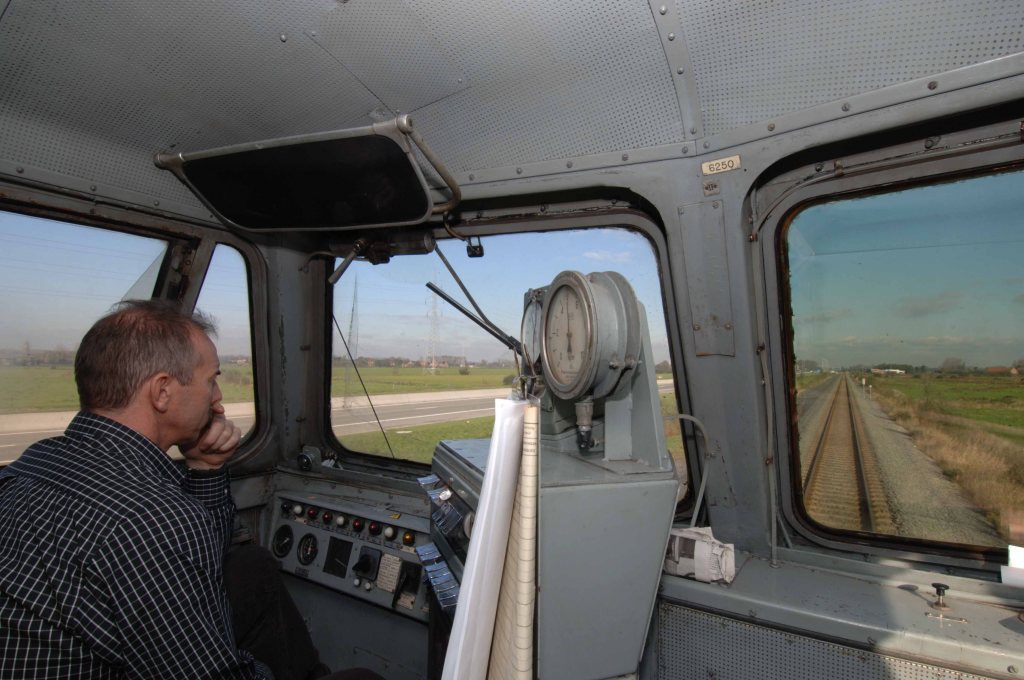
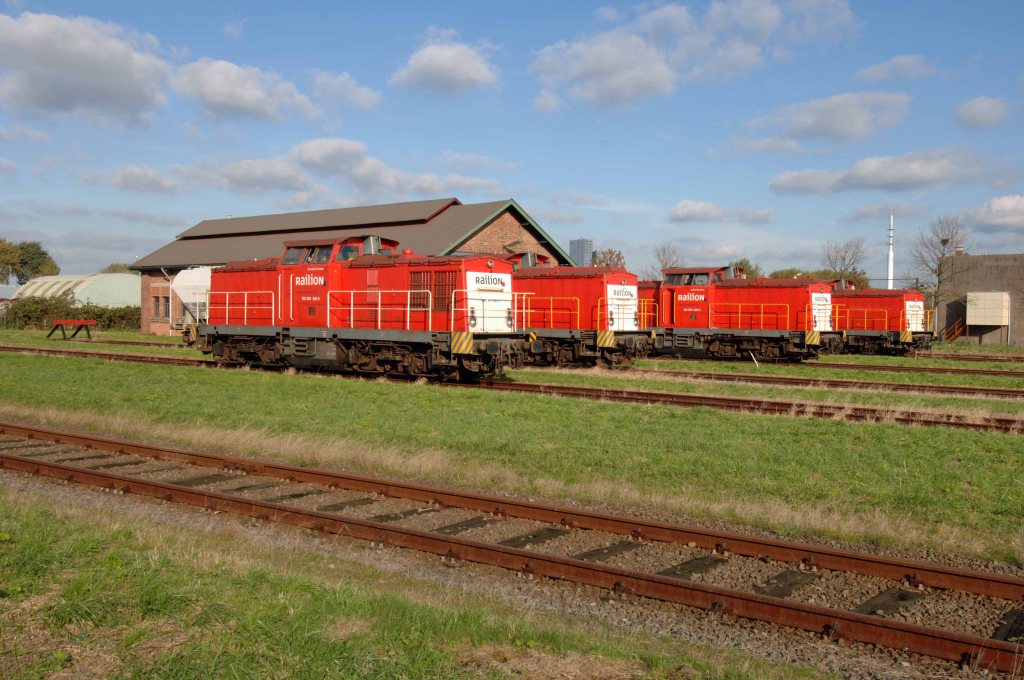
This evening, whilst Dawn’s been cooking some fabulous Indian curry I’ve been busy delving through the picture archives thanks to a friend who jogged my memory . Earlier today Anthony Roberts posted a picture from Belgium showing one of their Cass 62 diesel locos. This set me thinking, and searching my Zenfoilio site. I realised that I’d never added old pictures from some Belgian tours I did back in 2006. I used to have them on my old Fotopic website, but when that went tits-up I lost a lot of caption details as I’d never added it to the original files (which I still have). So this evening has been spent hunting down info to try and rebuld the collection on my Zenfolio site. You can find the resurrected gallery here. Thank God for websites like six bells junction, which has allowed me to check the details of the tour. I’ve more pictures to add but that’s going to have to wait until later in the week. It’s taken me 8 years, another few days won’t make any difference! Here’s a couple of samples. I must admit these pictures have triggered a real bout of nostalgia for what were some wonderful times with a great bunch of people. I used to go over on these tours with a group of friends from the Gloucester area under the banner of Pathfinder railtours. You’ll see some of them in the pictures.
The view from the cab of Class 62 no 6250 as we travel across HollandA line-up of Railion Class 204 locos at Terneuzen. Holland. 4.11.06.
It’s been one of those days where just opening a single newspaper has highlighted why the UK’s ‘green’ movement simply isn’t fit for purpose. They’re more part of the problem, not the solution. I say this with a huge amount of regret as I see myself as someone with a real concern for the environment with a fear of what we’re doing to the planet, but the past few years has seen me look at these groups with fresh eyes.
Let me explain. I saw a paper copy of yesterday’s Guardian earlier. On one page it carried a story reporting on a new report from the Office of National Statistics that says traffic on our roads has increased by 33% in the past 30 years. Here’s a link.
The article by Gwen Topham quoted someone called Jenny Bates, from (what are supposedly) ‘Friends of the Earth’, who said “Despite noise made by vehicle manufacturers about cleaner petrol and diesel technology, transport is still the most climate-polluting sector and it’s clear petrol and diesel sales have to stop as soon as possible…The only way to stop transport from leading us to further climate breakdown is to drastically cut the miles travelled by car. Cleaner options such as bicycles, buses and trains need to be made more accessible and more affordable” .
Perhaps FoE could explain exactly how they propose we can do this when they actively oppose building the high-speed 2 railway (HS2), the only way our increasingly overcrowded rail network will ever be able to cope with a modal shift from road to rail?
To add insult to injury and highlight just how much environmental groups in the UK have totally lost the plot, the opposite page carried a piece on how the Woodland Trust have secured delays to clearing some of the tiny pockets of UK woodland that will have to be cut down to make way for HS2!
I mean, seriously? They’re going to take the fundamentalist approach that ignores the bigger picture? Every single tree and patch of UK woodland is inviolable. Forget tackling global climate change if it means a single hectare here has to be sacrificed for the greater good…
This is why I’ve no time for UK environmental groups like the Woodland Trust or ‘Friends’ of the Earth. They’re not part of the solution, they’re part of the problem. They’ve no real answers to anything. In fact, they oppose the only workable solution we have to vastly increase capacity on our railways and tackle Co2 emissions from transport! This is through the looking-glass stuff! The road lobby and oil companies must be pissing themselves laughing at the way ‘Green’ groups are doing their job for them. What annoys me is the mealy-mouthed statements we get from these groups, where they say “Oh, we’re not opposed to high-speed rail in principle” (just don’t ever try to build it in practice, because we’ll scream blue murder!).
I’ve written about the hypocrisy of the Woodland Trust in this matter before here. Since then, myself and a few other people have been doing some digging and it turns out their hypocrisy verges on the downright dishonest. I’ll be blogging about that in greater detail soon. So, next time you get bombarded with requests for money from these people via Facebook or whatever, just pause for a moment and wonder, are they really offering any solutions, or are these campaigns just a cynical way to raise more money?
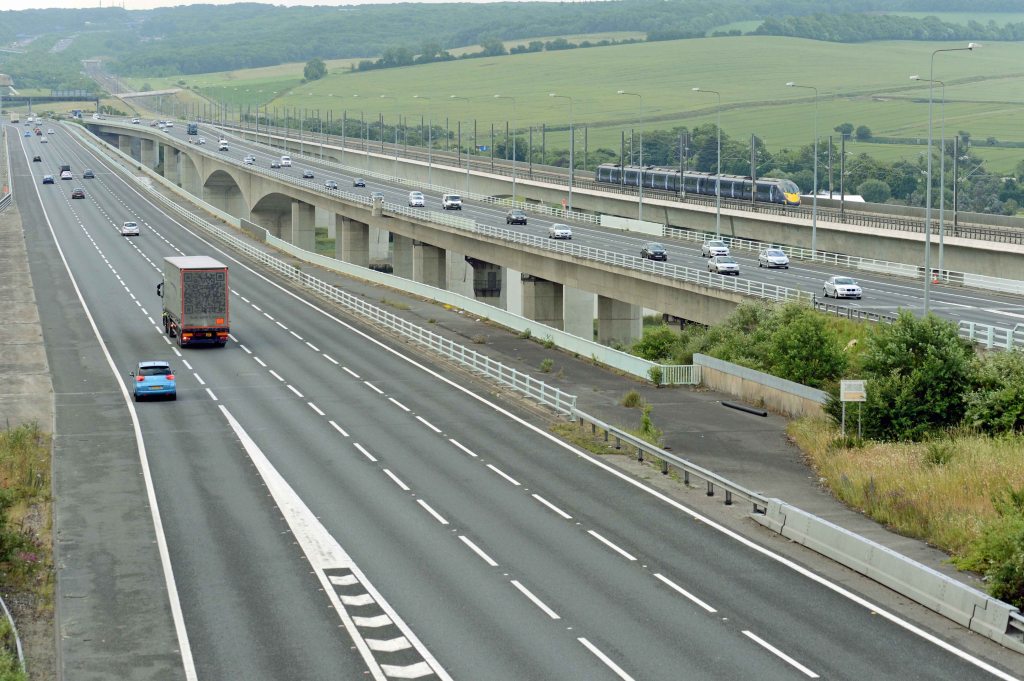
Meanwhile, here’s an illustration of the problem. These are the Medway viaducts in Kent, where the M2 crosses next to HS1.
The M2 requires two massive viaducts, each one far wider than that used by HS1. In the background you see an electric train capable of 140 mph that can carry 352 people seated (and many more standing). Unlike the 60-70mph vehicles on the motorway, it can be carbon-neutral. Yet (supposedly) green groups oppose this as a way to link our major cities! Madness, utter madness…
Regular readers may know that I’ve a cynical streak when it comes to academics. Sadly, there’s a number of them who seem to think their undoubted expertise in specific fields makes them a sage on all things, including complex subjects they know absolutely nothing about – not that this stops them pontificating!
The latest to come to my attention was this load of unmitigated tosh from Professor Dieter Helm, who’s an economist and lecturer at the University of Oxford and also an advisor to the Government.
Sadly, the professor seems to think that his knowledge of economics means that he doesn’t need to do any proper research when it comes to writing about the railways and HS2. If he had, he would have been very quickly dissuaded from writing the nonsense he’s produced. He starts badly, then rapidly goes down hill from there!
Here’s his opening stance:
“What is the question or questions to which HS2 is supposed to be an answer?” Do go on? “When it comes to HS2, the search for a justifying rationale has gone through many episodes. Only one, the original idea, has some merit, but HS2 is no longer an answer to it.” Really? And that original idea was what, exactly? “The original idea, the good one, was to integrate the UK into a European increasingly interconnected high-speed network” Err, Professor, if you’d bothered to do the slightest bit of research you’d have known that’s complete cobblers. Helm is talking about the link between HS1 and HS2 that was dropped by the Higgins review back in 2014.
In fact, that was never “the original idea” at all. HS2 came about because the then Labour Government asked Network Rail to look into the need for new rail capacity. The study, “Meeting the capacity challenge: The case for new lines” was published in 2009. Here’s a link to it. But the idea wasn’t new even then. An earlier feasibility study by W.S. Atkins was commissioned by the Strategic Rail Authority in 2001.
the 2009 Network Rail study considered four corridors and came to the conclusion that the best value option and the one that addressed future capacity constraints was a new high-speed route from London to Scotland.
Note that there was no mention of a link between the new line and HS1. This came about later.
The Network Rail study was the basis for HS2. It was taken forward by the Labour Government under Lord Adonis who’d already set up HS2 Ltd. HS2 Ltd reported back at the end of December 2009 and the then Transport Secretary, Andrew Adonis, published the Government’s response in a Command Paper, ‘High Speed Rail’, in March 2010. It was only then that a possible HS1-HS2 link was suggested as an option. It was never the “original idea” at all. That year, Labour lost power and the new Government confirmed the HS1-HS2 link as a firm proposal, until it became obvious it was a non-starter.
So, Helm’s fallen at the first hurdle. Let’s have a look at some of his other claims. Having got the first one badly wrong he claims that
” First, it is not true that the existing lines could not be upgraded and carry more capacity. Railways are basically empty for almost all of the time, and the distance between and number of trains depends upon stations and signalling. Standing on a mainline station platform at say Didcot Parkway, staring at the empty lines, reflects the fact that for most of the time there are no trains”.
Where to start with this nonsense? No-one has claimed that existing lines can’t be upgraded. Clearly, Helm has no idea that we spent £9bn upgrading the West Coast Main Line just 12 years ago! The point is that upgrading the Victorian network is complex, expensive and disruptive and it adds very little extra capacity compared to building a new high-speed line!
The next one’s even more laughable! Railways are “basically empty for almost all the time” Are you serious? This is weapons-grade nonsense. As for standing On Didcot Parkway, what on earth is that meant to prove? The levels of ignorance of how railway capacity actually works here is stunning. It would be laughable from an ordinary member of the public, but this man’s an Oxford Professor!
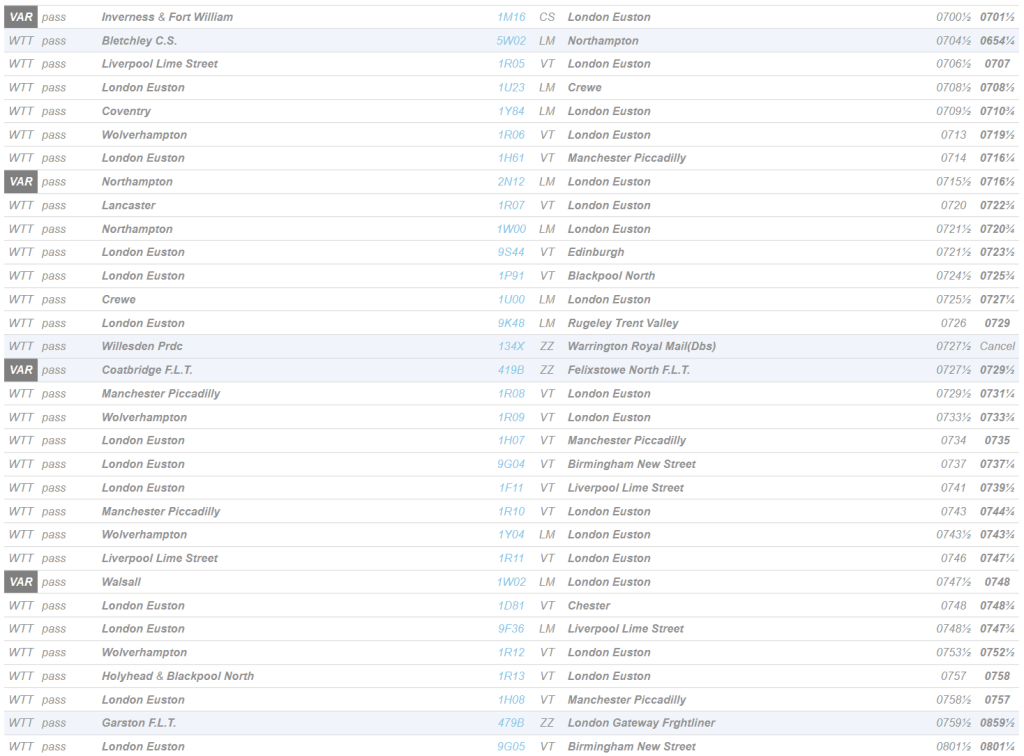
OK, let’s have a look at those ’empty railways’ in the real world. Here’s a copy of today’s actual train workings from ‘real time trains’ for Roade, which is on the two track section of the West Coast Main line South of Rugby. This is the section that phase 1 of HS2 is designed to relieve. This is what passed between 07:00 and 08:00 this morning. A note for those unfamiliar with this, the times in the two right hand columns show first the working timetable times, then the actual time the train passed.
There were 31 trains out of 32 scheduled, as one was cancelled. There’s 16 trains heading for Euston alone, that’s roughly one every four minutes. Some “mostly empty” railway, eh? Right, let’s have a look at the next bit of nonsense.
“Few mainlines carry trains less than 10 to 15 minutes apart. Existing lines could be upgraded, and they have the great merit of already existing and require much less extra land and demolitions that the new line must have. For £100 billion, the existing rail network could be upgraded almost everywhere, with comprehensive modern signalling, station enhancements and a coherent fibre enabled communication system to run it“
Yet again the Prof falls flat on his face in the first sentence. How many other main lines do I need to provide real-time running information to expose this nonsense on stilts? Has the Prof any idea of how much of our railway network HAS already been upgraded over the past few years, or how the fact Network Rail’s spending record amounts doing more?
How does any of this remove the need for HS2? It doesn’t. For example rebuilding Reading at a cost of £1bn a few years ago has done nothing to add capacity to the WCML, only HS2 can do that. OK, let’s plough on.
“Far from dispersing growth to the north from the south, it could easily work the other way around. Furthermore, it is not obvious that the economic growth problem in the north is caused by lack of connection to London, or that the £100 billon spent on HS2 is the best way of increasing the northern growth rate”.
Here we see the usual obsession with London, ignoring all the other places HS2 connects. But let’s tackle this one head on as I’m a perfect example of why this is a fallacy. I live in West Yorkshire but I often work in London. Where do I spend the money I earn in London? Most of it in West Yorkshire, where I live, not where I work. When I get the morning Express to London and home in the evening there are hundreds of other Yorkshire folk doing exactly the same, only now it’s getting increasingly difficult to work on the trains as they’re full. If I get the Grand Central service from Halifax to Kings Cross I’ll be lucky to get a seat, even in First Class, making me less productive. This is the difference between economic theory and reality. Right, next..
“Promoting the economic growth prospects in the north is much more about connectivity within the north” The Prof seems blissfully unaware this is exactly what HS2 does. If we take “the North” as being out of the M25! The current rail services between Birmingham, Leeds and Manchester are slow and not fit for purpose. HS2 will cut journey times between B’ham and Manchester by 52% and B’ham and Leeds by 58%! It will make a huge difference in connectivity between those major cities – and many more.
“In transport, there are two main alternative options. The money could be spent on upgrading the existing rail network, with smart signalling and metering, and smart system coordination, better smarter stations, better access to stations, more and better stations, and better rail lines”.
Frankly, some of that doesn’t even make sense. What on earth is “smart signalling and metering“? If he’s referring to digital signalling like ATO, he’s clearly unaware of the limited capacity gains it offers on mixed traffic railways like the West Coast Main Line (the busiest in the EU). It’s estimated by signalling experts that digital signalling could offer around 15% extra capacity on mixed traffic lines. At the current rate of growth, that would be eaten up in just a few years. Then what? We’re back to square 1. In contrast, HS2 offers a massive capacity increase by moving non-stop express trains off the existing lines onto dedicated lines where digital signalling really can help because all trains are running at the same speeds. It also frees up lots of capacity on our existing network. Not just on the WCML but also on the East Coast and Midland main lines.
” If autonomous electric vehicles develop, controlled by smart systems, and powered by low carbon electricity generation, then roads may be better than rail in the future, having greater flexibility and able to take denser traffic.”
“If”? We need solutions now, not play wait and see! As it is autonomous vehicles have been overhyped and underachieved. I may not see eye to eye with the commentator Christian Wolmar on HS2, but he’s done some excellent work debunking the hype around driverless cars. Even “if” they did arrive there’s no way we’d be seeing what the Professor is suggesting as every vehicle on the road would need to be autonomous before you’d see this pipe-dream happen. But just say it did. Electric vehicles are still far more polluting than trains. Oh, and how an electric car carrying a max of 5 people and limited to 70mph will be ‘better’ than a 200mph train carrying 1100 is stretching reality to breaking point. This is no ‘alternative’ to HS2.
Finally, we get this old cherry.
“If the counterfactual is the infrastructures more generally, then the first candidate would be fibre and broadband. This would cost less than £100 billion to complete and one of its impacts would be to reduce the need to travel and hence the demand for travel.”
Really? As we’ve had fibre and broadband for many years now, perhaps the professor could say when it’s ever reduced travel demand? Rail passenger numbers are still growing and hitting record numbers. Here’s West Coast operator Virgin trains figures. Virgin has grown passenger numbers from 30.4m in 2012-13 to 38.3m in 2017-18, an increase of 25.98%!
Here’s the statistics for the other West Coast operator, West Midlands Trains. They’ve grown numbers from 60.5 million in 2012-13 to 74.9 million in 2017-18, that’s a growth of 23.8%. So much for broadband reducing travel…
In fact, it’s arguable that improved wireless communication and technology has helped increase, not cut, travel as less and less people are tied to their offices – hence so many people working on trains! OK, next…
“It is hard to avoid the conclusion that the future is more likely to be cars and vehicles than trains”
No, it’s really, really not, this is more nonsense on stilts. High-speed rail is the land transport of choice in the 21st century, which is why so many countries are investing in it. China has built 25,000 km already in just a few short years. Now we have Saudi Arabia, Turkey, Russia and Morocco added to the list. Soon there’ll be Indonesia, India, Thailand the USA and many others.
Like the professor, I could go on, but there’s little point. I think my job here is done. It’s a great shame when academics get so carried away with themselves they trot out stuff like this. I could call it badly-researched, but it’s not. It’s hard not to draw the conclusion that he’s done no research at all.
It’s been an interesting and busy day so far, even if I’ve not got done everything I hoped. Yesterday the details of the Oakervee review panel into Hs2 came out, which saw me write a comment piece for RAIL mag about it, then a much longer blog that looked at the composition of the Committee. The past 24 hours have seen a barrage of comment – much of it woefully ill- informed or politically driven – but it’s been good to see the projects supporters wade through this nonsense to forcefully rebut it. Few of us have any worries about the review, but we know the next few days and maybe even weeks will be full of froth until the Committee reports back and we can continue with building HS2 without anymore daft diversions. There’s enough political theatrics going on as it is what with Boris the Clown humiliating us on his European tour. Brexiters are finding out to their cost that the excuse they used that the only reason Brexit wasn’t going well was because a ‘remainer’ was PM, was as true as all their other claims.
Away from the froth I’ve been busy sorting out pictures for clients and my website, along with future travel plans and events. This Saturday we’re having a day on a friend’s narrowboat and I’ve also been sorting out Eurostar tickets for the next ‘Big 6 on Tour’ adventure, which sees a group of us venture further afield to Bruges for a few days.
I’d planned to head out and top up the library shots as I’m meeting a friend in Stalybridge later, but – despite all the predictions of brilliant weather to come – it’s been pretty miserable in the Calder Valley today, with rain issuing from some very gloomy skies. Hardly conducive to photography. That said, I’m off out shortly (if this bloody rain ever stops) , so let’s see what transpires…
13:33.
The rain finally eased enough for me to make a dash for freedom and walk down into Sowerby Bridge. The weather may be wet, but it’s also humid, which I wasn’t expecting. Waterproof + camera bag + mile long walk = clammy!
Now I’m drying off on Northern’s 13:21 to Chester as far as Manchester Piccadilly. It’s a Class 150/153 combo with plenty of spare seats. I think the weather’s put a damper on things for many leisure travellers, although a couple of hardy cyclists did detain at a very miserable looking Todmorden, where the tops of the surrounding hills are lost in the murk.
14:20.
Manchester’s weather’s living up to the city’s reputation although the sun’s struggling manfully to show its face. The skies are dark and threatening enough to make for some interesting pictures so I’ve decided to look at a place I’ve been meaning to revisit for a while, the area around Northern’s Newton Heath depot. I’m heading there courtesy of these.
Metrolink has been a great success and I’ve never understood the antipathy some rail enthusiasts have towards converting heavy rail routes to light. The Oldham loop was a classic example! Now it’s far more successful and serves more communities than the heavy rail route ever did.
15:58
I’d forgotten just how run-down and depressing the area around Newton Heath is! Despite regeneration efforts it’s still struggling. The area seems to be a classic example of the fact you can regenerate buildings, but people are far more of a challenge. The depot is expanding as a new shed’s being built to service the new CAF built Ckass 195s.
16:49.
I’ve moved on again and left the dereliction and despondency of Manchester behind. A pair of Pacers have brought me to Stalybridge, home of one of the finest station bars on the network.
21:18.
I’ve enjoyed a very pleasant evening being a Northern Ambassador to a friend from South of London who’s never really explored Manchester. We only had a couple of hours but a look around the city’s ‘Northern Quarter’ has done the trick. Now I’m on my way home as tomorrow’s a very busy day as I’ll soon be on the move again.
21:42.
The final trip of the day. I’ve changed at Hebden Bridge to get a connection to Sowerby Bridge. The problem is the Blackpool- York train I’ve connected with is a human zoo. The contents of these trains doesn’t inspire of the future of the human race, nor the planet
On 21st August the
Transport Minister, Grant Shapps MP announced the composition of the Oakervee
Hs2 review panel. The deputy chair
will be Lord Berkeley whilst the panel will consist of Michele Dix, Stephen
Glaister, Patrick Harley, Sir Peter Hendy, Andrew Sentance, Andy Street, John
Cridland and Tony Travers.
The
members are both pro and anti Hs2, politicians, rail leaders and academics who’ll
examine all the claims and counter claims made. It’s a well-balanced panel as
academia will be tempered by real world experience and those who understand the
issues and need to deliver results on the ground.
Progress will have to be rapid as their report is expected in the Autumn. I expect to see off some of the wilder claims and ‘alternatives’ and focus on why we’re building Hs2 in the first place. I also expect the claims that HS2 can be terminated at Old Oak Common seen off once and for all. I believe that making Lord Berkeley, a man who’s been a constant critic of HS2 whilst proposing a number of impractical ‘alternatives’ himself as Deputy Chair to be a clever move as he’s going to have to sign up to the report’s conclusions.
Let’s
have a look at the panel in greater detail.
Doug Oakervee
Oakervee
has decades of experience in delivering major civil engineering projects. A
former President of the Institution of Civil Engineers, he was the Executive
Chairman at Crossrail from Dec 2005 to
May 2009 and non-Exec Chairman of Hs2 Ltd from March 2012 until December 2013.
Michèle Dix
A Chartered Civil Engineer and former board member of construction company Halcrow, Michele joined Transport for London in 2000 where she had responsibility for the congestion charge. In 2007 she became Managing Director of Planning. She was responsible for leading the planning strategy on the future transport needs of London. In February 2015 Michèle left Planning to become the Managing Director of Crossrail 2 and is now responsible for developing Crossrail 2 and gaining funding and powers for it. Her depth of understanding of the impact of Hs2 in London and its transport network will be extremely valuable.
Professor Stephen Glaister
Glaister is Professor of Transport and Infrastructure in the Centre for Transport Studies at Imperial College London. He’s a long-standing advisor to government on transport issues and economics and contributed to the Eddingtom report. He’s a ‘soft’ critic of HS2 who tends to see both sides of an argument without reaching any firm conclusion. He was interviewed by Halligan for his ‘Dispatches’ hatchet job on Hs2. Halligan asked him “is it (Hs2) good value”? Glaister replied “nobody knows”! I expect Glaister will offer the same non-committal advice to this committee.
Councillor Patrick Harley
Harley is a Conservative Cabinet Member at Dudley MBC and former Council Leader as well as a member of the West Midlands Combined Authority. He’s been a backer of transport initiatives in the West Midlands, including Hs2, which is very important to the area. Harley’s a strong supporter of Midland Metro and has highlighted links it will provide to HS2
Sir Peter Hendy CBE
Hendy needs little introduction. Currently the very active Chair of Network Rail he’s a former bus man, having started his career in the public transport industry in 1975. He was appointed to the position of Managing Director of Surface Transport for Transport for London in 2001. In 2006 he was appointed Commissioner of Transport for London before moving to Network Rail in 2015. Peter has enormous experience of running the sharp end of public transport and understands the need for a strategic vision for both London and the UK.
Andrew Sentence
Sentence is a business economist. Formerly Senior Economic Advisor to PWC from 2011 to 2018, previously he was an external member of the Bank of England’s Monetary Policy Committee from 2006 -2011. He’s also a former head of economic policy and director of economic affairs at the CBI who has an interest in the low carbon economy. Amongst other things he’s a former member of the Commission for Integrated Transport (2006–10). I suspect he’ll bring a balanced look at the economics and Hs2’s potential to tackle carbon emissions.
Andy Street
Andy’s a former MD of John Lewis who’s currently the Conservative Mayor of the West Midlands and a strong pro Hs2 voice in the Tory party. He’s an unabashed ambassador for the West Midlands and the positive economic benefits better transport links like HS2 bring to the area.
John Cridland
John’s
a former Director of the CBI (an organisation that supports HS2). He’s
currently Chair of Transport for the North (TfN) and well placed to know the
real issues. TfN have made it clear that HS2 phase 2 is essential to delivering
Northern Powerhouse Rail.
Professor Tony Travers
Tony’s another academic. He’s currently Visiting Professor in LSE Department of Government and Director of of the London School of Economics who’s advised the Government on a number of occasions. A critic of HS2 but someone who focusses on costs of the project rather than the practicalities of it. Hardly surprising, as that’s the beauty of academia, you can ‘umm and ahh’ safe in the knowledge that it’s not your neck on the line.
The review’s remit
Importantly, each member will focus on a specific area, feeding into and being consulted on the report’s conclusions, without having a right of veto. I expect the academics to do what academics do – and the politicians and business leaders to draw up the conclusion. After all, it’s the elected politicians whose necks will be on the line, and there’s plenty of experienced people on the panel to pose the question, “if not Hs2, what’s your plan B, and you’d better come up with it PDQ!”
I would
be surprised if the review delivers a major policy change on HS2. The phase 1
project is too far down the line to be sent back to the drawing board as that
would result in chaos on the railways at huge additional cost. On the
(potential) eve of Brexit it would also deliver entirely the wrong political
message. Don’t expect Hs2 to be cut back to Old Oak Common either, the
technical problems with such an idea are huge.
What
could be possible is for elements of phase 2 to be changed. Imagine if some of
the funding for the sections around Leeds and Manchester was diverted to Transport
for the North to deliver (at an earlier date) the elements of Hs2 that would be
integral to Northern Powerhouse Rail? This budget reallocation wouldn’t stop
Hs2, but it would address some of the cost issues and politically, it would
show a real commitment to the North that the Prime Minister has already stated.
Then, when Hs2 phase 2 is built it can simply link up with existing NPR
infrastructure. Of course, all this is entirely speculative. We’ll have to wait
until the autumn to see what the review decides.
The past few weeks have seen the charity The Woodland Trust finally break cover and come out in opposition to Hs2. This is due to the fact they’re very much a single-issue campaign who really can’t see the woods for the trees. Forget the wider issues of climate change, they’re all about woodland, and Hs2 will cut though some ancient woodland which simply can’t be avoided except at huge cost. For the WT, cost doesn’t come into it. In their view ancient woodland should be protected at any cost. But then, when it’s not your money you’re spending, that’s easy to say!
When I’ve challenged the WT on their opposition to HS2 they’ve come over all pained and said that they don’t object to HS2 ‘in principle’ – only in practise! Frankly, this hypocritical stance doesn’t fool anyone. They want to see HS2 delayed, or cancelled, as their latest campaign makes clear. According to them “Any transport system that destroys irreplaceable habitats such as ancient woodland can never be called ‘green'”.
Notice the use of the word “destroys”? There’s a lot of emotive hyperbole in their writing about HS2. They also describe it as “smashing” through ancient woodland. If you believed their rhetoric you could be forgiven for thinking HS2 was more like Genghis Khan and the Mongol hordes sweeping across the country rather than engineering companies that are building something and have to adhere to strict environmental standards that are legally enforceable.
There’s also another problem. Exactly how much is HS2 allegedly “destroying”, and how? You won’t get any firm answers from the WT, they’re extremely coy when it comes to detail other then headline figures, as this tweet demonstrates.
What exactly does “facing damage” mean when it’s at home? It’s meaningless. Emotive, but meaningless. Look at this statement from their latest petition against HS2.
“It’s a terrible situation – we could lose many of our greatest national assets for no reason at all”
“Many”? really? Let’s try and get some perspective here and I’m using the Woodland Trusts own figures to supply it.
The WT estimate that there’s 450,000 hectares of ancient woodland across the UK.
That’s 450,000 hectares out of a grand total of 3.19 million hectares of woodland across the UK. OK, so how much ancient woodland is HS2 going to affect? The Woodland Trust’s own figure is 40.2 hectares but they don’t define what ‘affected’ is. We don’t know what percentage of that is cut down, or what HS2 might come near and supposedly “damage” in passing. It’s all very nebulous and the WT refuse to come clean over what any of this actually means in practise. So, here’s the numbers crunched. If there’s 450,000ha of ancient woodland and only 40.2ha is affected by HS2, that’s just 0.008%. Now, what was that the WT said, oh yes “lose many of our greatest national assets” 0.008% is “many”? Someone’s not being honest with people here…
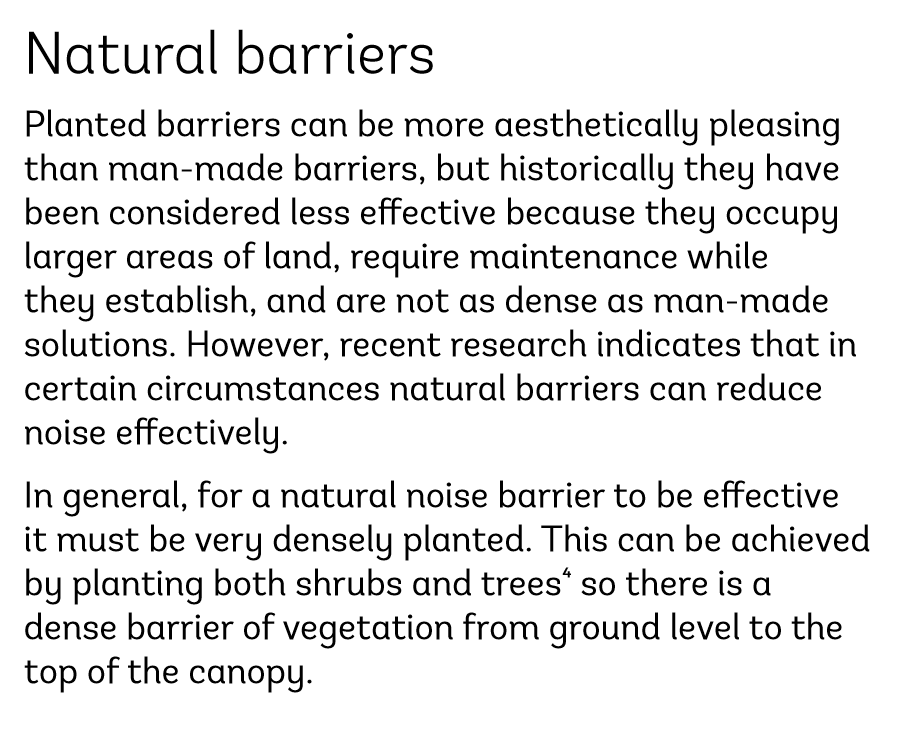
Talking of not being honest, the Woodland Trust list noise and dust as part of the “damage” HS2 will cause to ancient woodland. Yet one of their own fact sheets on HS2 talks about woodland making good noise and dust barriers! How’s that for hypocrisy. Here’s a link to their information sheet. Here’s part of what it says.
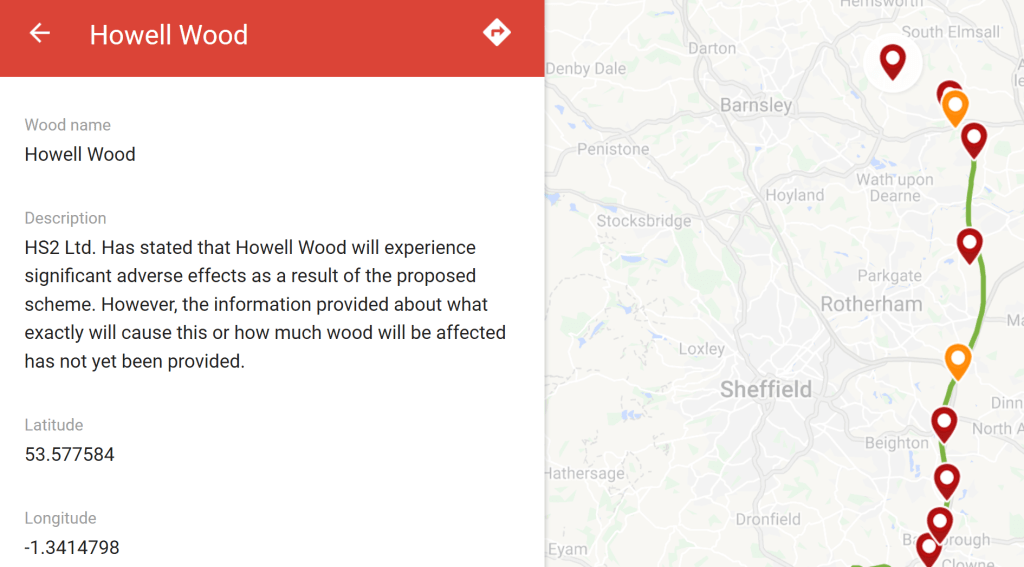
Another awkward question the Trust refuse to answer is how can they be so precise with their figures, like the 40.2ha claim when they admit themselves that they don’t actually know the size of the areas of woodland on Hs2 Phase 2b that will be affected? This is taken from their website.
The WT admit they don’t know how much of the wood will be affected, so how can they make such precise claims? This isn’t the only wood where they admit they’ve no idea either…
Today, the Woodland Trust have been tweeting out this latest exaggeration. They’re no longer claiming 40.2ha of Woodland’s affected by HS2, they’re now saying it’s 57.8ha. So where’s the evidence for this new claim? There’s none. Nothing at all. As I’ve already shown, it’s impossible for them to substantiate such a claim – even their own website admits that – because no-one knows what will happen on phase 2b until the plans are finalised and the Petitioning process is completed. They’re deliberately misleading people.
There’s also one very large elephant in the room that the WT point-blank refuse to see. If we’re serious about cutting carbon emissions from transport the only way we can do that is by vastly increasing our rail capacity to cope with the modal shift needed to get lorries and cars off our roads. That means building HS2 (which the WT oppose). If we don’t do that, it won’t just be ancient woodland affected by climate change, it will be all 3.19 million hectares of UK woodland. The WT really can’t see the woods for the trees. The sad truth is that – like many single-issue campaigns – the WT’s blinkered approach is part of the problem, not part of the solution.
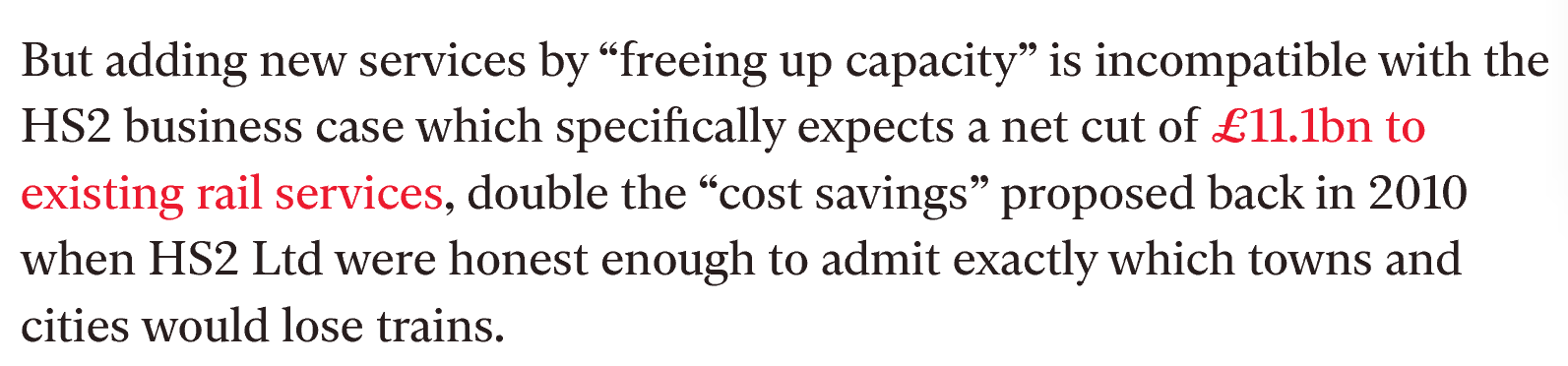
A few days ago, StopHs2 ‘Campaign Manager’ Joe Rukin was given a platform by the Independent newspaper to spout his usual dishonest rubbish about Hs2 without the slightest challenge. There was no interview, just a polemic written by Rukin. In it, he doubled-down on some of his old lies, such as the claim that there will be billions of pounds worth of service cuts on the conventional network to fund Hs2. Here’s the quote.
Rukin knows this is a lie as it’s been pointed out to him over many years by many people. But he can’t resist retelling it, just like his many others, because Rukin will never admit his dishonesty and dishonesty is all he’s got left now their ‘campaign’ is up shit creek without a political paddle. I first exposed it here way back in February 2015. Of course, in those days, Joe claimed it was only £8.3bn! Here’s what I wrote at the time.
“Joe’s totally unsubstantiated claim that this means “£8.3 billion of cuts to classic services” might be considered suspect by the most innocent of readers. And they would be right. It is true that in the Economic Case analysis (table 9 on page 78) is a figure of £8.265 billion, labelled “classic line savings”. So what’s that all about? Well first, it refers to the full network in Phase 2, not Phase 1. Then, it’s a Present Value, that is, 60 year’s worth of annual sums all rolled into one. So the annual figure relevant to Phase 1 will be a lot – and I mean a lot – smaller. Which is why Joe doesn’t quote it.
But whatever it is, is Joe right to paint this as “cuts”? Got it in one, no he isn’t. Go back to the beginning, and remember that, apart from the new Curzon St services, the HS2 service for Phase 1 is basically the present Virgin pattern unplugged from the WCML at Handsacre and plugged into HS2 to Euston instead. So we have, for instance, an HS2 train every hour that runs from Liverpool, calls at Runcorn and Stafford, and then on to Euston on HS2. The cost in terms of fuel, maintenance, crew and fleet leasing should be charged to HS2, no-one would dispute. But that train replaces a Virgin service that callsat Runcorn and Stafford, then to Euston on the WCML. So of course the saving from replacing that train with the HS2 service should be deducted from the cost of running the HS2 train. Same stations, same destination, and faster. What has been “cut”? Nothing.”
Since Rukin first told this lie many new rail franchises have been let. Most recently the Greater Anglia, Northern Rail, SouthWest Rail, Transport for Wales, East Midlands Rail franchises and from today – the new West Coast partnership which will cover the west Coast Main Line and phase 1 of HS2 as the new franchise will run until March 2031.
So, where are Joe’s cuts? Not a single franchise that has been let since HS2 was first mooted has contained ANY service cuts. Exactly the opposite in fact, they’ve all introduced new services and new trains. In the case of Greater Anglia they’re replacing their entire train fleet! It’s the same with many others, who are expanding, not contracting their fleets! So, where are the cuts, Joe? Take this snippet from todays West Coast announcement. Some of these new services will be run by brand-new bi-mode trains!
Whichever way you look at the evidence, it’s clear that Rukin’s a serial liar who will say anything. Oh, you might have noticed something else. This new franchise covers the West Coast Main Line and HS2 phase 1 until 2031. Why would the Government let a franchise for a new railway that it’s about to cancel?
Joe has a big problem, he can lie as often as he likes about these things, he can ignore the facts – but the facts keep coming back to expose him for what he is – a man whose pants are perpetually on fire!
Every so often, an article appears in ‘The Spectator’ where the sole intention is to knock HS2. Don’t be fooled into thinking the ‘speccie’ is somehow a magazine of independent mind. It’s the house journal and propaganda sheet for the far-right of the Tory party. It’s also famous for producing fiction masquerading as fact. It has a long history of getting it wrong on events around HS2. In fact, if you believed everything you ever read in the rag, HS2 should have been stillborn.
The latest mountain of rubbish comes from one Ross Clark, a man who’s clearly a stranger to knowing anything about the subject, or even bothering to do the slightest research on it. He’s come up with this nonsensical piece called “There is a far better option than HS2, and it already exists.
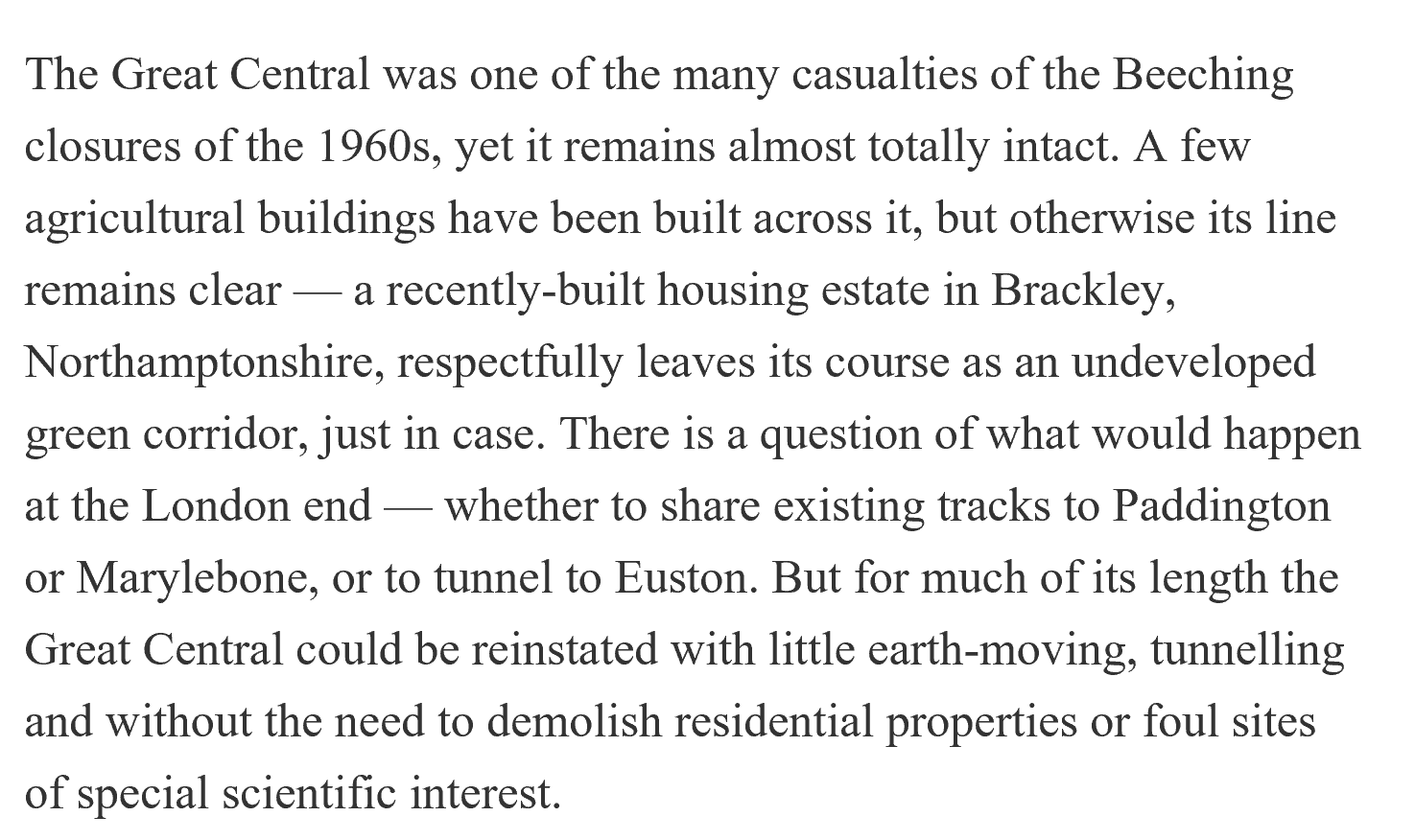
Yes, you’ve guessed it, he’s blathering on about re-opening the Great Central railway! For some reason, the Great Central is one of those totemic issues to people of a certain age, not all of them are railway enthusiasts, although many of them are. It’s symptomatic of England being stuck in the past rather than looking positively to the future, ‘cos for a ‘bright’ future, all we have to do is bring back the past, obviously! You can see this bonkers thinking in the whole Brexit shambles. Anyway, I digress. Let’s have a look at some of Clark’s claims.
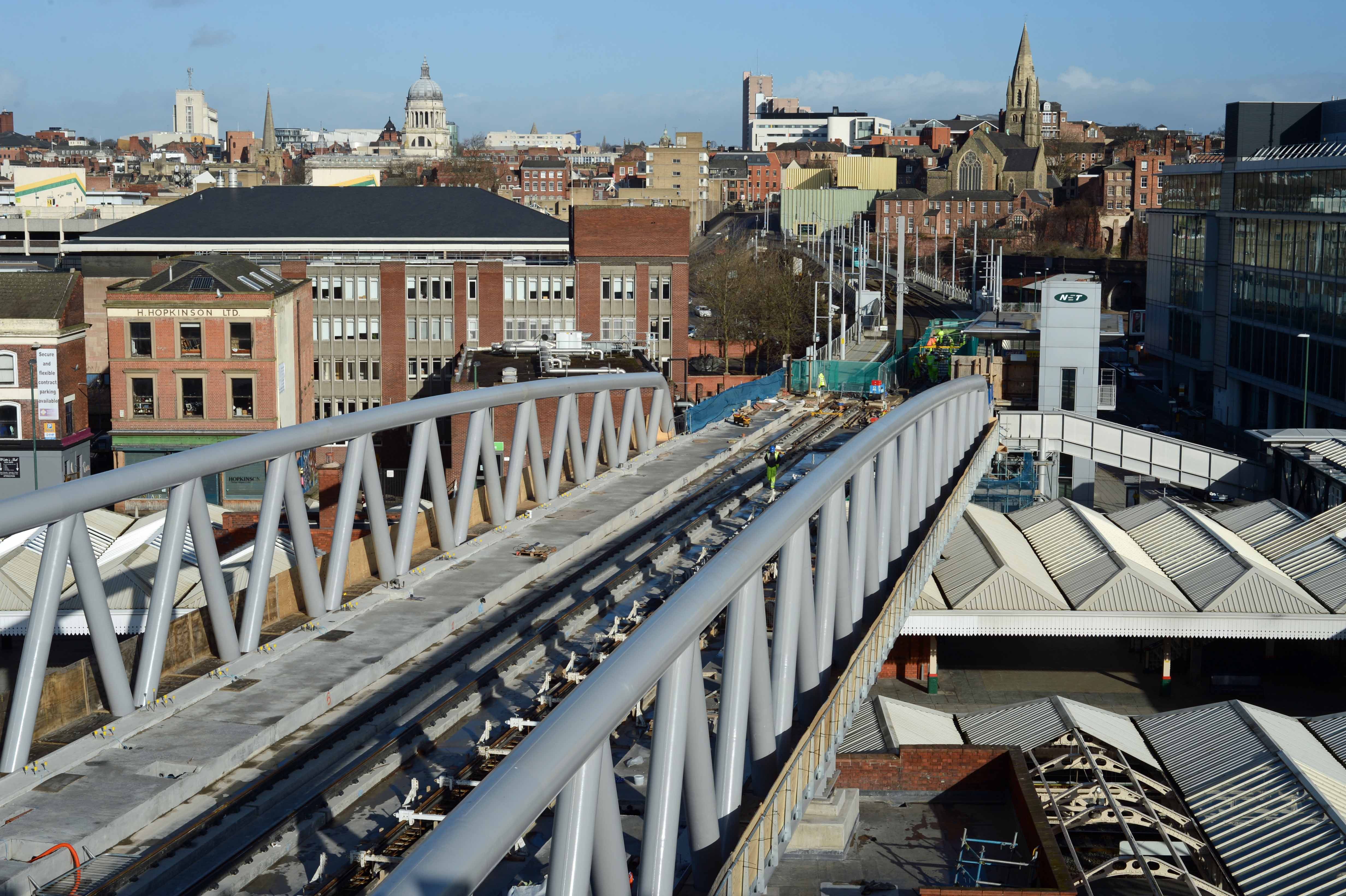
I’m struggling to find a single factual statement in this. Where to start? It takes the same route as HS2? No, it doesn’t. The nearest to Birmingham the GC went was Rugby, after which it headed North to go to Leicester, Nottingham and Sheffield. There’s a clue in its name! Its viaducts and bridges are ‘unused’? Well, ignoring the fact many of them have been demolished, that would be news to the good citizens of Nottingham, as much of the city centre formation of the GC has been incorporated into the new tramway, and the site of Nottingham Victoria is now a shopping centre. Here’s an illustration of the scale of changes in Nottingham.
This shot was taken in 2014. It shows the new tram route crossing over the centre of the remaining Nottingham station. It’s built on the course of the Great Central, which crossed the station in exactly the same spot, only that was demolished years ago. This bridge now links the two separate sections of the NET tramway. Remove this and you cut the new tram network in half. Not only that, but the remaining formation of the GC is used by NET in the background. The GC’s ‘almost totally intact’? Pfft!
This website has a great selection of pictures documenting the demolition of the Great Central around Nottingham.
As you can see, the idea that the tracks were ripped up 53 years ago, leaving the formation untouched until the present day is just a load of cobblers, frankly. For example, much of the GC’s route through Leicester was demolished by the beginning of the 1980s whilst the famous bowstring bridge was dismantled in 2009. Here’s a fascinating website that documents the demolition of the Great Central’s infrastructure around Leicester. It blows Clark’s claims out of the water.
At Rugby, the huge ‘birdcage’ bridge that used to carry the GC over the West Coast Main line was demolished in 2006. There’s also a large industrial estate to the north now. It’s the same with the 223m long viaduct at Brackley, which was demolished in 1978. There’s also the small matter that a couple of chunks of the GC around Loughborough are now part of the preserved Great Central railway. They had to reinstate the bridge over the Midland Main Line at great expense and any battle to reclaim the route from them would be rather expensive I imagine! Oh, talking of Blackley, William Barter’s sent me this link, which proves Clark couldn’t even get the bit about reopening the GC not affecting any SSSI’s right. Part of the GC route IS an SSSI!
The GC had ‘the fastest expresses in the country’? That’s a new one I’ve never heard before and I notice he offers no evidence for that claim. The GC had no ‘racing’ stretches like the LNER did on the East Coast main line, or the Great Western had on Brunel’s ‘billiard table’, it just had few stations on the London extension.
Then we get the age-old nonsense that the GC’s London Extension was built to ‘continental loading gauge’. No. It wasn’t. The most common guff you hear is that it was built to ‘Berne gauge’ – only Berne gauge wasn’t established as a standard until a 1912 conference (yes, you’ve guessed it – in Berne!) and wasn’t adopted until 1914, long after the GC London extension was opened. Yes, it does have a slightly more generous loading gauge than many other UK railways built earlier (but only on the London extension), but that’s not equal to any of the standards accepted in Europe and it certainly isn’t the same as the UIC standards trans-European railways like HS1 are built to. It’s also worth noting that many EU railways like Belgium, Germany and the Scandanavian countries use a loading gauge that’s far bigger than Berne.
Another howler is the claim that the GC London extension built as a high speed railway. Firstly, define ‘high-speed’? In the era the GC was built, 75mph was ‘high-speed’, it’s not now. The idea that to can just reinstate a few bridges, relay the track and whizz trains up and down it at 140mph as Clark asserts is just another fantasy. Of course, there’s a subtle irony about these high-speed claims. The London extension was high-speed because it was built as straight as possible through open country and had few intermediate stations so that expresses weren’t slowed down. All these are things opponents of Hs2 object to!
Here’s some more guff from Clark.
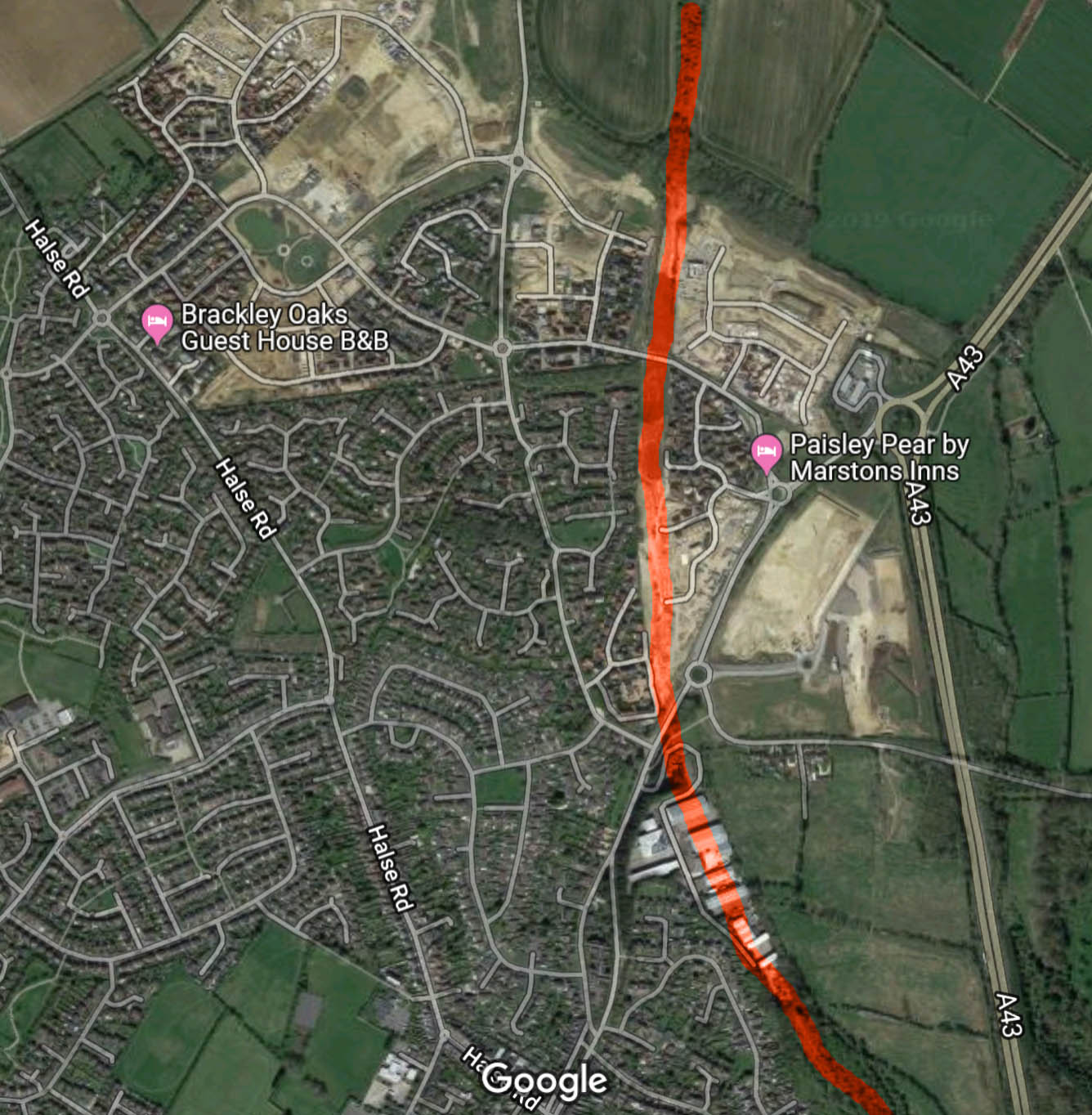
Right, we’ve already exposed the “almost totally intact” nonsense, but let’s really put that one to bed. The line remains ‘clear’ at Brackley? I’ve already mentioned the demolished viaduct there, but here’s a screengrab from Google maps showing the town itself. I’ve marked the old GC route in red.
If the line’s ‘clear’ at Brackley, what’s that big industrial estate towards the bottom of the picture then? I could produce map after map showing how little is actually left of the GC route on the ground, rather than in Clark’s imagination. Plus, does Clark seriously think that the residents of the new housing estate would welcome the idea of the place being cut in two by re-opening the GC? Nimbyism would be rife along the route, just as it has been with HS2, where plans to reuse part of the GC formation in Bucks met with opposition from Nimbys!
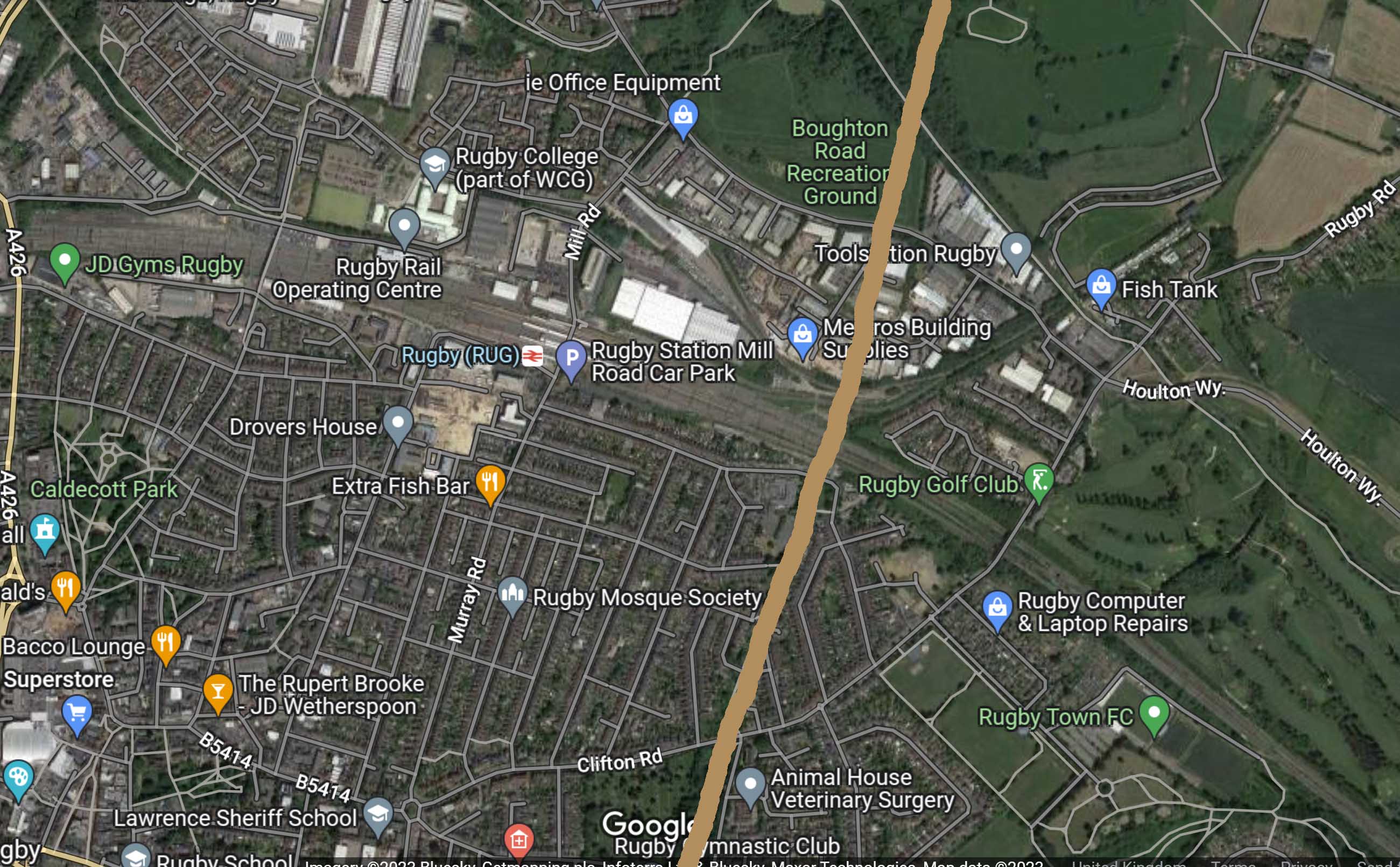
Now lets look at Rugby. There was never a connection between the Great Central and the LNWR at Rugby that faced towards Birmingham. THE GC passed over the LNWR on the famous ‘birdcage bridge’. To build any such connection now you would have to demolish a large part of the town! It’s utterly bonkers but then these people never let facts get in the way of their flights of fancy. Can you imagine the uproar in Rugby if anyone seriously suggested this? Here’s a map to illustrate the issue. I’ve drawn on the old route of the GC so you can see the problem.
Now let’s address the ‘question’ of the London end, which Clark poses but glibly ignores answering. Run into Marylebone? You’re having a laugh! Since the 1966 closure of the GC Marylebone’s fortunes have changed completely, once proposed for closure itself its now a very busy station run by Chiltern trains who added two more platforms in 2006 to cope with all the extra trains they run. There’s simply no spare capacity there, nor on the Metropolitan line tracks the route shares with London Underground heading up through Rickmansworth to Amersham. As for running into Paddington. that’s just as laughable, it’s yet another London terminus with no spare capacity. In the 50 years since the GC closed rail services have grown massively, a point totally ignored by Clark. He also mentions Euston but neglects to mention the fact HS2 is having to build a lot of new platforms there to cope. Here you see the beauty of being a writer who’s untroubled by reality, you can airly solve these problem with a few taps on your keyboard. In the real world however…
It’s time that we finally put to bed this fiction that re-opening the Grand Central is either possible, or desireable. We need to stop indulging in these flights of fancy into the past and start dealing with the reality of the future. One last point. The weather. Unless you’ve had your head buried in the sand these past couple of weeks you can’t have failed to notice that the weather is getting more extreme. Our Victorian rail network was built for an age when Climate Change wasn’t even considered. Now we know the truth. HS2 has been designed and will be built to cope with those ‘once in a century’ events that are now happening almost every year. We cannot rely on Victorian infrastructure forever.
I’ve a favour to ask… If you enjoy reading this blog, please click on an advert or two. You don’t have to buy anything you don’t want to of course (although if you did find something that tickled your fancy would be fab!), but the revenue from them helps to cover some of the cost of maintaining this site – and right now (because of Covid), us locked-down freelances need all the help that we can get…
You have to laugh! StopHs2, the only ‘group’ left opposing Hs2 have come up with a cunning wheeze to explain the fact that the Hs2 Phase 2a hybrid bill sailed through Parliament with a majority of 246 last week. Their plan? Don’t even mention that it ever took place – just ignore the fact! So, there’s no mention of it on their website, or their Facebook, or in tweets. It’s as if it never happened!
You can understand why it’s an embarrassment to them as it underlines their complete irrelevance nowadays and the fact that what little political support they had has collapsed. I blogged about the result here.
How long Stophs2 are going to maintain this pretence is a good question. It’s certainly made a mockery of their claim that they’re ‘the’ place to go to, to learn about Hs2! But it is very funny! I’s yet more signs of the irrelevance of Stophs2 nowadays. Unlike the Phase 1 petitions, they weren’t even involved in the Phase 2a process at any level. No-one invited them along, so they rarely mentioned it. But then they’ve always been a campaign (and I use that term in its loosest sense) that’s been firmly based on Phase 1 of Hs2. Mind you, as their Chair, Penny Gaines actually lives in Bournemouth nowadays (no, really!) they’re even more isolated. Of course, quite what Penny chairs is open to question, as Stophs2 is little more than her and Kenilworth based Joe Rukin!
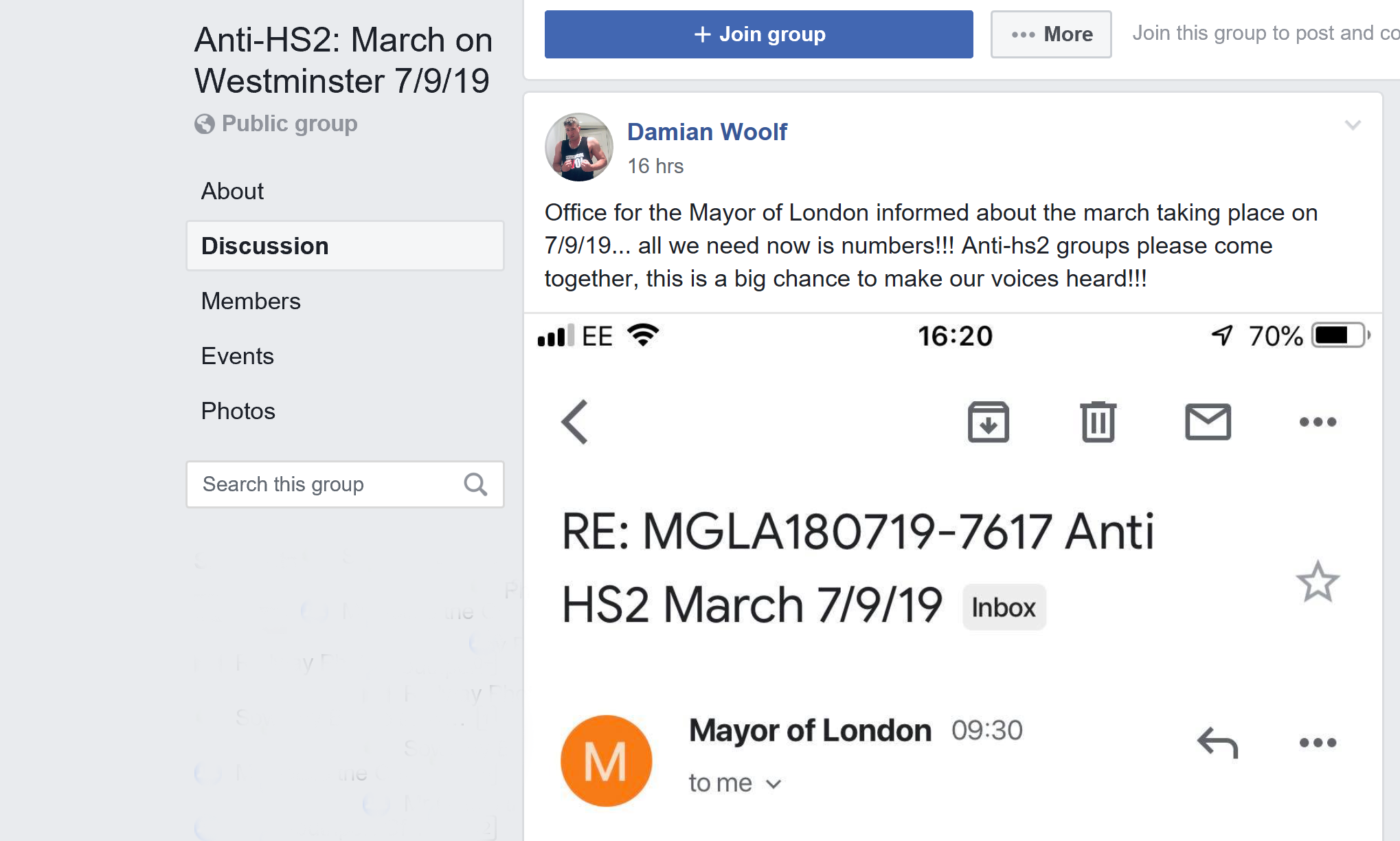
Meanwhile, some lone soul has decided to arrange another anti Hs2 demonstration in London via Facebook and Twitter! If it ever happens (which is extremely doubtful) It’s meant to take place on the 7th September.
Unsurprisingly, Hemel Hempstead based Woolf is also a Brexit fanatic. Oh, I wouldn’t bother with his Facebook page either as there’s little of interest, unless you like looking at someone posting lots of ‘selfies’ all about bodybuilding! His attitude to people on Twitter (where he uses the appellation @drophs2) doesn’t exactly inspire much confidence in his rhetorical or intellectual capacities either…
You have to wonder. There’s 6.5 million people living on the route of Hs2, yet there’s never been a credible anti Hs2 campaign. The best they came up with was the Hs2 Action Alliance – which at least had some educated people involved, even if they were only Chiltern Nimbys! Now it’s reduced to the likes of Rukin and Gaines, a couple of dozen ‘Walter Mitty’ types who still think ranting on Twitter will stop Hs2, few self publicists like young Woolf plus a handful of misguided Greens who can’t see further than the ends of their noses. Hardly what you’d call a ‘winning team’ is it? I popped in to have a look at the progress of StopHs2’s latest petition on the Government website this morning. It’s taken them 10 days to get another hundred signatures!
The petition doesn’t stand a hope in hell as to be on target they should have had 58,000 by now. It now needs over 800 every single day until October! I see no-one in Camden has signed it for almost 6 weeks now, leaving it stuck on a miserable 247.
I suspect StopHs2 are in for even more disappointment when (as is looking increasingly likely) the blond buffoon Boris Johnson becomes Prime Minister. The chances of Johnson cancelling HS2 are minimal (see link). They’ve previously been sold a pup by another Brexiter, Jacob Rees Mogg, who’s another one who says one thing and then does another. Having been quoted saying he’d cancel Hs2 he then goes and votes for it – several times in fact! You can read about that here. Their poster boys do have a habit of letting them down! I await Boris Johnson’s premiership with interest!
Yesterday, the High Speed Rail (West Midlands – Crewe) Bill had its 3rd reading in Parliament after completing the petitioning process. In a surprise to absolutely no-one except a few die-hard anti Hs2 people, it sailed through with a majority of 263 to 17. The 17 who voted against it were the usual rag-bag of MPs who’ve always opposed Hs2. This included disgraced former Labour MP Kelvin Hopkins (who had the whip withdrawn in 2017 after allegations of sexual misconduct and who is still ‘under investigation’) and another of his Brexit supporting ‘chums’, mad Kate Hoey MP, plus Helen Jones, the MP for Warrington North and the other pro-Brexit Labour dinosaur – Dennis Skinner. Also on the list were two Plaid Cymru MPs and 11 Conservatives. Yet again the Tory list featured the same old names. Bone, Fabricant, Cash, Gillan, Bridgen and McVey, plus 5 others. Completely outnumbering them were a cross party selection of 210 Tories, 45 Labour, 6 DUP and 2 Liberal Democrats.
To say it was a walkover would be an understatement! You can find the Hansard record of the debate here. Needless to say, the decision was welcomed by a wide range of political, business and transport groups up and down the country. But what of the anti Hs2 camp? Well, it’s a bit like saying “Don’t mention the war”! There’s been a news black-out from StopHS2, which has been hilarious! There’s no mention of the result on their website, Facebook page or Twitter account. Even more amusing, StopHS2 ‘Chair’, Penny Gaines was live tweeting all the way through the debate. In her usual style, Gaines tried to spin and hype anything negative said about Hs2 by the tiny number of detractors, whilst studiously ignoring anything said by its supporters. Producing over 100 Tweets in that time for her tiny band of 798 followers from her home in Bournemouth (yes, Bournemouth!) she kept up a stream of spin right up to the moment the vote was taken, as you can see here;
Then? Nothing. Absolutely nothing – complete radio silence in fact. She ran away and left people hanging. Well, she would have if there’d been many listening, the maximum she got was 10 retweets! As far as her Twitter thread goes it died just as soon as the result of vote was announced! It’s hilarious! Talk about denial!
So, that’s it folks, the Hs2 Phase 2a bill has passed with a massive majority and now goes on to the Lords, where it’ll also pass with a huge majority as there’s no more opposition to Hs2 there than there is in the Commons! In the meantime, the future of some of the MPs who voted against the bill is ‘interesting’ to say the least! Hoey has announced she’s standing down at the next election – jumping before her solidly Remain constituency deselect her. Hopkins future looks in doubt too. Plus a few of the other Brexit fundamentalists like Gillan & Fabricant could be in for a rough ride if/when Brexit blows up in the faces because of the impossibility of making Unicorns real. The same for Skinner when his constituents wake up to the real damage Brexit will cause. In fact, the correlation between opposition to Hs2 and support for Brexit is unmistakeable, although some prominent Brexiters – including one who previously pulled the wool over Hs2 antis eyes before – Jacob Rees-Mogg, who voted FOR the bill!
It’s only a question of time now before StopHS2 join all the other defunct anti Hs2 groups as historical footnotes – and failures.











 Paul Bigland